
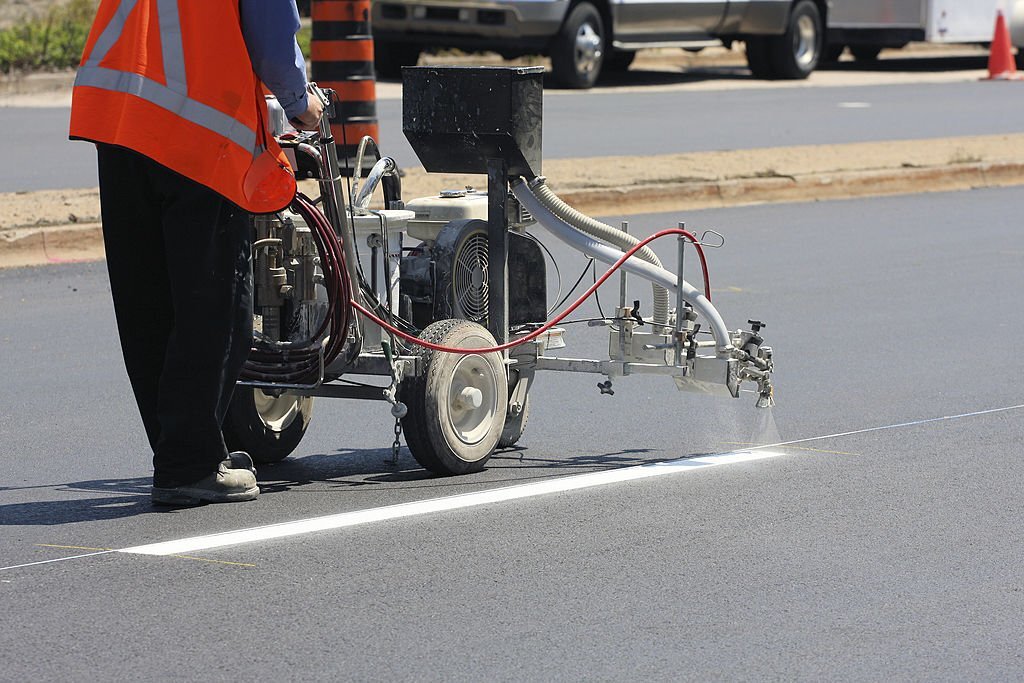
Road markings are not decorative — they are safety-critical infrastructure. Centre lines, lane dividers, pedestrian crosswalks, stop lines, and edge markings give drivers the information they need to navigate roads safely, especially at night and in poor visibility conditions. The quality, durability, and accuracy of those markings depends almost entirely on the road marking machine used to apply them.
Choosing the wrong machine — one that uses the wrong material for your climate, lacks the output needed for your project, or cannot produce the line accuracy required by IRC/MORTH standards — results in markings that fade early, require frequent reapplication, and create contract compliance problems. Choosing the right one makes your team faster, your contracts more profitable, and your roads safer.
At Kaushik Engineering Works, we manufacture road marking machines from our Sanand, Ahmedabad facility and have supplied them alongside our asphalt plants and road sweepers across highway projects in India and 35+ countries. This guide covers everything you need to consider before purchasing a road marking machine — machine types, marking materials, key technical factors, IRC compliance requirements, and the practical questions that determine the right choice for your project.
Types of Road Marking Machines — Which Is Right for Your Application?
Road marking machines are classified primarily by their drive system and mounting configuration. Each type suits a different range of applications, project scales, and operator requirements.
Self-Propelled Thermoplastic Road Marking Machine
The most widely used type on Indian highway projects. A self-propelled machine is driven by an operator seated on the machine, moving forward at a controlled speed while applying thermoplastic marking material through a heated screed shoe. Self-propelled machines offer consistent forward speed — the single most important factor for line quality — and can apply markings at production rates of 500 to 1,500 linear metres per hour depending on line width and material temperature.
Self-propelled machines are the right choice for:
- National highway and state highway lane marking projects
- Airport runway and taxiway markings
- High-volume projects where daily linear metre targets are significant
- Projects requiring consistent line width and edge definition under IRC specifications
Hand-Pushed Road Marking Machine
A smaller, manually pushed unit where the operator walks behind the machine at a controlled pace. Lower purchase cost, lower output, and more operator-dependent than self-propelled machines. Suitable for smaller applications — car park markings, factory floor lines, sports court markings, and short maintenance patches on urban roads where a self-propelled machine would be difficult to manoeuvre.
The inherent limitation of hand-pushed machines is speed consistency — human walking speed varies more than engine speed, producing line edges with slight waviness that is acceptable on low-specification surfaces but will fail visual inspection on IRC-compliant highway markings.
Truck-Mounted Road Marking Machine
The marking system is mounted on a truck, which travels forward at highway speed while applying markings. Used primarily for high-speed marking on express highways and motorways where applying markings from a slow-moving self-propelled machine would create a traffic management problem. The truck’s consistent forward speed produces excellent line quality. Capital cost is the highest of all types — suitable for specialised marking contractors handling large national highway projects.
Line Striping Machine (Walk-Behind)
A compact, walk-behind unit that applies cold paint, chlorinated rubber, or water-based marking materials using an airless spray system. The line striping machine is the right choice for car parks, warehouse floors, sports courts, construction zone temporary markings, and any application where thermoplastic is not required. Lower material cost than thermoplastic, but significantly shorter marking life — typically 6 to 24 months versus 3 to 7 years for thermoplastic on highway surfaces.
Road Marking Materials — Thermoplastic vs Cold Paint vs Others
The marking material you use determines durability, retroreflectivity, application temperature, and IRC compliance. Choosing the machine before choosing the material is the wrong sequence — the machine must be compatible with your required material.
| Material | Application Temp | Typical Life | Best Suited For |
|---|---|---|---|
| Hot thermoplastic | 180°C – 220°C | 3 – 7 years | National highways, state roads, MORTH/IRC compliant projects |
| Cold plastic (2-pack) | Ambient | 4 – 10 years | High-wear zones, pedestrian crossings, symbols |
| Water-based paint | Ambient | 6 – 18 months | Car parks, temporary markings, low-traffic roads |
| Solvent-based paint | Ambient | 12 – 24 months | Urban roads, industrial areas, medium-traffic surfaces |
| Epoxy | Ambient | 5 – 8 years | Airports, ports, high-durability industrial markings |
For Indian national and state highway projects, hot thermoplastic is the mandatory material under IRC:35 (Code of Practice for Road Markings). Thermoplastic is applied at 180°C to 220°C, bonds to the road surface as it cools, and accepts glass beads (retroreflective elements) for night visibility. Any machine purchased for government highway work must be capable of handling hot thermoplastic at these temperatures.
For a detailed comparison of the two most common machine types for Indian highway projects, see our guide on thermoplastic vs cold plastic road marking machines.
Key Technical Factors to Evaluate Before Buying
1. Material Tank Capacity
Tank capacity determines how long the machine can mark continuously before refilling — and refilling interrupts production. A larger tank means longer continuous marking runs, fewer stops, and more consistent line quality because the machine is not frequently decelerating to a stop and restarting.
For highway centre line and edge line marking, a minimum tank capacity of 200 litres is recommended for production efficiency. Smaller tanks (60–120 litres) are adequate for car park and urban applications where marking runs are shorter and interrupted by layout changes.
2. Heating System and Temperature Control
Thermoplastic material must be maintained at the correct application temperature (typically 180°C to 200°C for standard thermoplastic) throughout the marking operation. A machine with inadequate heating capacity will allow material temperature to drop during long marking runs — producing inconsistent viscosity, poor flow through the screed shoe, and lines with uneven edges.
Look for:
- Thermostatically controlled heating system — maintains material at target temperature automatically
- Both manual and electric temperature gauges — dual redundancy for temperature monitoring
- Adequate burner capacity relative to tank size — a small burner on a large tank cannot maintain temperature at high production rates
- Insulated tank construction — reduces heat loss and fuel consumption between marking runs
3. Screed Shoe Design and Line Width
The screed shoe is the component that contacts the road surface and determines the final line width, thickness, and edge definition. Interchangeable screed shoes allow the same machine to produce different line widths — typically 10 cm, 12 cm, 15 cm, 20 cm, and wider for symbols and arrows.
On MORTH-compliant highway projects, line widths are specified precisely — typically 10 cm for broken lane lines and 15 cm for solid edge lines. A machine that cannot hold consistent line width through the full marking run will fail quality inspection regardless of how good the thermoplastic material is.
4. Glass Bead Dispenser System
Retroreflective glass beads are applied immediately after the thermoplastic is laid — they partially embed in the hot material surface and create the retroreflective effect that makes road markings visible at night. IRC:35 specifies both bead application rates and retroreflectivity requirements for national highway markings.
Evaluate:
- Bead tank capacity: Should be proportional to material tank capacity — running out of beads mid-run defeats the purpose of continuous marking
- Bead dispensing control: Gravity or pressure-fed dispensers must apply beads uniformly across the full line width — uneven bead distribution creates retroreflectivity variation
- Adjustable bead rate: Different project specifications require different bead application rates — the dispenser should be adjustable without tools
5. Forward Speed Control
Forward speed consistency is the single most important operational factor for line quality. Any variation in forward speed — caused by engine RPM fluctuation, terrain gradient, or operator input — directly produces variation in thermoplastic layer thickness and line edge quality.
Self-propelled machines with hydrostatic drive offer better speed consistency than machines with mechanical gearbox drives — for the same reason that hydrostatic pavers produce better road surfaces than mechanical drive pavers. On high-specification highway projects, hydrostatic drive self-propelled marking machines are strongly preferred.
6. Ignition System — Manual vs Automatic
Modern road marking machines offer both manual and automatic ignition. Automatic ignition systems reduce setup time, eliminate manual lighting safety risks, and allow faster restart after marking breaks. For highway production marking where time efficiency matters, automatic ignition is a practical advantage.
IRC and MORTH Compliance Requirements for Road Markings
All road markings on national and state highway projects in India must comply with IRC:35 (Code of Practice for Road Markings with Paints) and MORTH specifications. Key compliance requirements that affect machine selection:
- Material: Hot applied thermoplastic conforming to IS:5703 for highways
- Retroreflectivity: Minimum retroreflectivity of 150 mcd/m²/lux (new) measured per IRC:35 — requires glass bead application
- Line width tolerance: ±5mm from specified width across the full marking run
- Thickness: Minimum 3mm thickness for thermoplastic markings
- Straightness: Maximum deviation of 10mm over any 3-metre length
These tolerances can only be consistently achieved with a properly calibrated self-propelled thermoplastic machine — not with hand-pushed or cold paint machines, regardless of operator skill.
Frequently Asked Questions — Road Marking Machine Selection
What is the most common road marking machine used on Indian highways?
Self-propelled thermoplastic road marking machines are the most common type used on Indian national and state highway projects. They apply hot thermoplastic material at 180–220°C, deposit glass beads for retroreflectivity, and maintain the line width and straightness tolerances required by IRC:35 and MORTH specifications. KEW manufactures self-propelled thermoplastic road marking machines for exactly these requirements.
What is the difference between thermoplastic and cold paint road marking machines?
A thermoplastic road marking machine heats material to 180–220°C before application — producing a durable, retroreflective marking that lasts 3 to 7 years on highway surfaces. A cold paint machine applies solvent or water-based paint at ambient temperature — faster to set up, lower material cost, but significantly shorter marking life (6 to 24 months). IRC:35 requires thermoplastic for national and state highway projects in India.
How do I know what tank capacity I need?
Estimate your daily marking requirement in linear metres, then calculate material consumption: a standard 10cm wide thermoplastic line at 3mm thickness consumes approximately 3 kg of material per linear metre. At 300 kg/hr production rate, a 200-litre tank (approx. 240 kg at 1.2 kg/litre density) provides roughly 50 minutes of continuous marking before refilling. If your daily programme requires consistent runs of 500+ metres without stops, a larger tank or a plan for rapid refilling is essential.
Can the same road marking machine apply different line widths?
Yes — most self-propelled thermoplastic machines accept interchangeable screed shoes in different widths. Standard widths available are 10 cm, 12 cm, 15 cm, 20 cm, and wider for symbols and arrows. Screed shoe changes typically take 10 to 20 minutes. Confirm the range of screed shoes available before purchasing, and verify that the machine’s bead dispenser width is compatible with the widest screed shoe you will use.
Is a glass bead dispenser necessary?
Yes — for any highway, urban road, or airport marking that must meet retroreflectivity requirements under IRC:35 or airport authority specifications, a glass bead dispenser is mandatory. Thermoplastic markings without glass beads have very low retroreflectivity and are not compliant with IRC specifications. All KEW road marking machines are supplied with glass bead dispensers as standard.
Get a Quote for KEW Road Marking Machine
Kaushik Engineering Works manufactures road marking machines for national highway projects, state roads, airport runways, urban roads, and export markets. Our machines are built with high-grade materials, equipped with thermostatically controlled heating, adjustable glass bead dispensers, and both manual and automatic ignition options — designed for IRC and MORTH compliance on Indian highway projects.
Contact our team with your project requirements — daily marking output, line widths, material type, and application — and we will recommend the right machine configuration with a detailed technical and commercial proposal.
📞 +91 98251 64764 | +91 2717 415587
📧 info@kaushikengineeringworks.com
📍 PE-107, Sanand II Industrial Estate, Bol GIDC, Sanand, Ahmedabad – 382110, Gujarat, India
🕐 Mon–Sat: 8:00 AM – 7:00 PM

