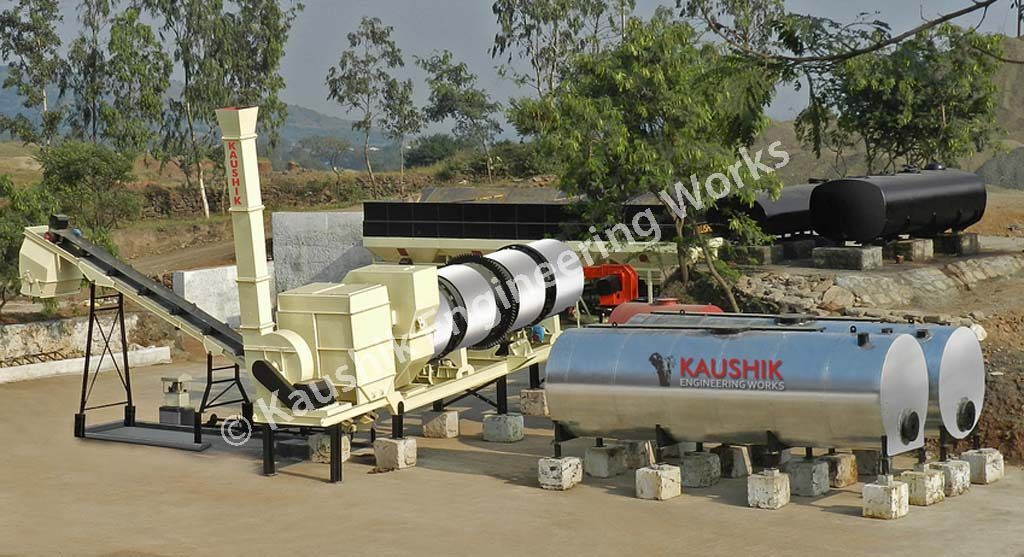
An asphalt drum mix plant operates by feeding cold aggregates into a rotating drying drum where they are heated to the target temperature, then mixing them with bitumen and filler inside the same drum in a continuous process — producing hot mix asphalt that is discharged directly into waiting trucks without any intermediate storage or batch weighing cycle.
This continuous production method is what distinguishes a drum mix plant from a batch mix plant. There is no pause between one mix cycle and the next — material flows in at one end and finished asphalt exits at the other in an unbroken stream, as long as the plant is running and inputs are being fed.
At Kaushik Engineering Works, we have been manufacturing asphalt drum mix plants from our Sanand, Ahmedabad facility for over 15 years, supplying contractors across India and 35+ countries. Our KEW Series drum mix plants — from the 40 TPH KEW-45 to the 150 TPH KEW-65 — all use our proprietary Thermodrum system for heat transfer. This guide explains the complete operating sequence, stage by stage.
Step-by-Step Operating Sequence of an Asphalt Drum Mix Plant
Stage 1 — Cold Aggregate Feeding
The operation begins at the cold aggregate feeder unit. This is a series of individual bins — typically four to six — each holding a different aggregate size fraction (40mm, 20mm, 10mm, stone dust, sand). Variable-speed belt feeders under each bin control how much of each fraction is released onto a common collection conveyor.
The feed rate from each bin is set by the plant’s control system according to the target mix design. Getting this proportioning right at the cold feed stage is the foundation of mix quality — if the gradation entering the drum is wrong, no downstream adjustment can fix it. KEW drum mix plants are fitted with oversize aggregate removal vibratory screens at the end of the cold feed conveyor, which screen out any material too large for the mix before it enters the drum — protecting drum internals and preventing gradation spikes in the finished mix.
Stage 2 — Conveying to the Drying Drum
The cold aggregates collected from all bins travel on a conveyor belt to the inlet of the drying and mixing drum. On mobile drum mix plants like KEW’s MDM series, this conveyor is designed to fold for transport and unfold quickly during setup — reducing site mobilisation time to 2 to 4 days.
A vibratory scalping screen at the conveyor discharge point makes a final check before the aggregates enter the drum, removing any oversize material that passed through the cold feed screen.
Stage 3 — Drying and Heating Inside the Drum
The drum is the central component of the entire plant. It is a large rotating cylinder, typically 1.2 to 2.0 metres in diameter and 6 to 12 metres long, fitted with internal flights — angled steel plates welded to the drum wall.
As the drum rotates, the flights lift the aggregates and cascade them through the hot gas stream produced by the burner at the drum inlet. This repeated lifting and showering of aggregates through the heat is what dries the moisture from the aggregate surface and raises the temperature to the target range — typically 150°C to 175°C for standard penetration grade bitumen mixes.
The burner at the drum inlet uses diesel, LDO, or furnace oil as fuel. The fuel tank is an integral component of the plant, sized to provide several hours of uninterrupted operation. Burner efficiency directly affects fuel consumption — one of the largest operating cost variables on any asphalt project. KEW’s Thermodrum system uses a triple heat transfer mechanism — conductive, convective, and radiation — to extract more heat from the same fuel input compared to conventional single-mode drum heating systems.
Stage 4 — Mixing with Bitumen and Filler (KEW Thermodrum)
In the second half of the drum, once the aggregates are dry and at temperature, bitumen and filler are introduced.
Bitumen is stored in insulated tanks fitted with heating coils that maintain the bitumen at 140°C to 160°C — the temperature range where it flows freely through the pump and spray system. A variable-speed computerised bitumen metering pump draws bitumen from the storage tank and injects it into the drum through a spray bar positioned in the mixing zone. The injection rate is synchronised with the aggregate feed rate — as aggregate feed increases or decreases, bitumen injection adjusts automatically to maintain the target bitumen content percentage.
Filler material — stone dust or mineral filler — is stored in a dedicated filler silo and fed into the drum’s mixing zone by a screw conveyor. The filler quantity is also controlled by the plant’s synchronised metering system and added in proportion to the aggregate feed.
In the mixing zone of the drum, the combined action of the rotating drum, the flights, and the heat produces a uniform coating of bitumen over every aggregate particle — the finished hot mix asphalt. The entire drying and mixing process takes place inside a single rotating drum, which is the defining feature of the drum mix plant design.
Stage 5 — Pollution Control
As the hot gas and dust from the drying process travel through the drum, they carry fine aggregate particles and combustion products that must be captured before the exhaust is released to the atmosphere. CPCB norms require all asphalt plants operating in India to be fitted with effective dust collection systems.
KEW drum mix plants are fitted with two-stage pollution control:
Dry dust collector (primary) — A cyclone or series of cyclones that use centrifugal force to separate heavy dust particles from the exhaust gas stream. The collected dust drops into a hopper at the bottom of the collector and is typically returned to the mix as filler.
Wet dust collector or baghouse filter (secondary) — A secondary stage that captures finer particles that pass through the primary cyclone. Wet dust collectors use water spray to trap fine dust; baghouse filters use fabric filter bags. Baghouse filters are more efficient and produce dry dust that can be reused; wet collectors generate sludge that must be disposed of.
The cleaned exhaust gas exits through the stack. On well-maintained plants operating within their rated capacity, emissions should be within CPCB limits. Stack temperature and dust readings are monitored on the plant’s control panel.
Stage 6 — Hot Mix Discharge and Loading
The finished hot mix asphalt exits the drum at the discharge end and falls onto a load-out conveyor (also called a slinger conveyor) that carries the mix to the truck loading point. The conveyor can typically swing to cover the full width of the truck bay, allowing the mix to be distributed evenly across the truck body.
Trucks are positioned below the discharge point and loaded to the target weight — calculated from the truck’s rated capacity and the mix’s bulk density. On plants with integrated truck scales, the control system can track total production by weight throughout the shift.
From the moment of discharge, the mix temperature must be monitored. Most standard mixes should be placed and compacted before the temperature drops below 120°C — meaning the haul distance from plant to paving site, and the number of trucks in rotation, directly determine whether the mix arrives at the right temperature. Plants fitted with a hot mix storage silo can hold finished mix for 1 to 4 hours without significant temperature loss, providing a buffer against truck shortfall or paving delays.
Key Components of an Asphalt Drum Mix Plant
| Component | Function | KEW Feature |
|---|---|---|
| Cold aggregate feeder | Meters aggregate fractions onto feed conveyor | Variable speed feeders + oversize removal screen |
| Drying and mixing drum | Dries, heats, and mixes aggregates with bitumen | KEW Thermodrum — triple heat transfer system |
| Drum burner | Generates heat for drying and heating aggregates | Low fuel consumption, adjustable flame output |
| Bitumen storage tanks | Store and heat bitumen to application temperature | Insulated tanks with internal heating coils |
| Bitumen metering pump | Inject bitumen into drum at controlled rate | Variable speed — synchronised with aggregate feed |
| Filler silo and feeder | Store and supply mineral filler to mixing zone | 1.5 to 50 tonne capacity options available |
| Dust collection system | Capture exhaust dust — CPCB compliance | Dry dust collector standard; wet collector / baghouse filter optional |
| Load-out / slinger conveyor | Transfer finished mix to waiting trucks | Swivelling design for even truck loading |
| Control panel | Automate and monitor all plant operations | Fully computerised; auto, semi-auto, and manual modes |
Drum Mix Plant vs Batch Mix Plant — Operational Differences
Understanding how a drum mix plant operates is clearer when compared directly to a batch mix plant — the other main asphalt plant type used in India.
In a drum mix plant, all stages happen simultaneously and continuously: while fresh aggregates are being dried at the drum inlet, already-dried aggregates further along the drum are being mixed with bitumen, and finished mix is being discharged at the outlet. There is no pause, no weighing cycle, and no batch-to-batch interval. Output is continuous.
In a batch mix plant, the process is sequential: aggregates are dried, then elevated to a screening tower, sorted into hot bins by size, weighed individually in a weigh hopper, combined with weighed bitumen and filler in a pugmill mixer, and discharged as a complete batch — before the next cycle begins. Each batch is precisely weighed, giving better mix-to-mix consistency, but the batch cycle introduces an inherent production rhythm that caps peak output.
For a detailed comparison to help you choose between the two types, refer to our guide on asphalt drum mix plant vs batch mix plant selection.
Frequently Asked Questions — Asphalt Drum Mix Plant Operation
What is the difference between a drum mix plant and a batch mix plant?
A drum mix plant produces asphalt continuously — aggregates are dried and mixed with bitumen inside a single rotating drum in an unbroken stream. A batch mix plant produces asphalt in discrete, weighed batches — each batch is measured and mixed separately before the next begins. Drum mix plants offer higher continuous output; batch mix plants offer better batch-by-batch mix control and greater flexibility for multiple mix designs.
What is the KEW Thermodrum technology?
KEW Thermodrum is a proprietary heat transfer system built into KEW drum mix plants that uses three simultaneous heat transfer mechanisms — conductive (direct contact), convective (hot gas flow), and radiation (radiant heat from the drum wall and flights). This triple-mode approach delivers more heat to the aggregates per unit of fuel burned, improving fuel efficiency and ensuring more uniform aggregate temperature throughout the drum’s cross-section compared to conventional single-mode drum designs.
How is bitumen content controlled in a drum mix plant?
On a KEW drum mix plant, bitumen content is controlled by a variable-speed computerised metering pump that is electronically synchronised with the cold aggregate feed rate. As aggregate feed increases or decreases, the bitumen pump automatically adjusts its output to maintain the target bitumen percentage. This synchronisation is what ensures consistent binder content throughout continuous production — even when feed rates change due to truck availability or aggregate bin levels.
What pollution control equipment is required for a drum mix plant in India?
CPCB (Central Pollution Control Board) norms require asphalt plants operating in India to control particulate emissions from the exhaust stack. Drum mix plants must be fitted with a minimum of a primary dust collection system — typically a dry dust collector (cyclone type). A secondary wet dust collector or baghouse filter provides additional fine particle capture and is required on many government projects and in urban areas. KEW drum mix plants are supplied with CPCB-compliant dust collection systems as standard.
Can a drum mix plant use reclaimed asphalt pavement (RAP)?
Yes. Drum mix plants can be modified to incorporate RAP — reclaimed asphalt pavement from old road surfaces — into the new mix. RAP is introduced into the drum at a point beyond the burner flame to prevent overheating the residual bitumen in the RAP material. The proportion of RAP that can be incorporated depends on the drum configuration and the project’s approved mix design. KEW can supply RAP-capable drum configurations — consult our team for specific project requirements.
How often should a drum mix plant be calibrated?
Cold feeder calibration should be verified at the start of each project and after any change to aggregate type, moisture content, or stockpile condition. Bitumen pump calibration should be checked against a measured discharge test before each project phase and after any pump service. Calibration records are a mandatory quality control document on NHAI and most government highway projects. Refer to our asphalt mixing plant calibration guide for a complete procedure.
Get a Quote for KEW Asphalt Drum Mix Plant
Kaushik Engineering Works manufactures stationary and mobile asphalt drum mix plants across a range of capacities — from 40 TPH (KEW-45) to 150 TPH (KEW-65) and above. All models feature the KEW Thermodrum system, computerised control with automatic, semi-automatic, and manual operation modes, and CPCB-compliant dust collection. Full commissioning support and after-sales service are provided from our Sanand, Ahmedabad manufacturing facility.
Contact our team to discuss your project’s capacity requirements, site conditions, and fuel preferences — or to request a detailed technical and commercial proposal.
📞 +91 98251 64764 | +91 2717 415587
📧 info@kaushikengineeringworks.com
📍 PE-107, Sanand II Industrial Estate, Bol GIDC, Sanand, Ahmedabad – 382110, Gujarat, India
🕐 Mon–Sat: 8:00 AM – 7:00 PM