
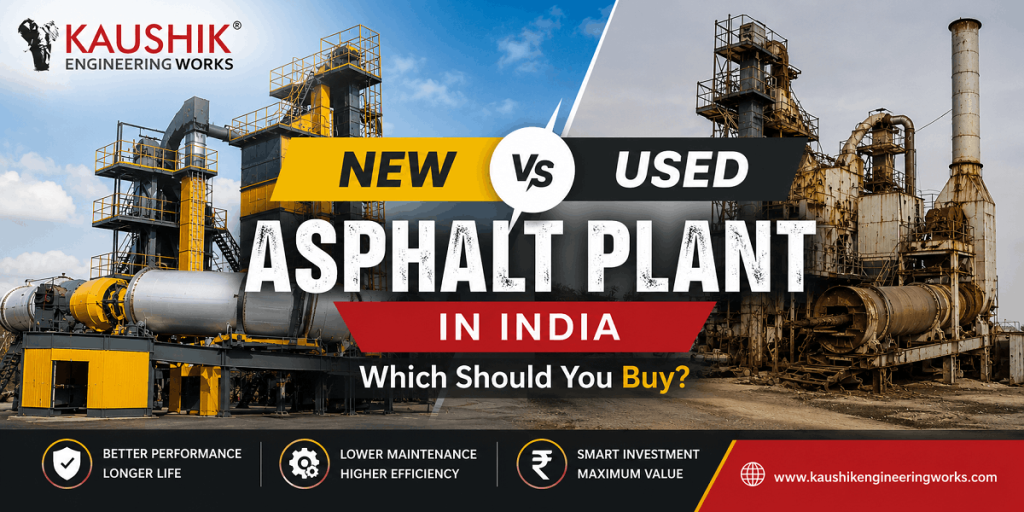
A used asphalt plant can cost 40-60% less than a new one, but that discount disappears fast the day a Pollution Control Board inspector asks for a Consent to Operate the previous owner never transferred to you. This is the part most buying guides skip, and it is exactly why so many contractors regret a second-hand purchase within the first monsoon season.
If you are comparing a new vs used asphalt plant for a road contract, a private project, or as a first-time investment, the decision is not just about the price tag on the machine. It involves compliance paperwork, financing eligibility, tender documentation, and the real condition of components you cannot see from a photograph. A new asphalt plant is manufactured to current MoRTH specifications, comes with a transferable pollution consent, and is backed by the OEM’s warranty and installation support. A used asphalt plant is an existing machine, sold as-is, where the buyer inherits both its mechanical condition and its regulatory history.
In this guide, we break down actual Indian market pricing for both options, the CPCB and tender-eligibility risks that construction equipment blogs rarely mention, a practical inspection checklist if you do go the used route, and a decision framework based on the kind of project you are running.
Quick answer: Buy new if you need CPCB compliance, NHAI/PWD tender eligibility, financing, or long-term reliability with warranty backing. A used plant can make financial sense only for short-term, low-budget projects — provided you personally verify the pollution consent status, maintenance history, and structural condition before paying anything.
New vs Used Asphalt Plant: Quick Comparison
Before getting into the details, here is how the two options stack up across the factors that actually decide whether a purchase works out.
| Factor | New Asphalt Plant | Used Asphalt Plant |
|---|---|---|
| Upfront cost | Full price | 40-60% lower |
| CPCB consent | Fresh, in your name | Usually needs re-application |
| Warranty | 1-2 years from OEM | None, unless a certified rebuild |
| Financing | Bank/NBFC loans widely available | Difficult; higher interest, if at all |
| NHAI/PWD tender fit | Usually meets equipment-age clauses | Often disqualified on age/documentation |
| Delivery time | 4-8 weeks (manufacturing lead time) | Immediate, if available locally |
| Customization | Full — capacity, control system, fuel type | None — fixed configuration |
| Hidden repair risk | Low | High — depends entirely on prior use |
How Much Does a New vs Used Asphalt Plant Cost in India?
Pricing depends heavily on capacity (TPH — tonnes per hour), plant type (drum mix vs batch mix), and mobility (mobile vs stationary). Based on current listings from Indian manufacturers and equipment dealers, here is what buyers are actually paying:
New Asphalt Plants
- Mobile drum mix plants (40-60 TPH): roughly ₹29 lakh to ₹85 lakh, depending on control automation and bin configuration
- Stationary batch mix plants (60-120 TPH): roughly ₹1.2 crore to ₹1.7 crore, with fully automatic PLC-controlled units at the higher end
- Compact/entry-level units (below 40 TPH): can start around ₹37-40 lakh for storage-mix or smaller drum configurations
Used/Second-Hand Asphalt Plants
- Used mobile batch mix plants (100 TPH class): commonly listed around ₹55-60 lakh in the current resale market
- Used mobile drum mix units: can be found in the ₹25-45 lakh range depending on operating hours and burner condition
- Prices swing widely based on age, documented maintenance, and whether the seller can produce a valid pollution consent — plants without this paperwork are usually priced lower for a reason
The gap looks attractive on paper. But the real cost comparison only makes sense once you factor in what a used plant does not come with — starting with compliance.
The Compliance Risk Most Buyers Don’t Check Before Buying Used
An asphalt plant cannot legally operate in India without a valid Consent to Operate (CTO) from the State Pollution Control Board, issued under the Air (Prevention and Control of Pollution) Act. This consent is tied to the plant’s specific location, owner, and emission control setup — it does not automatically transfer with a change of ownership.
When you buy a used plant, you are not buying its old CTO. You are buying a machine that will need fresh consent in your name, at your new site, under whatever emission norms apply in 2026. If the plant’s baghouse filter or emission control system was designed for older, looser standards, it may not clear inspection at all without a costly retrofit.
We covered the current compliance requirements in detail in our 2026 CPCB norms and shutdown-prevention checklist — worth reading before you finalize any used-plant purchase, since a shutdown notice after installation costs far more than the money you saved buying second-hand.
Will a Used Plant Disqualify You From NHAI or PWD Tenders?
It can, and this is where many first-time buyers get caught out. NHAI and state PWD tender documents frequently specify equipment-age limits, valid calibration certificates, and BIS or MoRTH compliance documentation as eligibility conditions — not as a formality, but as a scoring criterion during technical bid evaluation.
A used plant bought without a documented service history, original manufacturer invoice, or updated calibration certificate can fail this screening before pricing is even discussed. If government contract work is part of your business plan, a new plant with clean, current paperwork removes this risk entirely. This is one of the most overlooked factors in the new-vs-used decision, and it rarely appears in generic buying guides written for international markets rather than Indian tender conditions.
Financing and GST: Why New Plants Are Easier to Fund
Banks and NBFCs offering equipment finance almost always require a manufacturer’s invoice, a clear title, and — for construction machinery — proof of compliance documentation. New plants tick all three boxes automatically, which is why term loans and equipment finance schemes are readily available for them, typically covering 70-80% of the invoice value.
Used plants are a different story. Most lenders either decline to finance second-hand construction equipment or offer it at a noticeably higher interest rate with a shorter tenure, since resale value is harder to assess. On the tax side, a new plant purchased from a GST-registered manufacturer gives you a clean tax invoice and full input tax credit. A used plant bought from an unregistered dealer or a private seller often comes without proper GST documentation, which complicates your input credit claim and can raise questions during an audit.
If You’re Still Considering a Used Plant, Inspect These 7 Things First
If budget constraints make a used plant the only realistic option, do not skip a physical inspection. Here is what to check, in order of what actually causes the most expensive failures:
- Pollution consent status: Ask for the original CTO and confirm with the State Pollution Control Board directly whether it is active, expired, or was ever suspended.
- Maintenance logs and operating hours: A plant with documented servicing history is a fundamentally different purchase than one with no records at all.
- Dryer drum and burner condition: Check for internal corrosion, especially on plants that operated in coastal Gujarat, Maharashtra, or other high-humidity regions — monsoon exposure accelerates rust on the drum shell and flight design.
- Load cell calibration certificate: An uncalibrated weighing system produces an inconsistent bitumen-aggregate ratio, which affects mix quality and can fail job-mix-formula testing on government contracts.
- Electrical panel and control system: Confirm voltage compatibility with your site’s power supply and inspect the PLC panel for water damage or outdated components that are no longer supported.
- Baghouse or dust collector filters: Worn filters are a direct compliance failure point and are expensive to replace on older plant models.
- Structural welds and frame: Look closely at load-bearing joints and the chassis (for mobile units) for stress cracks or rust — these are the components a photo or a quick site visit will not reveal.
Total Cost of Ownership: New vs Used Over 5 Years
The purchase price is only the starting point. Once you factor in downtime, repairs, and compliance costs over a typical 5-year ownership period, the gap between new and used narrows considerably — and in some cases, reverses.
| Cost Factor (5-year estimate) | New Plant | Used Plant |
|---|---|---|
| Purchase price | Baseline | 40-60% lower |
| Compliance/CPCB re-application | Included in setup | Additional cost, often unbudgeted |
| Unplanned downtime (repairs) | Low, warranty-covered initially | Higher, especially years 1-2 |
| Fuel/energy efficiency | Optimized burner and insulation design | Depends on age; often lower efficiency |
| Financing cost | Lower interest, longer tenure | Higher interest, if approved at all |
We go deeper into the ownership math in our complete guide to calculating TCO for road construction machinery, which walks through the formula step by step.
Which One Should You Actually Buy? A Decision Framework
The right choice depends on what kind of work you are lining up, not just what you can afford today.
- NHAI or state PWD contractor: Buy new. Tender eligibility, calibration certificates, and compliance documentation matter more than the upfront saving.
- Private builder or real estate developer with one-off project: A used plant can work, but only after a full inspection and confirmed CTO status. Budget separately for a possible retrofit.
- Disaster relief or short-term mobile deployment: A certified rebuilt plant from a reputable manufacturer — one that comes with an OEM overhaul and limited warranty — is a reasonable middle ground between new and fully used.
- First-time asphalt plant owner testing the business: New, smaller-capacity plants are often a safer entry point than a used large-capacity plant, since you avoid inheriting someone else’s maintenance backlog while you are still learning plant operations.
When Does a Used Plant Actually Make Sense?
Not every project justifies the premium of a new plant. If you are bidding on a small, private, non-government contract with a tight budget and no long-term equipment plan, a well-documented used plant with a valid, transferable pollution consent and a clean maintenance history can be a reasonable decision. The key phrase there is “well-documented” — a used plant bought purely on price, without verifying paperwork, is where most of the horror stories in this industry start.
Frequently Asked Questions
Is it worth buying a used asphalt plant in India?
It can be worth it for small, private, short-duration projects where budget is the primary constraint. It is rarely worth it for government tender work, where equipment age, calibration certificates, and valid CPCB consent are eligibility requirements, not preferences.
Can I get a bank loan for a used asphalt plant?
It is possible but difficult. Most banks and NBFCs prefer financing new plants because of the clear invoice, warranty, and predictable resale value. Used plants, when financed at all, typically come with higher interest rates and shorter repayment tenures.
Does a used asphalt plant need a new CPCB consent?
Yes. The Consent to Operate is tied to the specific owner and site location — it does not transfer automatically with a change of ownership. Buyers must apply fresh with the State Pollution Control Board before commissioning the plant at a new site.
How much cheaper is a used asphalt plant compared to new?
Used asphalt plants in India typically sell for 40-60% less than an equivalent new unit, though the exact discount depends on age, operating hours, and documented maintenance condition.
Can a used asphalt plant qualify for NHAI or PWD tenders?
Only if it meets the specific equipment-age and documentation clauses in the tender, which vary by project. Many used plants fail this screening due to missing calibration certificates or outdated compliance paperwork, so it is worth checking tender conditions before purchase, not after.
What is the biggest risk of buying a second-hand asphalt plant?
The biggest risk is inheriting an invalid or non-transferable pollution consent, which can result in a shutdown notice after you have already installed and started operating the plant. Mechanical wear is the second major risk, particularly in dryer drums and burners exposed to years of monsoon humidity.
Making the Right Call for Your Business
The new-vs-used decision for an asphalt plant comes down to three questions: what kind of contracts are you targeting, can you get the plant financed and compliant without delays, and do you have the technical capacity to inspect a used machine properly before you pay for it. For contractors chasing NHAI and PWD work, a new plant with clean documentation removes risk that a discounted price tag cannot make up for. For smaller, private projects, a carefully inspected used plant with a verified pollution consent can still be a sound investment.
At Kaushik Engineering Works, we manufacture asphalt drum mix plants and batch mix plants — both mobile and stationary — built to current MoRTH and CPCB specifications, with full documentation, calibration support, and installation assistance included. If you are weighing a new vs used asphalt plant purchase and want a straight assessment of what fits your project and budget, our team can walk you through the options.
Call us at +91-98251 64764, write to info@kaushikengineeringworks.com, or request a quote for a site consultation.

