
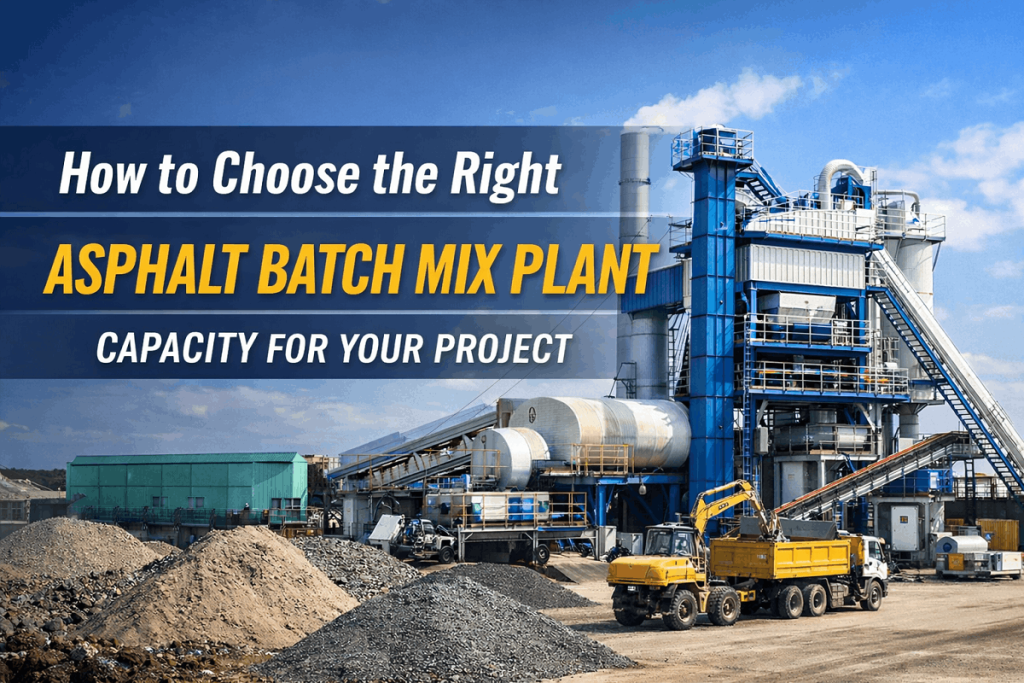
Choosing the right asphalt batch mix plant capacity is one of the most important decisions in any road construction business. It affects daily output, project timelines, fuel usage, truck movement, mix quality, operating cost, and long-term return on investment.
If the plant is too small, paving teams may keep waiting for the mix, deadlines may slip, and overtime costs can rise. If the plant is too large, you may end up paying for capacity that your projects, site logistics, or transport system cannot fully utilise. In both cases, efficiency suffers.
That is why selecting an asphalt batch plant should never be based only on the highest TPH number in a brochure. The right choice depends on your actual project demand, hauling conditions, shift pattern, mix type, future workload, and site realities.
For contractors, infrastructure developers, and EPC companies, the best capacity decision is the one that aligns machine output with real working conditions. This guide explains how to make that decision with clarity and confidence.
What Plant Capacity Really Means
In an asphalt batching plant, capacity is usually expressed in tonnes per hour (TPH). This number refers to the amount of hot mix asphalt the plant can produce under standard operating conditions.
However, rated capacity and real-world working capacity are not always the same.
Actual production can be affected by:
- Aggregate moisture
- Ambient temperature
- Burner efficiency
- Bitumen and filler supply
- Mix change frequency
- Truck availability
- Site coordination
- Downtime between batches
In practical conditions, output is often lower than the plant’s rated figure. That is why experienced buyers do not choose a plant only by brochure capacity. They choose a plant that can deliver stable production on-site, day after day.
A well-selected asphalt plant should support the paving crew smoothly, maintain mix quality, and run efficiently within the project’s logistics and cost structure.
Typical Capacity Range by Project Type
The table below offers a practical starting point:
|
Plant Capacity |
Typical Use |
| 80–100 TPH | Rural roads, municipal roads, and district-level works |
| 120–140 TPH | Urban roads, state highway upgrades, and medium contracts |
| 160–180 TPH | National highways, industrial corridors, and larger EPC jobs |
| 200–260 TPH | Expressways, airport pavements, and major infrastructure packages |
| 300+ TPH | Mega projects, export markets, dedicated high-volume corridors |
This table is only a guide. The right capacity depends on your actual tonnage requirement, not just project category.
Step 1: Start With Daily and Hourly Asphalt Demand
The first and most important step is to calculate how much asphalt your project needs.
Basic Formula
Required Plant Capacity (TPH) = Total Daily Asphalt Requirement ÷ Effective Working Hours Per Day
To estimate daily asphalt demand, you need:
- Road length to be paved per day
- Road width
- Layer thickness
- Bulk density of the mix
Example Calculation
Suppose a project requires paving:
- 2,000 metres per day
- 7 metres wide
- 50 mm thick bituminous concrete layer
Then:
Volume per day
= 2,000 × 7 × 0.05
= 700 m³
If the bulk density is 2.35 tonnes/m³, then:
Daily asphalt requirement
= 700 × 2.35
= 1,645 tonnes/day
If the plant operates for 10 effective hours per day:
Required capacity
= 1,645 ÷ 10
= 164.5 TPH
In this case, a 160–180 TPH asphalt batch mix plant would be a practical choice.
This method is much more reliable than selecting capacity by guesswork. It gives you a project-based starting point and helps avoid overspending or undercapacity problems.
Step 2: Consider Average Demand, Not Just Peak Demand
Many buyers make the mistake of sizing a plant only for maximum output days. But a project may have only a few peak-demand days and many moderate-demand days.
Ask:
- What is the average daily tonnage over the life of the project?
- How often will the plant actually run at full demand?
- Are paving teams working in one shift or multiple shifts?
- Will the project maintain the same pace throughout?
A slightly oversized plant can offer useful flexibility, but a heavily oversized plant may remain underutilised for long periods. That raises capital cost without improving real productivity.
The goal is to choose a plant that can comfortably handle normal demand while still leaving a practical margin for variation.
Step 3: Match Plant Capacity With Truck Availability and Haul Distance
An asphalt batch mix plant can only perform as well as the transport system around it. Even a high-capacity plant will struggle if there are too few trucks, the haul distance is too long, or site unloading causes delays.
Plant output, trucks, and paver speed must work as one connected system.
Key Logistics Factors to Check
- Number of available trucks
- Truck payload capacity
- Distance between plant and paving site
- Average turnaround time
- Site unloading speed
- Paver laying rate
If the haul distance is long, you may need:
- More trucks
- Better dispatch planning
- A more balanced plant capacity instead of simply a larger one
If the plant produces faster than the paving crew can place material, the mix handling becomes inefficient. If it produces too slowly, the paver may stop and restart, which affects workflow and surface consistency.
Simple Logistics Rule
The best setup is one where:
- The plant can load continuously
- Trucks can cycle without bottlenecks
- The paver receives a steady flow of material
That balance matters more than a high-rated TPH on paper.
Step 4: Factor in Mix Type and Project Complexity
Not every road construction project uses the same mix design. Some jobs involve repetitive production of a standard mix. Others require multiple layers, changing specifications, tighter tolerances, or speciality mixes.
This is where an asphalt batching plant offers a major advantage. Because it works in batches, it provides better control over proportions, temperature, and recipe changes.
Common Mix Considerations
| Mix Type |
Practical Impact on Production |
| Dense Bituminous Macadam (DBM) | Usually supports good throughput |
| Bituminous Concrete (BC) | Requires tighter control and may slightly reduce effective output |
| Stone Matrix Asphalt (SMA) | Typically lowers effective throughput due to added complexity |
| Mastic Asphalt | Longer mixing time and lower output |
| RAP-incorporated mixes | Require a compatible configuration, which can affect productivity |
If your project requires premium wearing courses, frequent mix changes, or specification-driven production, plant selection should focus on both capacity and control.
The best asphalt batch plant is not always the one that produces the most. It is the one that produces the right mix consistently at the pace your project needs.
Step 5: Look at Site Conditions Before Finalising Capacity
Capacity selection should never happen in isolation from the site.
A plant may have the right rated output, but poor site conditions can reduce real performance significantly.
Site Factors That Matter
- Available installation area
- Stockyard layout
- Aggregate storage and drainage
- Bitumen tank placement
- Filler handling arrangement
- Entry and exit movement for trucks
- Power availability
- Distance from the paving front
If the stockyard is poorly planned, aggregates remain wet, and drying becomes less efficient. If truck movement is restricted, loading slows down. If the site is too tight, even a technically suitable plant may become operationally inefficient.
Site Readiness Checklist
Before finalising plant size, check whether the site can support:
- Smooth truck circulation
- Safe loading and unloading
- Adequate stockpile space
- Proper bitumen storage
- Reliable power or DG backup
- Pollution-control installation
- Future operational expansion, if needed
A well-matched plant should fit the site as comfortably as it fits the project demand.
Step 6: Evaluate Fuel Efficiency and Cost Per Tonne
Output alone does not determine profitability. The real question is: what does each tonne cost to produce?
A plant with higher capacity can lower fixed cost per tonne only if it is used properly. If it runs far below its efficient operating range, cost per tonne may actually rise.
Cost Factors to Evaluate
- Fuel consumption
- Burner efficiency
- Aggregate moisture handling
- Power usage
- Labour requirement
- Wear-part replacement frequency
- Maintenance downtime
- Spare parts availability
How Utilisation Affects Economics
|
Scenario |
Daily Output |
Fixed Cost Absorption |
| Small plant running near full use | Can be economical for steady moderate demand | Better for smaller jobs |
| Large plant running far below capacity | Often inefficient | Higher capital burden |
| Well-sized plant with stable utilization | Usually, the best balance | Stronger ROI |
Fuel is one of the highest operating costs in any asphalt plant. Wet aggregates, poor stockyard drainage, and inefficient burner performance can reduce output while increasing production cost.
That is why buyers should not focus only on the plant purchase price. They should look at the total operating efficiency over the years of use.
Step 7: Think Beyond the Current Project
A plant is not a short-term consumable purchase. It is a long-term business asset.
When choosing capacity, ask:
- What kind of contracts are you targeting over the next 3–5 years?
- Will you handle multiple projects at the same time?
- Are you planning to bid for larger highway or EPC packages?
- Do you need room to scale without buying another plant too soon?
This does not mean you should overbuy based on optimism. But it does mean you should consider realistic growth plans instead of choosing only the minimum required for one current project.
A balanced decision looks at both today’s project demand and near-future workload visibility.
Stationary or Mobile: Which Configuration Fits Your Capacity Need?
Capacity and configuration often go hand in hand.
A Stationary Plant Is Suitable When:
- The project duration is long
- Output demand is stable
- The plant location will remain fixed
- Quality control and automation are high priorities
A Mobile or Modular Plant Is Suitable When:
- Projects shift frequently
- Site relocation is part of the business model
- Installation speed matters
- Geographic coverage is wide
The same capacity can serve different businesses in different formats. That is why plant selection should consider not only TPH, but also how the equipment will be deployed.
Common Mistakes to Avoid
Many poor buying decisions happen not because the plant is bad, but because the sizing process is weak.
Avoid These Common Mistakes
- Choosing a plant based only on maximum TPH
- Ignoring truck numbers and haul time
- Underestimating aggregate moisture
- Focusing only on the current project needs with no forward view
- Overlooking the stockyard and site layout
- Ignoring the mixed flexibility requirements
- Neglecting spare parts and service support
- Assuming a bigger plant always reduces cost
Smart buyers treat plant selection as a system decision, not just a machine purchase.
Why the Right Manufacturing Partner Also Matters
Even the right capacity choice can become a problem if after-sales support is weak, spare parts are delayed, or the plant is not configured properly for your workload.
A reliable manufacturing partner should help you assess:
- Project tonnage
- Shift pattern
- Logistics flow
- Mix requirements
- Site conditions
- Capacity margin
- Service and maintenance expectations
For buyers evaluating an asphalt batch mix plant, the real value is not only in the machine. It is also in the technical guidance before purchase and the support after installation.
Quick Capacity Selection Checklist
Use this checklist before finalising your decision:
|
Question |
Why It Matters |
| What is the real daily asphalt requirement? | Gives the base capacity range |
| How many effective working hours are available? | Converts daily tonnage into hourly need |
| How far is the paving site from the plant? | Affects the truck cycle and steady flow |
| How many trucks are available? | Determines whether the plant can be fully utilised |
| What mix types will be produced? | Impacts real output and control needs |
| What are the stockyard and site conditions? | Influences fuel use and plant efficiency |
| Is this for one project or a future pipeline? | Helps decide whether extra capacity makes sense |
| Can local asphalt suppliers support the production rate? | Prevents material-flow interruptions |
Frequently Asked Questions (FAQs)
1. How do I choose the right asphalt batch mix plant capacity?
Start with realistic project tonnage, divide it by effective working hours, and then check whether truck movement, haul distance, paving speed, and site conditions can support that output consistently.
2. Is a larger asphalt batch plant always better?
No. A larger plant only adds value when the project volume, logistics, crew capacity, and raw material supply can support it. Otherwise, it may increase both capital cost and operating inefficiency.
3. Why do truck availability and haul distance matter so much?
Because plant output means little if trucks cannot move the mix efficiently from the plant to the paving site. Delays in transport directly reduce usable production.
4. When is an asphalt batching plant more useful than a continuous plant?
It is especially useful when the project needs better control over mix quality, more flexibility in recipe changes, and consistent production across varying specifications.
5. Why should I evaluate asphalt suppliers before plant selection?
A stable supply of aggregates, filler, and bitumen is essential for continuous production. If material flow is inconsistent, even the best asphalt batch mix plant cannot perform well.
Conclusion
Choosing the right capacity for an asphalt batch mix plant is not about buying the biggest machine. It is about selecting the most suitable one for your project conditions, transport setup, mix requirements, site layout, and business goals.
A well-sized plant helps you maintain steady production, improve cost control, support better paving performance, and build stronger long-term returns. A poorly sized plant does the opposite, no matter how impressive its brochure looks.
The best buying decision comes from matching plant capacity with real project demand, real working conditions, and realistic plans. When those factors align, your asphalt batch mix plant becomes more than equipment. It becomes a productive asset that supports project success and business growth.
Choose the Right Asphalt Plant. Build Stronger Roads
Selecting the right asphalt batch mix plant capacity is not just about output. It is about keeping your projects on schedule, controlling production costs, maintaining mix quality, and preparing your business for future growth. At Kaushik Engineering Works, we understand that every road project comes with different site conditions, tonnage demands, logistics challenges, and performance expectations. That is why we help contractors, infrastructure developers, and road construction companies choose solutions that match real project needs, not just brochure numbers.
With our expertise in road construction equipment manufacturing, we deliver reliable, high-performance plants designed for efficiency, durability, and consistent results in demanding working conditions. Whether you are planning for a municipal road project, a highway package, or large-scale infrastructure development, our team is ready to guide you toward the right fit.
Get in touch with Kaushik Engineering Works at +91 2717 415587 or +91 – 98251 64764 or email us at info@kaushikengineeringworks.com and take the next step toward smarter plant selection and stronger project performance.

