
A road surface is only as good as the bond between its layers, and that bond starts with a clean base. Dust, loose aggregate, and fine debris left behind on a milled or wet mix macadam (WMM) surface weaken adhesion with the tack coat, and that’s usually where premature raveling and early potholes start. It’s why every serious highway contractor treats surface cleaning as a fixed step in the process, not an optional one — and why the hydraulic broomer has become the standard tool for the job.
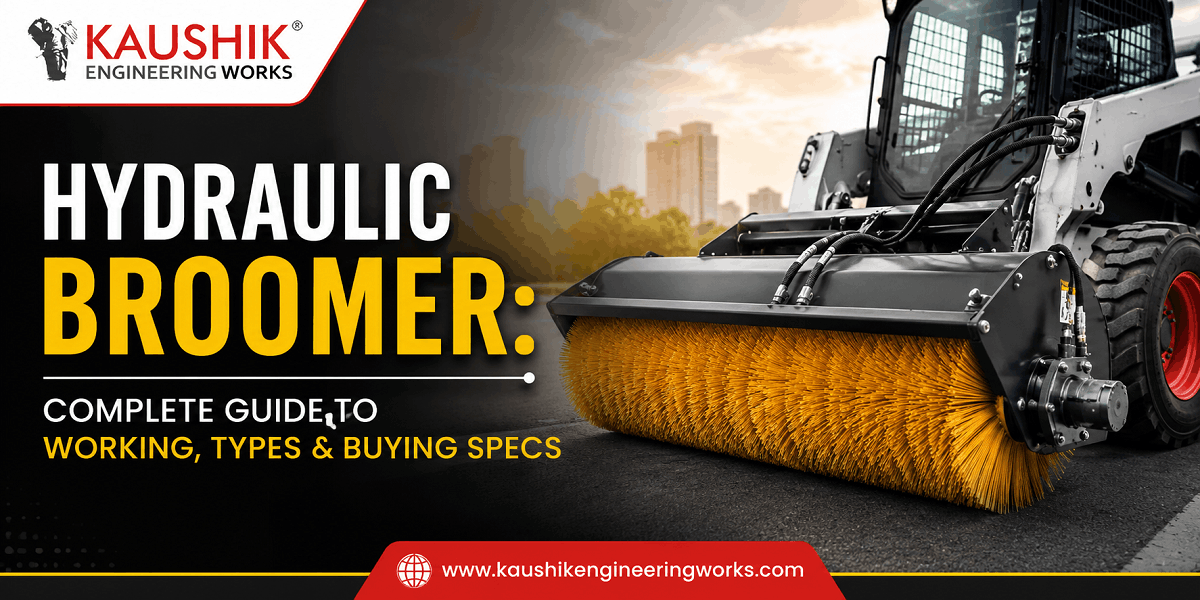
A hydraulic broomer is a tractor, loader, or skid-steer mounted attachment that uses the host vehicle’s hydraulic system to power a rotating brush, clearing dust, loose stone, and debris off a road surface before paving or during routine maintenance. Unlike a mechanical sweeper, which drives the brush through a chain and gearbox connected to the engine, a hydraulic broomer runs the brush off a dedicated hydraulic motor — so brush speed can be adjusted independently of how fast the tractor engine is running.
That one difference explains most of what makes hydraulic broomers useful on a live highway site. An operator can slow the brush down for a finished asphalt surface and speed it up for a compacted WMM layer, all without touching the throttle. On a stretch where the crew is moving between surface types in the same shift, that saves real time — fewer passes, less fuel burned per kilometre cleaned.
This guide walks through how a hydraulic broomer actually works, how it stacks up against a mechanical broom sweeper, which components and specs are worth checking before you buy, where it fits into a road project, and how to keep one running through a full paving season.
How Does a Hydraulic Broomer Work?
A hydraulic broomer draws power from the host vehicle’s existing hydraulic circuit instead of carrying its own engine. The tractor or loader’s Power Take-Off (PTO) drives a hydraulic pump, which pressurises fluid and sends it through hoses to a hydraulic motor mounted on the broomer unit. That motor converts the fluid pressure back into rotation, spinning the brush at whatever speed the operator sets.
Because the brush runs off a dedicated motor rather than a mechanical shaft, the same hydraulic system also handles raising, lowering, and angling the broom — often from a control inside the cab. A pressure release valve sits in the circuit to protect it if the brush hits something solid, like a raised joint or an embedded stone, tripping before the hose or motor takes damage.
This is also the reason snap-on, snap-off mounting has become standard on most modern units. Since the broom doesn’t depend on a mechanical drivetrain connection, it can come off one tractor and go onto another compatible vehicle in a few minutes.
Hydraulic Broomer vs Mechanical Broom Sweeper: Key Differences
Contractors comparing road-cleaning equipment usually end up weighing a hydraulic broomer against a mechanical broom sweeper, since both attach to a tractor and do roughly the same job on paper. The real difference is in how power gets to the brush.
| Factor | Hydraulic Broomer | Mechanical Broom Sweeper |
|---|---|---|
| Power transmission | Hydraulic pump + motor (fluid power) | PTO shaft, chain, and gearbox (direct drive) |
| Speed control | Independent of tractor engine RPM | Tied directly to engine RPM |
| Brush angle adjustment | Hydraulic, often cab-controlled | Manual, requires stopping the vehicle |
| Wear points | Fewer — hoses and motor seals | More — chains, gears, sprockets |
| Initial cost | Generally higher | Generally lower |
| Maintenance profile | Hydraulic fluid, seals, hose checks | Chain tension, gear lubrication |
| Best fit | Multi-surface highway contracts, cab-level control | Budget-focused, single-surface operations |
On most Indian highway projects, where a single machine might sweep a compacted WMM layer in the morning and finished asphalt shoulders by afternoon, the flexibility of independent brush-speed control tends to justify the higher upfront cost. A contractor working one surface type consistently, without much variation, may still get better value out of a mechanical unit. If you’re weighing this decision in more depth, our guide on choosing between road sweeper technologies covers vacuum and regenerative-air options as well.
Key Components of a Hydraulic Broomer
Not every broomer on the market is built to the same standard, and knowing what’s inside the machine makes it easier to tell the difference between models.
- Brush rings/bristles — Better units use polypropylene convoluted brush rings instead of solid rubber or basic nylon. Polypropylene holds up against bitumen residue, fuel, and lime exposure far longer, and the dish-shaped rings increase brush contact for a more thorough sweep. See our guide on road sweeper brush types for a closer look at bristle materials.
- Hydraulic motor — The core unit converting hydraulic pressure into brush rotation. Its build quality affects torque under load and how long it lasts.
- Pressure release valve — Protects the hydraulic circuit if the brush hits an obstruction, preventing hose blowouts and motor damage.
- Run-on system — Stops the heavy brush assembly from halting abruptly, which reduces shock load on the motor and mounting frame.
- Chassis and wheels — A pressed-steel casing gives the unit a good strength-to-weight ratio, while support wheels keep the broom stable on uneven or graded surfaces.
- Dust collection hopper (optional) — Some models route swept debris into a bin instead of leaving a windrow — useful near live traffic or in urban work zones.
- Air compressor and filter system (optional) — Higher-spec broomers add a compressor to blow fine dust out of joints and potholes ahead of the brush pass, paired with a filter that traps airborne particles.
Specifications to Check Before Buying a Hydraulic Broomer
Before signing off on a purchase, it’s worth checking these specs against your actual site conditions rather than going purely on price.
Working Width
Sweeping width decides how many passes it takes to clear a lane. A working width around 2,000 mm is standard on highway-grade units and covers a typical lane efficiently without excessive overlap.
Pressure Release Valve Rating
A valve rated around 160 bar gives enough headroom for continuous highway use while still tripping before hose or motor damage sets in. Cheaper units with a lower-rated valve tend to fail sooner under sustained load.
Wheel and Chassis Build
Support wheels in the 200 x 50 mm range hold up well on the uneven, graded sub-bases common on Indian highway sites. A rigid, pressed-steel casing matters more than it looks on a spec sheet — a frame that flexes transmits vibration into the hydraulic motor mount and cuts seal life short.
Brush Material and Replaceability
Check that the brush rings can be replaced individually instead of requiring a full brush-roll swap. 100% polypropylene convoluted rings outlast standard nylon bristles against bitumen, fuel, and lime exposure by a wide margin, and replaceable rings keep long-term running costs down.
Hydraulic Angling Range
The ability to angle the broom, typically up to 30 degrees in either direction, lets the operator match cambered or sloped sections without repositioning the tractor — a real time-saver on curved highway stretches and shoulders.
Attachment Compatibility
Snap-on, snap-off mounting that works across tractors, loaders, and skid-steers gives a fleet manager the flexibility to move the same broomer between project sites as needs change.
Where Are Hydraulic Broomers Used?
- Pre-paving surface preparation — Sweeping a milled surface, WMM layer, or granular sub-base clean before tack coat or asphalt application, for proper bonding between layers.
- Highway and expressway maintenance — Routine clearing of dust, gravel, and debris on active carriageways.
- Airport runway and taxiway cleaning — Foreign object debris (FOD) removal, where surface cleanliness is a safety requirement, not just a quality one.
- Urban and municipal roads — Contractors handling city infrastructure work alongside highway contracts.
- Industrial park and site access roads — Keeping haul roads and entry points clear of material tracked in by heavy vehicles.
Is a Hydraulic Broomer Worth It for Your Project?
Yes, for contractors handling recurring surface-prep work across more than one road type — the independent speed control and cab-level adjustability cut down pass count and labour time compared to a mechanical or manual alternative. The upfront cost runs higher, but on highway-scale work, avoiding rework from poor surface bonding usually covers that difference within a single project.
For a smaller operation working one surface type without much variation, a mechanical sweeper can deliver comparable results at a lower entry cost. It really comes down to how often the machine needs to adapt and how much cab-level control actually saves you on a given project.
Efficiency and Time Savings
A hydraulically powered brush clears a lane faster than manual sweeping or an older mechanical unit — which matters on time-bound highway contracts with penalty clauses for delay.
Operator Safety and Comfort
Cab-controlled height and angle adjustment keeps the operator inside the vehicle instead of manually resetting brush position, cutting dust exposure and physical strain over long shifts.
Lower Long-Term Maintenance
Fewer mechanical wear points — no chains, gears, or sprockets — generally means fewer unplanned breakdowns, though hydraulic hoses and seals need their own regular inspection.
Fleet Versatility
Snap-on compatibility across tractors, loaders, and skid-steers means one broomer unit can serve multiple sites without being locked to a single host vehicle.
Maintenance & Dust-Control Compliance
A hydraulic broomer’s simpler mechanical profile doesn’t mean it runs maintenance-free. A consistent routine keeps it reliable through a full paving season:
- Inspect hydraulic hoses and fittings weekly for leaks, abrasion, or pressure loss — a slow leak is often the first sign of a motor or seal issue on the way.
- Check the pressure release valve periodically to confirm it still trips at its rated pressure; a valve that’s drifted out of calibration risks hose or motor damage under load.
- Clean or replace filter elements on units with an air compressor attachment — clogged filters lose their dust-suppression effect and can push particulate back into the air instead of trapping it.
- Inspect brush rings for wear and replace them individually once bristle length drops enough to reduce contact, rather than waiting for a full-roll change.
- Lubricate PTO shaft connections at the tractor interface — this stays a mechanical wear point even on an otherwise hydraulic machine.
On the compliance side, dust-collection filters and optional water-spray attachments help limit airborne particulate during sweeping, which matters more each year as environmental norms around construction-site dust control continue to tighten across Indian states. Keeping filters maintained is as much a compliance safeguard as a performance one.
Conclusion
A hydraulic broomer earns its place on a road construction fleet by solving a problem that’s easy to overlook: a surface that isn’t properly cleaned before paving fails faster, no matter how well-engineered the asphalt or WMM layer above it is. The hydraulic drive’s independent speed control, cab-level adjustability, and fewer mechanical wear points make it the stronger option for contractors working across varied surface types, even with the higher upfront cost.
Before buying, weigh working width, pressure release valve rating, brush material, and attachment compatibility against your actual site conditions — a broomer that’s undersized for your lane width or underrated on hydraulic pressure ends up costing more in downtime than it saved at purchase. For contractors evaluating a highway-grade option, the KEW Robust Sweeper is built with the specifications covered in this guide as a baseline, not an add-on.
Frequently Asked Questions
Mechanical broom sweeper aur hydraulic broomer me kya fark hai?
Mechanical sweepers drive the brush through a PTO shaft, chain, and gearbox, so brush speed stays tied to engine RPM. Hydraulic broomers use a pump and motor instead, giving independent brush-speed control and cab-level height/angle adjustment — better suited to projects spanning multiple surface types.
Hydraulic broomer chalane ke liye ideal tractor HP kitni honi chahiye?
This depends on the specific broomer model and its hydraulic flow requirement — check the manufacturer’s compatibility spec rather than assuming, since an undersized tractor’s hydraulics can starve the broomer’s motor and reduce sweeping performance.
Kya hydraulic broomer WMM surface pe asphalt se pehle use ho sakta hai?
Yes. Sweeping a compacted wet mix macadam (WMM) layer clean of loose aggregate and dust before tack coat or asphalt application is one of the most common uses of a hydraulic broomer, and it directly improves layer bonding.
Standard hydraulic broomer ki sweeping width kitni hoti hai?
Highway-grade hydraulic broomers commonly offer a working width around 2,000 mm, which covers a standard lane efficiently in fewer passes. Narrower or wider units are available depending on the application.
Broomer brushes kitni baar replace karni chahiye?
Replacement frequency depends on usage hours and how abrasive the surface is, but bristles should be checked regularly and replaced individually once contact length drops noticeably — waiting too long reduces sweeping effectiveness and can strain the hydraulic motor.
Kya hydraulic broomers dust-control norms compliant hote hain?
Units fitted with filter systems and optional air-compressor or water-spray attachments are built to limit airborne dust during operation, which supports compliance with tightening environmental norms — though actual compliance depends on the specific model and how consistently its filters are maintained.
Get the Right Hydraulic Broomer for Your Site
A hydraulic broomer is only as good as the manufacturer behind it — spec sheets matter less if spare parts and service support aren’t available when you need them. Kaushik Engineering Works builds the KEW Robust Sweeper for exactly the conditions covered in this guide: variable-speed hydraulic control, 100% polypropylene convoluted brush rings, and a chassis built for Indian highway sub-base conditions, backed by nationwide servicing and spare parts availability.
Get in touch with Kaushik Engineering Works to request a quote or product catalogue for the KEW Robust Sweeper. Email info@kaushikengineeringworks.com or call +91-98251 64764.

