
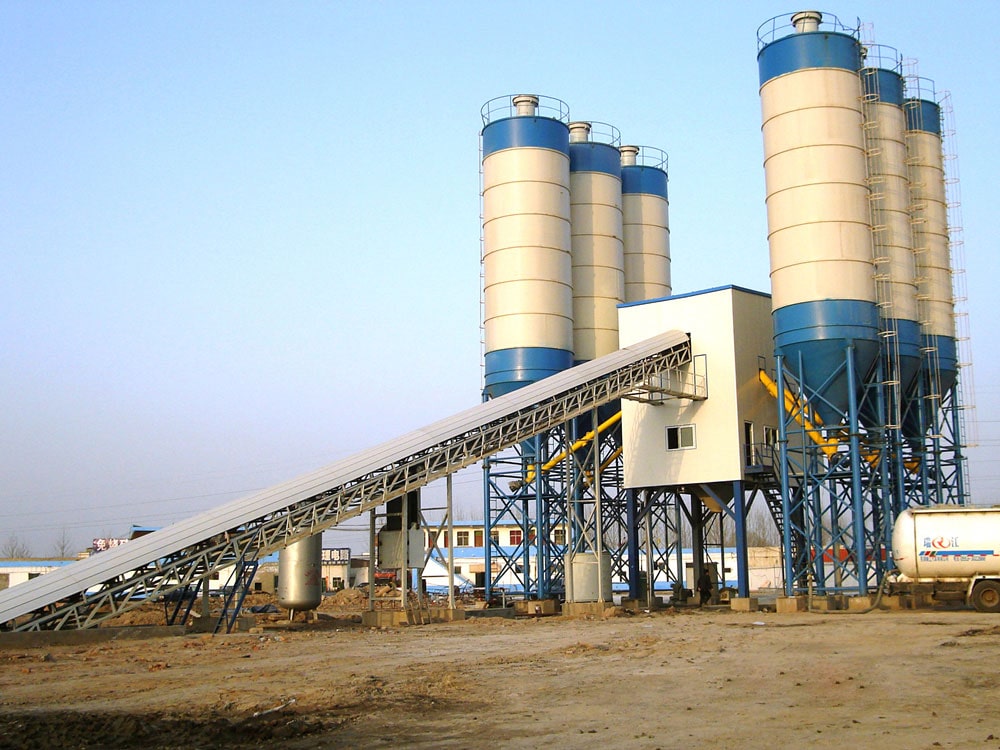
The price of a concrete batching plant in India varies enormously — from ₹20 lakh for a compact mobile unit to over ₹5 crore for a high-capacity stationary plant with full automation, multiple silos, and pollution control. Understanding what drives these differences is essential before you commit capital to a purchase, because the cheapest plant at the point of sale rarely delivers the lowest total cost of ownership over a project’s life.
At Kaushik Engineering Works, we manufacture mobile concrete batching plants from our Sanand, Ahmedabad facility and have supplied them across road, bridge, and infrastructure projects in India and 35+ countries. Based on that manufacturing and field experience, this guide breaks down every significant cost factor — from the plant itself to site preparation, operating costs, and total ownership economics.
Factor 1 — Plant Type: Mobile vs Stationary
The single largest cost variable is whether you choose a mobile or stationary plant configuration.
Mobile concrete batching plants are mounted on a chassis or skid for transport between sites. They cost less upfront, setup in 1 to 3 days, and can relocate as projects move. For contractors managing multiple short-duration projects or working at remote sites, mobile plants typically deliver better capital utilisation — the same plant generates revenue across multiple projects rather than sitting idle between jobs.
Stationary concrete batching plants are installed on a permanent foundation for long-duration, high-volume production. They offer larger capacity, more silo storage, and easier integration of additional equipment, but require civil foundation work (₹3 lakh to ₹15 lakh depending on soil conditions), longer setup time (7 to 20 days), and a relocation cost that makes moving them impractical.
| Plant Type | Indicative Purchase Price Range | Best Suited For |
|---|---|---|
| Mobile (compact, 15–20 m³/hr) | ₹20 lakh – ₹60 lakh | Road projects, remote sites, multiple project relocations |
| Mobile (medium, 30–60 m³/hr) | ₹60 lakh – ₹1.5 crore | Bridge projects, highway contracts, mid-size infrastructure |
| Stationary (60–100 m³/hr) | ₹1 crore – ₹2.5 crore | RMC plants, large infrastructure projects, urban construction |
| Stationary (100–120 m³/hr+) | ₹2.5 crore – ₹5 crore+ | High-capacity RMC, metro/expressway projects |
Note: Prices are indicative and vary based on specifications, automation level, and market conditions. Contact KEW for project-specific pricing.
Factor 2 — Plant Capacity (m³/hr)
Plant capacity — measured in cubic metres of concrete per hour — is the most straightforward cost driver. Higher capacity means more mixer volume, larger aggregate bins, bigger silos, more powerful motors, and more complex control systems. All of these add cost.
The practical decision is not “what is the maximum I might ever need?” but “what does my project actually require per day, and what capacity plant delivers that at the lowest total cost?” A plant running at 70–80% of capacity consistently outperforms a larger plant running at 30–40% — because idle capacity still consumes maintenance cost, depreciation, and operator time.
Calculate your required capacity as follows: divide your daily concrete requirement (in cubic metres) by your productive working hours, then add a 20% buffer for setup, cleaning, and operational pauses. This gives you the minimum hourly capacity you need. Avoid purchasing capacity significantly beyond this figure unless your project pipeline clearly justifies it.
Factor 3 — Automation Level and Control System
The control system — the PLC-based computer that manages the batching sequence — is one of the most significant quality and cost differentiators between plants at the same capacity level.
Manual batching: Operator manually opens gates and adds materials by observation. Lowest cost, high operator dependency, inconsistent quality, no batch records. Suitable only for very low-specification, low-volume applications. Not acceptable on most government contracts in India.
Semi-automatic batching: Weighing is automatic via load cells, but some operator intervention is required for each cycle. Medium cost, moderate consistency, limited documentation.
Fully automatic batching: The control system manages the entire batching sequence — aggregate feeding, cement delivery, water and admixture dosing, mixing time, and discharge — without operator intervention after recipe selection. Each batch generates a printed or digital record showing the exact weight of every material. This is the standard required on NHAI, PWD, and most government infrastructure projects. KEW mobile concrete batching plants are supplied with fully automated PLC control systems as standard.
The cost premium for full automation over semi-automatic is typically ₹3 lakh to ₹8 lakh depending on plant size — an investment that pays back quickly through reduced material waste, lower rejected batch rates, and compliance with quality documentation requirements.
Factor 4 — Mixer Type
The mixer is the most wear-intensive and mechanically critical component of any batching plant. Mixer type affects both purchase price and long-term wear part costs.
Twin-shaft mixer: Two counter-rotating horizontal shafts with mixing arms produce an intensive, high-shear mixing action. Produces highly uniform mix in 30 to 50 seconds per batch. Higher purchase price but shorter cycle time, suitable for high-output plants. Wear parts (tips and arms) are replaceable and are the primary maintenance cost.
Pan mixer: A rotating pan with fixed mixing blades. Thorough, uniform mix — particularly good for stiff, low-slump mixes and precast applications. Moderate purchase price.
Drum mixer (transit mix): The concrete is mixed in the transit mixer truck drum, not at the plant. The plant loads weighed dry or partially mixed materials. Lowest plant cost, but mix quality depends on truck drum condition and rotation speed during transit.
For most road and infrastructure applications in India, twin-shaft mixer plants are preferred for their output speed and mix uniformity — the cycle time advantage compounds significantly over a full working shift.
Factor 5 — Cement Silo Capacity and Number
Cement silos add significantly to the cost of a batching plant setup. A single 50-tonne silo costs approximately ₹4 lakh to ₹7 lakh; a 100-tonne silo costs ₹7 lakh to ₹12 lakh. Multiple silos are needed when the project uses both OPC and PPC cement, or when fly ash or GGBS is used as a partial cement replacement.
The required silo capacity depends on your daily cement consumption and the reliability of your cement supply chain. In remote project sites where cement delivery is intermittent, a larger silo buffer reduces the risk of production shutdowns due to supply gaps. In urban areas with reliable supply, a smaller silo is adequate.
Factor 6 — Steel Prices and Material Costs
A concrete batching plant’s structural frame, bins, conveyors, and mixer body are predominantly steel. Steel price fluctuations in India directly affect the manufacturing cost of batching plants and, by extension, the price you pay.
In periods of high steel prices, plant prices typically increase by 8 to 15% compared to low-steel-price periods. If you are planning a plant purchase, tracking structural steel prices (HR coil, IS 2062 plates) over the 6 months before your purchase date gives you a sense of whether current prices are at a cyclical high or low — potentially affecting your decision to buy immediately or wait.
Factor 7 — Site Preparation and Installation Costs
The plant purchase price is only part of the total investment. Site preparation and installation add costs that are frequently underestimated at the budgeting stage.
- Land clearing and levelling: ₹1 lakh to ₹5 lakh depending on site condition
- Civil foundation (stationary plants): ₹3 lakh to ₹15 lakh depending on soil bearing capacity and plant size
- Electrical connection and power supply: ₹2 lakh to ₹8 lakh depending on distance from grid and required load (typically 50–150 kVA)
- Water supply arrangement: ₹50,000 to ₹3 lakh depending on source distance and storage requirement
- Permitting and environmental compliance: ₹1 lakh to ₹5 lakh depending on state and district requirements
For a detailed breakdown of total setup costs including civil and utility work, refer to our concrete batching plant price analysis guide.
Factor 8 — After-Sales Support and Spare Parts Availability
The cost of a plant that stops working mid-project is not the repair cost — it is the project delay cost, which can dwarf the equipment value on a contract with penalty clauses. After-sales support and spare parts availability are, therefore, a real cost factor that belongs in the purchase decision.
Before finalising any plant purchase, verify:
- Does the manufacturer maintain a spare parts inventory in India?
- What is the typical lead time for critical wear parts (mixer tips, load cells, screw conveyor flights)?
- Does the manufacturer provide commissioning support and operator training?
- Is there a service team that can visit the site if a major breakdown occurs?
Plants from overseas manufacturers may carry a 15–20% lower purchase price but a 6 to 8 week spare parts lead time from the country of origin — a lead time that is unacceptable on an active highway contract. KEW plants are manufactured in India, with spare parts stocked at our Sanand facility and service teams available across India.
Frequently Asked Questions — Concrete Batching Plant Cost
What is the price of a concrete batching plant in India?
Concrete batching plant prices in India range from approximately ₹20 lakh for a compact 15 m³/hr mobile plant to over ₹5 crore for a 120 m³/hr+ stationary plant with full automation, multiple silos, and pollution control. The price depends primarily on capacity, plant type (mobile vs stationary), automation level, mixer type, and silo configuration. Contact Kaushik Engineering Works for a project-specific quote.
Is a mobile concrete batching plant cheaper than a stationary plant?
Yes — at equivalent capacity, a mobile plant is typically 20 to 35% cheaper to purchase than a stationary plant. Mobile plants also have significantly lower site preparation costs (no permanent foundation required), faster setup, and lower relocation costs. For contractors working across multiple project sites, the total cost of ownership advantage of mobile plants is even more pronounced. Read our detailed analysis on increasing cost efficiency with a mobile concrete batching plant.
What ongoing costs should I expect after purchasing a batching plant?
Ongoing costs include: operator wages (1 to 3 operators per shift), power consumption (typically ₹8,000 to ₹25,000 per month depending on capacity and usage), wear part replacement (mixer tips, screw conveyor flights, conveyor belts — typically ₹1.5 lakh to ₹4 lakh per year), preventive maintenance, and cement silo and bin cleaning. Annual maintenance cost for a well-maintained mobile batching plant is typically 3 to 5% of the plant’s purchase price.
Does buying a higher-capacity plant always reduce cost per cubic metre?
Not necessarily. A plant running at 70–80% of rated capacity produces concrete at a lower cost per m³ than either an undersized plant running at 100% (causing delays and quality compromises) or an oversized plant running at 30–40% (with high idle costs). The right capacity for your project — not the highest available — delivers the best unit economics.
How does automation level affect long-term cost?
Fully automated plants have a 10 to 15% higher purchase price than semi-automatic equivalents at the same capacity. Over a 3 to 5 year operational period, this premium is typically recovered through: lower material waste (±1% weighing accuracy vs ±5% manual), fewer rejected batches (reducing rework and delays), lower labour cost per m³ (fewer operator interventions), and compliance with government QA documentation requirements (reducing contract risk).
Get a Quote for KEW Mobile Concrete Batching Plant
Kaushik Engineering Works manufactures mobile concrete batching plants in 15 m³/hr, 20 m³/hr, and 30 m³/hr configurations — all with fully automated PLC control, twin-shaft or pan mixer options, and complete commissioning support from our Sanand, Ahmedabad facility.
Contact our team with your daily concrete requirement, project type, and site location — we will recommend the right plant configuration and provide a detailed technical and commercial proposal.
📞 +91 98251 64764 | +91 2717 415587
📧 info@kaushikengineeringworks.com
📍 PE-107, Sanand II Industrial Estate, Bol GIDC, Sanand, Ahmedabad – 382110, Gujarat, India
🕐 Mon–Sat: 8:00 AM – 7:00 PM

