
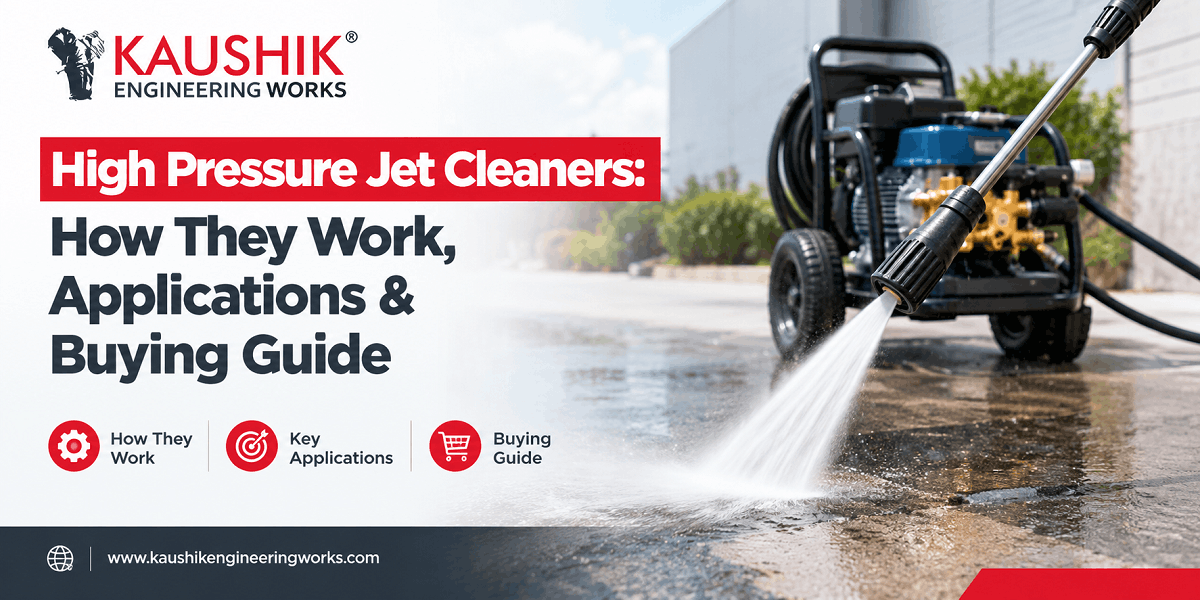
Not every cleaning problem on a construction or industrial site can be swept away. Old paint, rust, crystallised salt deposits, hardened grease, and cured concrete residue all bond to a surface in ways a broom or brush simply can’t touch. When a surface needs to be stripped back to bare, sound material before a new coating, weld, or overlay goes on, the tool that gets called in is a high pressure jet cleaner.
These machines show up across a wide range of settings — ports, refineries, bridges, storage tanks, precast yards, and pavement rehabilitation sites — anywhere a surface has to be genuinely clean, not just free of loose debris. And because the cleaning happens through pressurised water rather than abrasive blasting or chemical stripping, it’s also become the preferred method where dust and airborne contaminants are a safety concern.
A high pressure jet cleaner is an industrial machine that uses a plunger pump to force water through a narrow nozzle at high pressure, generating a concentrated jet strong enough to strip paint, rust, grease, and embedded dirt from hard surfaces. Depending on the model, it can run on cold water, heated water, or steam, and pressure output on industrial units typically falls somewhere between 140 and 500 bar — well above what a household pressure washer produces.
This guide covers how a high pressure jet cleaner actually works, how it’s genuinely different from a regular pressure washer, what’s inside the machine, where it fits into road and infrastructure projects, the main types available, and what to check before buying one.
How Does a High Pressure Jet Cleaner Work?
At the centre of every high pressure jet cleaner is a plunger pump. Unlike the simpler wobble or axial pumps found in consumer-grade machines, plunger pumps use reciprocating pistons driven off a crankshaft to build pressure in stages, which gives a steadier, ripple-free water flow rather than a pulsing one. That pump draws water from a tank or direct supply line and forces it through a high-pressure hose to a trigger-operated gun.
From there, the operator controls the spray through a lance fitted with a nozzle. Nozzle choice changes the outcome more than most people expect — a narrow, pencil-thin jet concentrates force into a small point for cutting through heavy rust or old coatings, while a wider fan-pattern nozzle spreads the same pressure over a broader area for faster general surface cleaning. Some systems also allow detergent or chemical injection into the stream, useful when the job involves oil or grease that water alone won’t fully lift.
A pressure relief valve and an unloader valve sit in the circuit to protect the pump — the relief valve caps maximum pressure, and the unloader diverts flow back to the tank when the trigger is released, so the pump isn’t working against a closed line. On hot water and steam units, a heating chamber sits between the pump and the outlet, since higher water temperature dramatically improves the machine’s ability to break down oil, grease, and old bituminous residue at a molecular level.
High Pressure Jet Cleaner vs Pressure Washer: What’s the Real Difference?
The terms “jet cleaner” and “pressure washer” get used almost interchangeably in everyday conversation, and for light jobs — a car, a patio, a driveway — the distinction barely matters. It matters a great deal, though, once you’re looking at industrial or road-construction-scale cleaning.
| Factor | High Pressure Jet Cleaner | Standard Pressure Washer |
|---|---|---|
| Pressure range | ~140–500 bar (industrial plunger pump) | ~100–150 bar (domestic/light-commercial) |
| Pump type | Crankshaft-driven plunger pump | Axial or wobble pump |
| Duty cycle | Continuous, heavy industrial use | Intermittent, light-duty use |
| Water temperature | Cold, hot, or steam options | Usually cold water only |
| Typical job | Rust and coating removal, industrial degreasing, pre-paint surface prep | Vehicles, patios, driveways, light exterior cleaning |
| Power source | Electric, diesel, petrol, or hydraulic-driven units available | Almost always electric |
The practical takeaway: if the job is removing something that’s bonded to the surface — old coating, corrosion, cured residue — rather than just rinsing off loose dirt, a domestic-grade pressure washer usually isn’t built for it. That’s the gap a proper high pressure jet cleaner is designed to fill.
Key Components of a High Pressure Jet Cleaner
Most industrial units, regardless of brand, are built around the same core components:
- Motor or engine — powers the pump; can be electric, diesel, or petrol depending on where the machine will be used.
- Plunger pump — builds and sustains water pressure; crankshaft-driven types run more efficiently and with less pressure ripple than older intensifier-style pumps.
- High-pressure hose — rated specifically for the machine’s pressure output; using an undersized hose is a common cause of premature failure.
- Trigger gun and lance — gives the operator direct control over when and where water is released.
- Nozzles — interchangeable tips (pencil-jet, fan-spray, turbo) that change how the pressure is applied to the surface.
- Unloader and pressure relief valves — protect the pump from damage when the trigger isn’t engaged or pressure exceeds a safe limit.
- Pressure gauge — lets the operator confirm the machine is running at the correct pressure for the job.
- Water tank or supply connection — some units run off a direct line, others carry their own tank for use away from a water source.
Where Are High Pressure Jet Cleaners Used in Road & Infrastructure Projects?
On construction and infrastructure sites specifically, high pressure jet cleaning shows up at a few recurring points:
- Removing old coatings and rust from steel bridge structures, guardrails, and industrial equipment before repainting or re-coating.
- Stripping crystallised salt deposits from concrete and steel surfaces — a common issue in coastal and marine infrastructure, where salt buildup interferes with new coating adhesion.
- Cleaning ports, terminals, and precast concrete pavers where heavy vehicle traffic and cargo handling leave embedded grime that ordinary sweeping can’t shift.
- Pre-paint and pre-coating surface preparation on tanks, pipelines, and structural steel, where any residual contamination reduces coating lifespan.
- General equipment cleaning for cranes, earthmoving machinery, and heavy plant, where accumulated grease and grime need periodic stripping down to bare metal for inspection or maintenance.
One advantage worth calling out on active sites: because the cleaning action is water-based rather than dry sweeping or abrasive blasting, it produces far less airborne dust. On sites where dust exposure is a safety concern for nearby workers, that’s often as important as the cleaning result itself.
Types of High Pressure Jet Cleaners
Cold Water Units
The most common and lowest-cost option, suited to general surface cleaning, loose dirt, and mild grime where heat isn’t needed to break the bond between contaminant and surface.
Hot Water Units
Add a heating chamber ahead of the outlet, raising water temperature significantly before it reaches the nozzle. Heat helps break down oil, grease, and bituminous residue far more effectively than cold water at the same pressure, which is why hot water units are the standard choice for heavy equipment cleaning and industrial degreasing.
Steam Units
Used less often, but valuable for the toughest grease and oil removal jobs, or where a lower water volume with maximum thermal cleaning effect is preferred.
Power Source Options
Electric units suit fixed-location or indoor use where a power connection is available. Diesel and petrol engine-driven units are built for mobile, off-grid site work. Hydraulic-driven units, powered off a tractor or loader’s hydraulic system similar to a hydraulic broomer, are less common but useful where a contractor wants to run multiple attachments off the same host vehicle.
What to Check Before Buying a High Pressure Jet Cleaner
Pressure and Flow Rate
Match pressure and flow rate (measured in bar/PSI and litres per minute) to the actual job. Light cleaning doesn’t need a 500-bar unit, and running an underpowered machine on heavy coating-removal work just wastes time and hours on the pump.
Cold, Hot, or Steam
If the work regularly involves grease, oil, or old bituminous coatings, a hot water unit earns back its higher upfront cost quickly in reduced cleaning time. Pure dirt and dust removal rarely needs that extra capability.
Duty Cycle and Build Quality
Confirm the pump is rated for continuous industrial duty, not intermittent domestic use — a mismatch here is the single most common reason contractors end up replacing a unit within the first year.
Nozzle and Accessory Range
Check what nozzle types and accessories come standard versus what’s sold separately. A wider range of interchangeable nozzles means the same machine can handle both fine surface prep and heavy-duty stripping.
Power Source Fit
Match the power source to where the machine will actually be used — electric for a fixed workshop location, engine-driven for a mobile highway or infrastructure site with no reliable power connection.
Maintenance & Safety Tips
- Inspect the high-pressure hose regularly for abrasion or bulging — a hose rated below the pump’s output pressure is a serious safety hazard, not just a maintenance issue.
- Check the unloader and pressure relief valves periodically to confirm they’re functioning; a stuck valve can push the pump beyond its rated pressure.
- Clean or replace inlet water filters to keep grit and debris out of the pump — this is one of the most common causes of premature plunger and seal wear.
- Never point a high-pressure jet at skin, loose clothing, or unprotected body parts — at industrial pressure ratings, the jet can break skin in an instant.
- Use appropriate PPE — eye protection, gloves, and non-slip footwear — since surfaces being cleaned become wet and slippery quickly.
- Drain and flush the system before extended storage, particularly for units used with detergents or chemical additives.
Conclusion
A high pressure jet cleaner solves a specific problem that sweeping, brushing, or standard washing can’t: getting a surface back to bare, sound material when something is actually bonded to it — rust, old coating, cured grease, or embedded salt. On road and infrastructure projects, that capability shows up wherever a surface needs to be genuinely clean before the next layer goes on, whether that’s a fresh coat of paint on a bridge structure or a re-coating job on port infrastructure.
Before buying, match pressure and flow rate to your actual job, decide whether hot water capability is worth the extra cost for your specific contamination type, and confirm the pump is rated for continuous industrial duty rather than light commercial use. Getting that match right the first time saves far more in downtime than it costs upfront.
For site-cleaning equipment more broadly — including dust control during surface preparation — Kaushik Engineering Works’ hydraulic road sweeper range includes a water-spray system on its low-wall sweeping attachment, built for exactly the pre-paving and site-maintenance work covered in this guide.
Frequently Asked Questions
High pressure jet cleaner aur normal pressure washer me kya fark hai?
A high pressure jet cleaner uses an industrial-grade plunger pump running at roughly 140–500 bar, built for continuous heavy-duty use. A standard pressure washer runs at a much lower pressure with a lighter-duty pump, meant for occasional cleaning rather than industrial or road-construction-scale work.
Road construction ke liye kitna bar pressure sahi rahega?
It depends on the job — general surface cleaning and dust removal need far less pressure than stripping old coatings, rust, or cured bituminous residue. As a starting point, evaluate the toughness of what needs to be removed before choosing a pressure rating, rather than defaulting to the highest available.
Rust aur old coating remove karne ke liye hot water zaroori hai kya?
Not always, but it helps significantly. Hot water breaks down oil, grease, and old coating residue more effectively than cold water at the same pressure, which is why hot water units are the standard choice for heavy equipment and coating-removal work.
High pressure jet cleaner se dust control me kya fayda hai?
Because the cleaning action is water-based, it produces far less airborne dust than dry sweeping or abrasive blasting — a meaningful safety advantage on sites where worker dust exposure is a concern.
Jet cleaner ki maintenance kitni baar karni chahiye?
Hoses, filters, and valves should be checked regularly — weekly on units in continuous use — since a worn hose or clogged filter is one of the most common causes of pump failure and safety incidents.
Electric ya engine-driven jet cleaner kaunsa better hai construction sites ke liye?
Electric units work well for a fixed location with reliable power access. For mobile highway or infrastructure sites without a dependable power connection, a diesel or petrol engine-driven unit is generally the more practical choice.
Looking for Complete Road Cleaning Solutions?
Kaushik Engineering Works manufactures the KEW Robust Sweeper — a hydraulic road sweeper built for pre-paving surface preparation, with an optional water-spray system on its low-wall sweeping attachment for dust control during site cleaning. For projects needing broader surface-prep or dust-management equipment, get in touch with our team.
Email info@kaushikengineeringworks.com or call +91-98251 64764 to discuss your requirements.

