
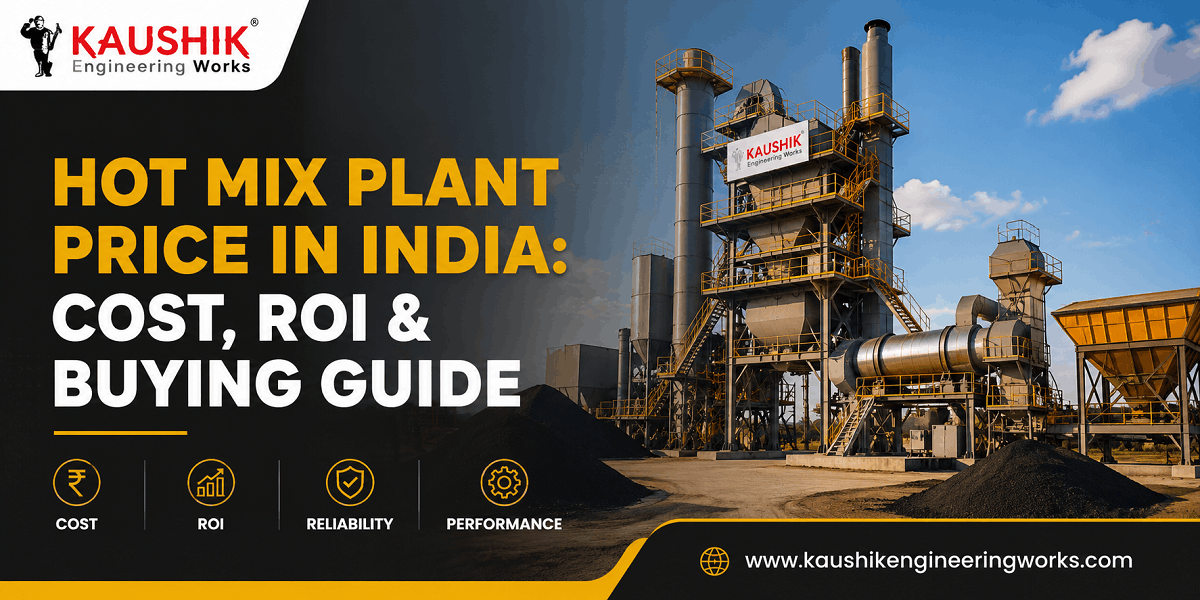
A hot mix plant is one of the most important investments in road construction, but the right purchase decision is rarely about the lowest quote. In India, the average indicative cost changes with plant capacity, mobility, automation, fuel system, and compliance features, so buyers should compare total value, not just the headline number. Published industry pricing examples show a wide spread, from lower-capacity mobile units to higher-capacity batch plants, which is why a realistic buying guide needs cost context, not a fixed price claim.
Direct Answer:
On average, a hot mix plant in India can fall anywhere from a lower-investment mobile setup to a much higher-capacity batch plant, depending on output and configuration. The most useful way to judge cost is by comparing capacity bands, operating needs, and long-term ROI instead of looking for one universal price.
What Is the Average Hot Mix Plant Price in India?
There is no single market rate for a hot mix plant in India. Indicative pricing published by manufacturers and industry guides shows that lower-capacity plants cost far less than high-capacity systems, and that mobility and automation can shift the investment significantly. For example, published ranges show 40–60 TPH plants around ₹25 lakh–₹45 lakh, 80 TPH plants around ₹45 lakh–₹70 lakh, 120 TPH plants around ₹70 lakh–₹1.2 crore, and 160+ TPH plants around ₹1.2 crore–₹2.5 crore.
To make the comparison easier, here is an indicative view of how the market is usually structured:
|
Plant type |
Typical use case |
Indicative price positioning |
| Mini mobile hot mix plant | Short-duration or small road jobs | Lower investment range |
| Mid-capacity hot mix plant | Local roads, contractors, recurring projects | Mid-range investment |
| High-capacity hot mix plant | Highway and large infrastructure work | Higher investment range |
That broad pattern is consistent with manufacturer examples showing mobile plants from about 40 TPH to 120 TPH, while larger batch systems and tailor-made configurations sit higher in the investment ladder.
What Affects Hot Mix Plant Pricing the Most?
The price of a hot mix plant is shaped by a few core engineering choices. Capacity is the first driver. A plant built for 40 TPH needs a very different material-handling, drying, and mixing setup than a 120 TPH or 160+ TPH unit. Higher output usually means stronger structural design, larger burners, bigger aggregate systems, and more robust control hardware.
Plant type matters too. A batch mix plant produces asphalt in measured batches, which gives more control over mix composition and is often preferred where consistency is critical. A drum mix plant works continuously, which suits contractors who need steady production and simpler output flow. The right choice is not universal; it depends on project volume, site behaviour, and quality requirements.
Mobility also changes the investment. A mobile hot mix plant is designed for faster relocation and quicker commissioning, which is valuable for contractors who move between sites. Stationary systems are generally better when the project base is fixed, and the plant will run for longer periods in one place.
Automation is another major factor. Manual systems can be lower cost, but semi-automatic and PLC-based plants usually improve control, consistency, and operator efficiency. In practical terms, better automation can reduce mix variation and help limit downtime, which is why many buyers treat it as a lifecycle value decision rather than just a purchase cost decision.
Average Hot Mix Plant Cost Breakdown
When contractors ask for a hot mix plant price, they are usually looking only at the machine. In reality, the full project cost includes several layers.
Main Plant Components
A typical hot mix plant includes cold feeder bins, conveyor systems, a dryer drum, burner, control cabin, bitumen storage and weighing systems, aggregate storage, mixing unit, and dust collection equipment. These are the core elements that define the plant’s output, quality, and energy profile.
Installation and Setup Costs
Beyond the machine itself, buyers should expect costs linked to transportation, foundation work, erection, electrical installation, commissioning, and operator handover. These costs vary by site condition, plant size, and whether the project needs a mobile or stationary setup. A mobile plant can reduce some civil effort, while a stationary plant may require more site preparation.
Compliance-Related Costs
This part is easy to overlook, but it matters. CPCB-related air and siting requirements can add cost because plants need proper dust control, stack planning, noise control, approved fuel arrangements, and site compliance preparation. A current NGT/CPCB-related document states particulate matter limits of 150 mg/Nm³ for batch-type hot mix plants and 300 mg/Nm³ for drum-type hot mix plants, along with stack-height calculations and related environmental controls.
Hot Mix Plant or Batch Mix Plant: Which One Gives Better Value?
A batch mix plant is generally chosen when mix control is the top priority. Because materials are weighed and mixed in separate batches, it can be a better fit for jobs where consistency and recipe control matter more than sheer continuous output.
A drum mix plant is usually more attractive when the priority is continuous production and operational simplicity. As per experienced manufacturers, drum plants work in a continuous process and are often selected for cost-effective output on highway-style projects. That makes them a strong option for contractors who need steadier throughput.
The best answer depends on the project pattern. If the work mix changes often, a batch mix plant may be worth the higher planning complexity. If the job is repetitive and output-driven, a hot mix plant with drum-based continuous production may give better operating value.
How to Judge ROI Before Buying a Hot Mix Plant
ROI is where many buyers make or lose money. A cheaper hot mix plant can become expensive if it consumes more fuel, needs more maintenance, or causes repeated downtime. Manufacturer guidance repeatedly emphasises that fuel efficiency, spare parts support, and build quality affect long-term profitability, not just upfront spending.
A simple way to think about ROI is this:
ROI improves when production is steady, fuel use is controlled, operator error is low, and the plant stays active on paid projects.
That means a buyer should compare:
- Expected tonnage per month
- Fuel consumption per ton
- Downtime risk
- Spare parts access
- Labour skill requirements
- Relocation needs
- Compliance readiness
If a contractor works on multiple jobs, a mobile hot mix plant may improve utilisation because the plant can move with the project. If the work is concentrated in one region, a stationary plant may offer better long-run stability.
Hidden Costs Buyers Often Miss
A lot of buying mistakes happen because the initial quote looks clean, but the project cost is not.
1) Transportation and Relocation
Moving a hot mix plant can add logistics cost, especially if the plant is large or the site is difficult to access. Mobile configurations can reduce this burden, but the buyer should still check transport dimensions, assembly time, and crane requirements.
2) Fuel Use
Fuel is one of the largest operating expenses in asphalt production. Industry pricing data shows that paying more upfront usually brings long-term fuel savings and fewer repair bills. This reveals exactly why a pricier plant can.
3) Maintenance and Spares
Wear parts, burner components, filters, and mixing elements affect uptime. If a supplier cannot provide quick spares, the plant may sit idle during peak work windows. That lost time can cost more than the original savings from a lower quote.
4) Compliance Preparation
Plants that do not meet dust, noise, and stack requirements can face shutdown risk, redesign costs, or delayed commissioning. CPCB-linked requirements are not optional extras; they are part of the real investment picture.
Buying Checklist for a Hot Mix Plant
Before you request a quotation, use this checklist.
Capacity Checklist
- Estimate your monthly tonnage.
- Match the plant to your project pipeline.
- Avoid overbuying unused capacity.
Technology Checklist
- Decide between a batch mix plant and a drum mix plant.
- Choose a mobile hot mix plant or a stationary plant based on project geography.
- Compare manual, semi-automatic, and PLC-based control options.
Compliance Checklist
- Verify dust control.
- Confirm stack design support.
- Check fuel compatibility.
- Ask for environmental readiness documentation.
Vendor Checklist
- Ask about installation support.
- Confirm spare parts availability.
- Review warranty terms.
- Ask for operator training.
- Check after-sales response time.
- Request reference projects.
Commercial Checklist
- Ask what is included in the quote.
- Ask what is excluded.
- Confirm civil, electrical, and transport costs.
- Compare total ownership cost, not only machine cost.
This is where choosing an experienced asphalt drum mix plant manufacturer matters. A credible manufacturer does more than sell steel and machinery. They help with commissioning, service, uptime, and plant performance over the full project life. Fast commissioning, genuine spares, and after-sales support are important parts of the value proposition.
Where Wet Mix Plant, WMM Plant, and Road Base Material Plants Fit
Many buyers compare a hot mix plant with a wet mix plant or WMM plant, especially when they are planning road layers from base to top surface. A wet mix macadam plant or road base material plant is used for base-layer preparation, while a hot mix plant is used for asphalt mixes for surfacing. They serve different stages of road construction, so the choice depends on the layer being produced, not just the equipment price.
That distinction matters because some buyers use the wrong machine search term and compare unrelated systems. A wet mix plant may be the right solution for base work, but it will not replace a hot mix plant for asphalt production. When a project requires both base and surfacing, contractors should evaluate both plant categories separately.
Final Takeaway
The best way to evaluate a hot mix plant price in India is to look at the total picture: capacity, plant type, mobility, automation, compliance, and long-term operating cost. Published industry examples show that pricing is highly variable, so an “average” number only becomes useful when it is tied to the plant’s output and configuration.
If your work is project-driven and mobile, a mobile hot mix plant may give better flexibility. If your work is steady and quality-sensitive, a batch mix plant may deliver more control. If your focus is continuous asphalt output, a drum-based system from an experienced asphalt drum mix plant manufacturer may be the better commercial fit. The right purchase is the one that performs well in the field, supports compliance, and improves ROI over time.
Frequently Asked Questions (FAQs)
1. What is the average hot mix plant price in India?
The average hot mix plant price in India varies based on plant capacity, automation level, mobility, and pollution-control features. Smaller mobile plants generally fall in a lower investment range, while high-capacity batch plants require a higher investment.
2. Which factors affect the hot mix plant cost the most?
A hot mix plant’s cost depends heavily on its TPH capacity, equipment type, automation level, fuel choice, portability, emission controls, and setup requirements.
3. Is a mobile hot mix plant better for small road projects?
A mobile hot mix plant is often suitable for small and medium road projects because it is easier to relocate, faster to install, and more flexible for contractors handling multiple job sites.
4. How do I choose the right hot mix plant capacity?
Choose hot mix plant capacity based on expected project volume, daily production requirements, future contracts, and operating hours. Oversized plants may increase operating costs, while undersized plants can reduce productivity.
5. What should buyers check before purchasing a hot mix plant?
Before buying a hot mix plant, buyers should check plant capacity, automation features, emission-control systems, spare parts availability, fuel efficiency, after-sales support, warranty coverage, and installation assistance.
Ready to Build a Smarter Asphalt Project?
A hot mix plant is more than a machine purchase. It is a long-term production decision that affects cost control, project delivery, and profitability on every job. If you are comparing options, the smartest next step is to choose a plant that matches your output needs, site conditions, and compliance requirements—not just the lowest quote.
At Kaushik Engineering Works, we understand that every road project has different demands, which is why the right solution must balance performance, durability, fuel efficiency, and service support.
Whether you are planning a new project, expanding capacity, or replacing an older setup, our team can help you evaluate the best plant configuration for your needs. Get the clarity you need before you invest. Review your requirements, compare the real operating value, and move forward with confidence.
Contact Kaushik Engineering Works at +91 2717 415587 or +91 – 98251 64764 or email us at info@kaushikengineeringworks.com to discuss your hot mix plant requirement and request a solution built for your project goals.

