
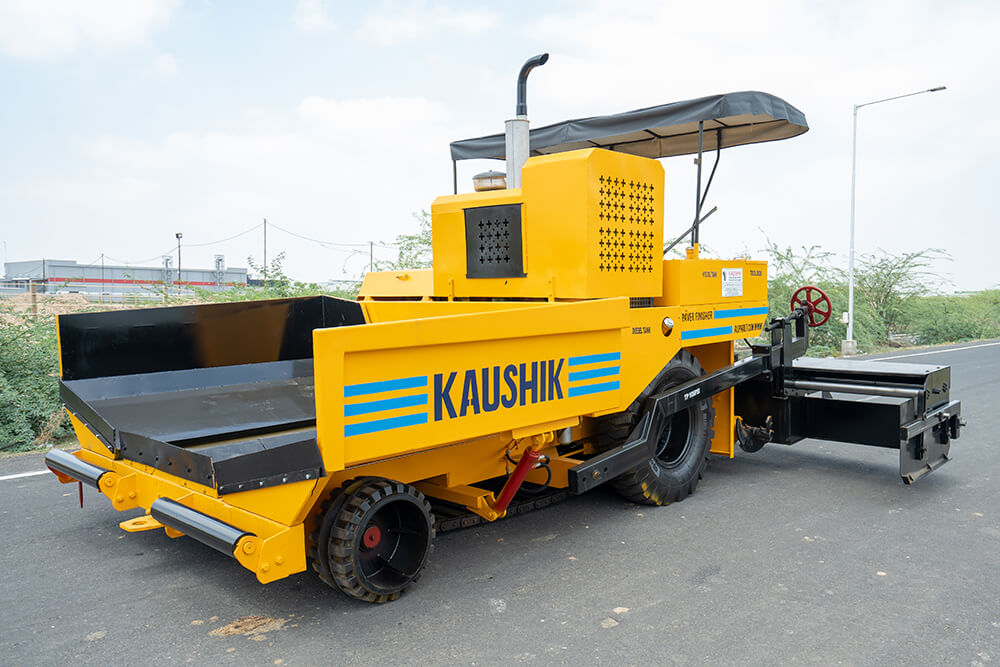
A mechanical road paver — also called an asphalt paver finisher or paver finisher — is the machine that determines the surface quality of every road you drive on. It receives hot mix asphalt from a truck, spreads it across the road width at a controlled thickness, and delivers a pre-compacted mat ready for the rollers to finish. Every kilometre of highway, every urban road, every airport runway paved with asphalt has passed through a paver’s screed.
The quality of the paved mat — its evenness, thickness consistency, surface texture, and cross-slope — is determined more by the paver’s performance and operation than by any other single machine in the road construction chain. A well-produced asphalt mix from the best drum mix plant can still produce a poor road surface if the paver stops frequently, runs at uneven speed, or has a misadjusted screed. Conversely, a consistently operating paver run by a skilled operator consistently produces a smooth, uniform mat that compacts well and delivers the road life the design intended.
At Kaushik Engineering Works, we manufacture hydrostatic paver finishers at our Sanand, Ahmedabad facility, supplying contractors across India and internationally. This guide explains why road paver machines are critical to modern road construction — covering their working principle, key components, performance factors, and how they fit into the overall paving system.
How a Mechanical Road Paver Works
A road paver finisher works in a continuous forward movement, receiving, spreading, and pre-compacting hot mix asphalt in a single pass. The process has five main stages:
Stage 1 — Receiving Material from the Truck
The paver positions itself behind a dump truck. As the truck reverses toward the paver, the truck body raises and hot mix asphalt tips into the paver’s receiving hopper at the front. The hopper holds a buffer quantity — typically 5 to 8 tonnes — that feeds the conveyor system behind it. This buffer allows the paver to continue moving for a short period while truck changeover happens, reducing the stop-start cycle that causes mat joints and surface irregularities.
Stage 2 — Conveying Material to the Augers
Chain conveyors at the bottom of the hopper carry the asphalt rearward to the spreading augers, positioned just ahead of the screed. The conveyor speed is controlled by sensors that monitor the material level ahead of the screed — speeding up when material level drops and slowing when it rises. Consistent material head in front of the screed is critical for uniform mat thickness.
Stage 3 — Spreading by Augers
The spreading augers — twin helical screws — distribute the asphalt evenly across the full paving width. The auger rotation speed and direction are adjustable and are matched to the forward speed of the machine to maintain a consistent material head across the screed width. Uneven auger feed is one of the most common causes of transverse surface irregularity — visible as waviness or thickness variation across the road width.
Stage 4 — Screeding and Pre-Compaction
The screed is the defining component of the paver. It rides on the asphalt mat behind the augers, levelling the surface and applying initial compaction through a combination of:
- Dead weight: The screed’s own weight provides basic compaction pressure on the mat
- Vibration: Electric or hydraulic vibrators in the screed reduce voids and improve surface texture
- Tamping bars: Some screeds include tamping bars that provide additional compaction action, particularly useful for dense or stiff mixes
The screed is not rigidly attached to the paver — it floats on the asphalt mat, finding its natural level based on material thickness, mix consistency, and forward speed. This floating action is what gives the paver its self-levelling capability — minor variations in subgrade level are absorbed by the screed’s free movement without showing up as surface irregularities in the mat.
Stage 5 — Forward Movement and Continuous Operation
The paver moves forward continuously. Stopping the paver — even briefly — creates a transverse joint in the mat where fresh material meets material that has begun to cool and stiffen. These joints are weak points that crack and deteriorate faster than continuously laid mat under traffic. On NHAI quality specifications, the number of transverse joints per kilometre is a measurable quality indicator. Minimising stops is therefore not just an efficiency goal — it is a mat quality requirement.
Key Components of a Road Paver Finisher
| Component | Function | Impact on Mat Quality |
|---|---|---|
| Receiving hopper | Receives and buffers asphalt from trucks | Buffer capacity reduces stop-start frequency and mat joints |
| Chain conveyors | Transfer asphalt from hopper to augers | Speed consistency affects material head and mat thickness uniformity |
| Spreading augers | Distribute asphalt across paving width | Auger consistency determines transverse material uniformity |
| Floating screed | Level, compact, and texture the mat surface | Primary determinant of surface smoothness and pre-compaction |
| Screed vibrators | Reduce air voids in the mat under the screed | Higher initial density reduces roller passes needed for target compaction |
| Tow point / push rollers | Connect paver to truck during material transfer | Smooth truck contact prevents paver surging that causes bumps |
| Travel drive system | Propel paver forward at controlled speed | Speed consistency is the most critical single factor for mat smoothness |
| Control system | Manage forward speed, screed settings, auger and conveyor speed | Automation reduces operator-induced variation in mat quality |
Why Road Paver Machines Are Critical to Modern Road Construction
Precision Surface Levels That Manual Methods Cannot Match
Before mechanical pavers became standard, road surfaces were laid by hand — spreading asphalt with rakes and lutes, checking thickness with depth gauges, and levelling by eye and experience. The result was surface irregularity that appeared within the first year of traffic as bumps, waves, and texture variation. A mechanical paver with a floating screed consistently delivers surface regularity (measured as International Roughness Index or IRI) that is unachievable by manual methods — and that MORTH specifications now require on all national and state highway contracts.
Controlled Thickness Across the Full Road Width
MORTH specifications prescribe layer thickness tolerances of ±6mm for Bituminous Concrete and ±10mm for Dense Bituminous Macadam. A mechanical paver maintains these tolerances consistently because the screed’s floating action responds to changes in the base beneath it — not to the operator’s eye. Manual methods cannot achieve consistent thickness over long stretches.
Higher Paving Speed Reduces Project Duration
A modern mechanical paver can lay asphalt at 3 to 8 metres per minute depending on layer thickness, mix consistency, and available truck supply. On a typical 7.5 metre wide road, this translates to 1,350 to 3,600 square metres per hour. Even the most skilled manual paving team cannot approach this output — and manual paving at higher speeds produces progressively worse surface quality.
Integration with the Full Paving System
The paver is the coordinator of the entire paving system. Its forward speed sets the pace for the truck cycle, the roller fleet, and the quality control team. A paver running at too high a speed for the available truck supply will stop frequently — damaging mat quality. A paver running too slowly wastes roller time and risks mix cooling before adequate compaction is achieved. Getting paver speed right, matched to plant output and haul distance, is the central logistical challenge of any highway paving operation.
Hydrostatic vs Mechanical Drive Pavers
Two drive system configurations are available on modern road pavers — hydrostatic and mechanical — and the difference affects both operating performance and maintenance requirements.
Hydrostatic paver finishers use a hydraulic drive system to power the tracks or wheels. Variable-speed hydraulic motors allow infinitely variable forward speed — the operator can adjust paving speed continuously without gear changes, producing smoother, more consistent forward motion. Hydrostatic pavers are easier to operate, respond better to varying material supply conditions, and typically produce better surface regularity than mechanical drive pavers. KEW manufactures hydrostatic paver finishers specifically for this reason.
Mechanical drive pavers use a gearbox-based drive system with fixed gear ratios. They are simpler mechanically, lower cost to purchase, and suitable for applications where continuous paving at a consistent speed is achievable. On projects with variable truck supply or tight site constraints that require frequent speed adjustments, mechanical drive pavers produce more stop-start cycles and correspondingly more transverse joints.
Frequently Asked Questions — Road Paver Machines
What is the difference between a paver finisher and a roller in road construction?
A paver finisher spreads and pre-compacts the hot mix asphalt mat — it determines the mat’s thickness, level, and initial density. A roller follows behind the paver and completes the compaction process, achieving the target density specified in the mix design. Both are essential — the paver creates the mat geometry, the roller achieves the final structural density. Neither can compensate for poor performance by the other.
Why should a road paver not stop during paving?
When a paver stops, the asphalt mat behind the screed continues to cool while the material ahead of the screed cools faster at the joint face. When paving resumes, fresh hot mix meets cooler, partially compacted mix at the stop point — creating a transverse joint. These joints are structurally weaker than continuously laid mat, compact to lower density, and crack under traffic earlier than the surrounding pavement. On NHAI highway contracts, transverse joint frequency is measured as a quality indicator.
What paving width can a road paver achieve?
Road paver screeds are typically extendable from a basic width to a maximum width. Standard road pavers in India cover paving widths from 2.5 metres (basic) to 8.5 metres (fully extended). Extensions beyond the basic screed width require bolt-on screed extensions that maintain the floating action across the full width. For wider roads, two pavers can be operated in echelon — side by side with overlapping widths — to produce a seamless full-width mat.
What mix temperature should asphalt be when it reaches the paver?
Standard penetration grade bitumen mixes should arrive at the paver at a minimum of 140°C to 150°C. The mix must be placed and compacted before temperature drops below 120°C for effective compaction. Haul distance from the asphalt mixing plant to the paver directly determines how much temperature is lost in transit and must be factored into the production planning — including truck insulation, haul route conditions, and time of day.
How does a hydrostatic paver improve surface quality compared to a mechanical paver?
A hydrostatic paver’s variable-speed hydraulic drive allows the operator to maintain perfectly consistent forward speed regardless of terrain gradient, material consistency changes, or minor speed adjustments. Mechanical drive pavers use fixed gear ratios, meaning any speed adjustment requires a gear change that momentarily disrupts forward speed consistency. Since screed performance is directly tied to forward speed consistency, hydrostatic pavers consistently produce better surface regularity on Indian highway projects.
Get a Quote for KEW Hydrostatic Paver Finisher
Kaushik Engineering Works manufactures hydrostatic paver finishers at our Sanand, Ahmedabad facility — designed for the demanding conditions of Indian highway construction with hydraulically controlled hopper operations, screed lifting, and vibrating/tamping arrangements. Our pavers are built with quality components for long years of trouble-free performance, backed by spare parts availability and service support from our Works and Regional Offices.
Contact our team to discuss your project’s paving width requirements, production capacity, and site conditions — or visit our hydrostatic paver finisher product page for full technical specifications.
📞 +91 98251 64764 | +91 2717 415587
📧 info@kaushikengineeringworks.com
📍 PE-107, Sanand II Industrial Estate, Bol GIDC, Sanand, Ahmedabad – 382110, Gujarat, India
🕐 Mon–Sat: 8:00 AM – 7:00 PM

