
If you own or operate an asphalt plant in India, the start of 2026 has likely brought a wave of unease. The regulatory landscape for road construction equipment is shifting beneath our feet. What was considered “compliant” just two years ago is now often grounds for a show-cause notice. With the National Green Tribunal (NGT) intensifying its oversight on “Red Category” industries and the Central Pollution Control Board (CPCB) tightening particulate matter limits, the margin for error has vanished.
Gone are the days when a simple wet scrubber and a remote location were enough to secure your Consent to Operate (CTO). Today, State Pollution Control Boards (SPCBs), from the strict monitoring in NCR to the evolving standards in Maharashtra and Karnataka, are leveraging satellite imagery, drone surveys, and real-time monitoring to identify non-compliant asphalt plants. The cost of ignorance is no longer just a warning letter; it is immediate seal-down orders, heavy environmental compensation fines, and blocklisting from future NHAI tenders.
At Kaushik Engineering Works, we don’t just manufacture machinery; we build business continuity. We understand that your plant is the heart of your project. If the plant stops, the paving stops, and the penalties pile up. To help you navigate this volatile environment, we have compiled the ultimate, fact-based survival guide. Whether you operate a portable drum mix plant for rural roads or a high-capacity asphalt batch mix plant for national highways, this guide is your roadmap to surviving the 2026 norms.
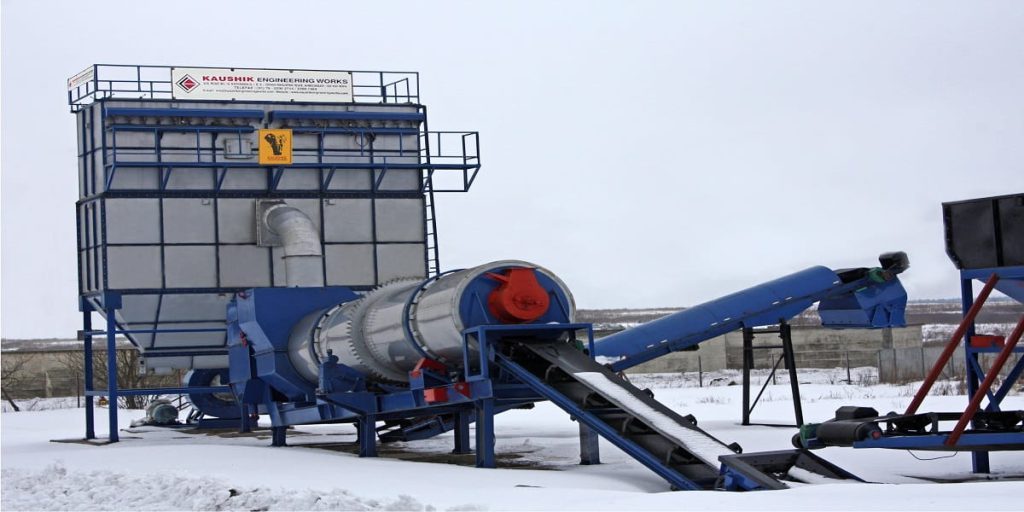
The Red Category Reality: Why the Rules Changed in 2026
In the eyes of Indian regulators, an asphalt mixing plant is no longer viewed simply as a piece of construction equipment. It is classified as a significant source of industrial pollution. This classification under the “Red Category” means that the scrutiny level is at its absolute peak.
The 2026 enforcement strategy is different from previous years. It focuses on three critical, often overlooked areas:
- Micro-Siting Violations: It is not just about being away from the city. It is about specific distances from schools, hospitals, and highways, measured with GPS precision.
- Fugitive Emissions: Regulators are no longer just looking at the smoke from your chimney. They are looking at the dust blowing off your cold feeder bins and conveyor belts.
- Fuel Quality: The crackdown on dirty fuels like unapproved pyrolysis oil or high-sulphur furnace oil is aggressive.
For an asphalt plant in India, understanding these shifts is the difference between a profitable season and a legal nightmare.
Pillar 1: The Distance Trap (Siting Criteria)
The most common reason for a CTO rejection in 2026 isn’t the smoke, it’s the location. Many contractors buy a plant, set it up on leased land, and then apply for permission, only to be rejected because they violated a buffer zone by 50 meters.
The CPCB and various State Boards have harmonised their siting guidelines to stricter standards. Here is what you need to measure before you even drop the first load of aggregate:
1. Habitation Buffer Zones
Your asphalt plant generally must be at least 300 to 500 meters away from the nearest human habitation. This includes not just towns, but even small village clusters (typically defined as a settlement of 100+ people). In sensitive zones or near major metropolitan areas, this buffer can extend to 1 kilometre.
2. The Highway Proximity Rule
Historically, contractors placed plants right on the edge of the National Highway (NH) to minimise transport costs. The new norms often require a 200-meter buffer from the right-of-way (ROW) of National or State Highways.
- The Exception: If the plant is dedicated exclusively to that specific highway project, you may get a temporary exemption, but this requires a specific Project-Based CTO that expires the moment the road is finished.
3. Ecological Sensitivity
If your site is within 10 kilometres of a Wildlife Sanctuary, National Park, or an Eco-Sensitive Zone (ESZ), you strictly need clearance from the National Board for Wildlife (NBWL). Ignorance of an ESZ boundary is the fastest way to get a permanent seal order.
Practical Tip: If your current site violates these norms, do not wait for the inspection. Consider upgrading to our mobile drum mix plant solutions. These units are designed for rapid dismantling and relocation, allowing you to move to a compliant zone without the sunk costs of heavy civil foundations.
Pillar 2: The 150 vs. 300 Rule (Emission Standards)
This is the technical heart of the new regulations. The allowable limit for Particulate Matter (PM) emissions, the soot and dust that leaves your chimney, depends entirely on the technology you use. Knowing your limit is crucial.
For Asphalt Batch Mix Plants
Because asphalt batch mix plants are typically larger (80 TPH to 200+ TPH) and are often stationary units used for long-term projects near urban centres, the regulations are tighter.
- The Limit: Strictly capped at 150 mg/Nm³.
- The Challenge: Achieving this with a standard wet scrubber is difficult, especially as the plant ages. It almost always requires a baghouse filter (Fabric Filter) system.
For Drum Mix Plants
For continuous drum mix plants, which are often used in remote locations or for lower-volume roads, the norms have historically been more relaxed.
- The Limit: Typically 300 mg/Nm³.
- The Catch: If your plant is located in a designated “Critically Polluted Area” (CPA) or an industrial cluster with a poor Air Quality Index (AQI), this relaxation is revoked. In these cases, you must meet the 150 mg/Nm³ standard, regardless of your plant type.
Many older asphalt plants in India running on simple primary dust collectors (cyclones) are currently emitting over 600 mg/Nm³. Operating these legacy machines in 2026 is a calculated risk with very poor odds.
Pillar 3: Fugitive Emissions (The Silent Killer)
In 2026, regulators stopped looking up at the chimney and started looking down at the ground. Fugitive Emissions refer to dust that escapes from sources other than the main stack. This is where most Indian contractors fail their audits.
Aggregates and Cold Feeders
The act of loading cold feeder bins with a JCB or loader generates massive dust clouds. If this dust crosses your site boundary, it is a violation.
- The Fix: You must install Wind Breaking Walls (usually 10-15 ft high GI sheets) around three sides of your aggregate storage area.
- The Upgrade: Modern asphalt mixing plants now come with covered conveyor belts. If yours are open, retrofitting them with simple hood covers is a cheap way to show inspectors you are serious about compliance.
The Black Smoke from Burners
Visible black smoke is usually a result of incomplete combustion or poor fuel quality.
- Permitted Fuels: Most states now mandate the use of Low Sulphur High Speed Diesel (LSHSD), LDO, or Piped Natural Gas (PNG). Using unauthorised “tyre oil” or high-sulphur furnace oil is a major violation that can lead to immediate prosecution.
- Burner Efficiency: A Kaushik Engineering Works asphalt plant comes equipped with high-pressure jet burners that ensure 99.9% fuel combustion. If your burner is older than 5 years, it likely lacks the air-to-fuel ratio control needed to prevent black smoke during startup.
Technology Deep Dive: Baghouse vs. Wet Scrubber
To meet the strict 150 mg/Nm³ limit, the pollution control device (PCD) you choose for your asphalt plant in India is the most critical hardware decision you will make.
1. The Wet Scrubber (Venturi Type)
This has been the industry standard for decades. It uses high-pressure water sprays to scrub dust particles out of the air stream.
- Pros: Lower initial cost, simple to operate.
- Cons: Requires a large water supply (a scarcity in many Indian regions); generates sludge that must be disposed of carefully; typically achieves 250-350 mg/Nm³, which is borderline for new norms.
- Verdict: Good for rural drum mix plants where water is abundant, and norms are at 300 mg/Nm³.
2. The Baghouse Filter (Fabric Filter)
This is the future-proof solution. It acts like a giant vacuum cleaner, pulling exhaust air through hundreds of heat-resistant fabric bags (usually Nomex or Aramid) that trap even the finest dust.
- Pros: Can achieve emissions as low as 20-50 mg/Nm³ (far below the 150 limit); it is a dry process, so no water is needed. It recovers fines (stone dust) that can be returned to the mix, saving you money on filler material.
- Cons: Higher initial investment; requires careful temperature management to prevent bags from burning or clogging.
- Verdict: Essential for asphalt batch mix plants and any plant operating near a city.
The Kaushik Advantage: We have seen a massive shift in 2026, where contractors are retrofitting their existing drum mix plants with baghouse filters. This not only guarantees compliance but also improves the quality of the mix by controlling the fines returned to the drum.
Pillar 4: The CEV Stage V Power Challenge
A hidden aspect of the 2026 norms involves the power source of your plant. Most asphalt plants in India are powered by Diesel Generator (DG) sets.
As of recent updates, all construction equipment engines and DG sets must meet CEV Stage V (or CPCB IV+) emission standards.
- The Impact: If you are using an old, non-compliant generator to power your new asphalt plant, the plant itself might be legal, but the power source is illegal.
- The Solution: When buying a new asphalt mixing plant, ensure your manufacturer helps you size the generator correctly so you can invest in a Stage V-compliant genset that handles the load without tripping.
Documentation: The Shield Against Harassment
Even if your asphalt plants are running clean, poor paperwork can lead to penalties. Bureaucracy loves a paper trail. Ensure you have these documents ready on-site, organised in a Compliance Folder:
- Valid CTO (Consent to Operate): Ensure it hasn’t expired. Apply for renewal at least 3 months before the expiry date.
- Environmental Log Book: A daily record of fuel consumption, hours of operation, and mix production tons. Discrepancies here are often used to prove over-production beyond your permitted capacity.
- Stack Monitoring Report: A monthly report from an NABL-accredited third-party lab proving your emissions are within limits. Do not fake these; cross-verification is becoming common.
- Green Belt Proof: Photos showing tree plantation along your site boundary. Most CTOs require that 33% of the plot area must be a Green Belt.
- Hazardous Waste Authorisation: If you are using a wet scrubber, the sludge is technically hazardous waste. You need authorisation for its disposal (usually drying and reusing in sub-base, if permitted).
Operational Best Practices to Lower Emissions
Sometimes, you don’t need new hardware; you just need better habits. Here are three operational tweaks to lower the emissions of your asphalt batch mix plant or drum plant immediately:
1. Manage Aggregate Moisture
This is the #1 cause of high emissions. Wet aggregates require more fuel to dry. More fuel burned means more exhaust gas and more smoke.
The Fix: Cover your stockpiles. A simple tarpaulin shed can reduce aggregate moisture by 2-3%. This seemingly small change can reduce your fuel consumption and your stack emissions significantly.
2. Control the Temperature
Overheating the mix releases blue smoke (bitumen fumes), which is highly toxic and visible.
The Fix: Strict temperature control. Ensure your mix discharge temperature never exceeds 160°C-170°C. Modern control panels from Kaushik Engineering allow for precise, automated burner modulation to prevent overheating.
3. Optimise the Air-to-Fuel Ratio
A burner running “rich” (too much fuel, too little air) produces black smoke. A burner running “lean” (too much air) wastes fuel.
The Fix: Regular tuning of the burner damper linkage. It takes 15 minutes but saves lakhs in fuel and fines.
How Kaushik Engineering Works Keeps You Safe
At Kaushik Engineering Works, we foresaw these regulatory shifts years ago. We didn’t just wait for the laws to change; we engineered our machines to be ready for them. That is why our modern asphalt batch mix plant and drum mix plant models are Compliance-Ready.
- Digitised Burners: Our proprietary burner designs optimise fuel usage, reducing carbon footprint and visible smoke. They are compatible with cleaner fuels like LDO and Natural Gas.
- Modular Pollution Control: We offer customizable pollution control units. You can start with a Wet Scrubber for a rural project and easily upgrade the same plant to a Baghouse Filter if you move to an urban contract.
- Siting Support: We don’t just sell you the iron. Our team assists you with technical layout drawings to help you maximise land usage while maintaining the mandatory buffer zones, ensuring your CTO application sails through.
- Retrofitting Services: Do you have an older asphalt mixing plant? We can retrofit it with our advanced pollution control devices to bring it up to 2026 standards.
Conclusion
The 2026 CPCB norms are not a hurdle. They are a filter. They will filter out the unprofessional, fly-by-night operators who cut corners, leaving the market open for serious, professional contractors who value quality and compliance.
By upgrading your asphalt plant in India today, you are not just avoiding a fine, you are securing your reputation. When you bid for a prestigious NHAI or PWD project, being able to say, “My plant is 100% compliant with 2026 emission norms,” is a powerful differentiator.
Is Your Plant 100% Inspection-Ready?
The 2026 CPCB norms are not just guidelines, they are the new law of the land. One surprise inspection could halt your entire project, leading to massive financial losses and reputational damage. Don’t wait for a show-cause notice to force your hand.
At Kaushik Engineering Works, we turn compliance into your competitive advantage. Whether you need to retrofit your current drum mix plant with advanced pollution control systems or upgrade to a certified, low-emission asphalt batch mix plant, our experts have the solution.
Secure your peace of mind and your profits today.
Contact us for a no-obligation compliance audit of your site:
- Phone: +91-9825164764 / +91-2717415587
- Email: info@kaushikengineeringworks.com

