
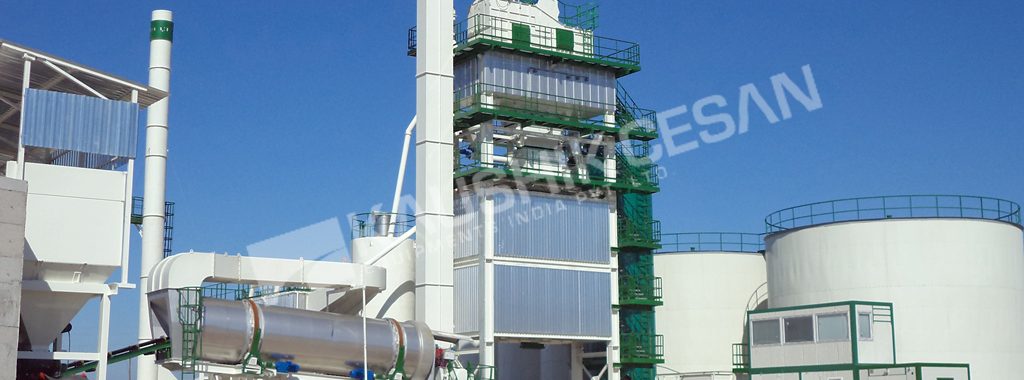
A hot mix plant — also called an asphalt mixing plant or hot mix asphalt plant — is the central production machine in any road construction project using bituminous pavement. It heats aggregates to a specified temperature, blends them with bitumen and mineral filler in exact proportions defined by the job mix formula, and discharges hot mix asphalt ready for transport to the paving site.
At Kaushik Engineering Works, we have been manufacturing hot mix plants from our Sanand, Ahmedabad facility for over 15 years. In that time, we have supplied drum mix plants and batch mix plants across 35+ countries — from NHAI national highway projects in India to road infrastructure programs in Nigeria, Kenya, and Saudi Arabia. This guide draws on that field experience to help contractors, project managers, and infrastructure developers choose the right plant for their specific needs.
What Is a Hot Mix Plant and How Does It Work?
A hot mix plant works by combining four core processes in a controlled sequence: aggregate drying and heating, screening or weighing, bitumen dosing, and mixing. The sequence varies between drum mix and batch mix configurations, but the underlying objective is identical — produce a uniform, temperature-consistent asphalt mix that meets the approved job mix formula.
The process begins at the cold feed bins, where aggregates of different sizes are metered out by variable-speed belt feeders. These aggregates travel to the drying and heating unit, where a burner raises their temperature to between 150°C and 170°C, depending on the mix design. Bitumen — stored in insulated tanks at around 150°C — is introduced at the mixing stage in quantities controlled by a weighing or flow metering system. Mineral filler (stone dust) is added separately, also by weight.
The completed mix is discharged into waiting trucks, or into a storage silo if the plant is equipped with one. From the moment of discharge, the mix must reach the paving site and be laid within a defined temperature window — typically before the temperature drops below 120°C for standard mixes — making coordination between plant output, haul distance, and paving speed critical.
Types of Hot Mix Plants: Drum Mix vs Batch Mix
Both drum mix and batch mix plants produce hot mix asphalt, but they work on fundamentally different principles. Choosing the right type depends on your project’s daily tonnage, number of mix designs, site conditions, and budget.
Drum Mix Plants (Continuous Production)
In a drum mix plant, aggregates are dried, heated, and mixed with bitumen inside a single rotating drum in a continuous process. There are no batches — material flows in at one end and hot mix exits at the other in an unbroken stream. This makes drum mix plants well suited to large highway projects where a single mix design is used consistently over long stretches.
KEW asphalt drum mix plants use our proprietary Thermodrum system — a triple heat transfer mechanism combining conductive, convective, and radiation methods — to deliver better fuel efficiency and more consistent aggregate temperatures compared to standard drum designs. Our stationary models range from 40 TPH (KEW-45) to 150 TPH (KEW-65), with higher-capacity options available. Mobile drum mix plants (MDM-25 and MDM-45) are containerised for easy transport and rapid setup at remote sites.
The honest trade-off: drum mix plants offer limited flexibility when multiple mix designs are needed on the same project. Switching gradations mid-production is slower and requires more careful calibration than on a batch plant.
Batch Mix Plants (Precise Batch-Wise Control)
A batch mix plant produces asphalt in separate, weighed batches. Hot aggregates are screened into different size fractions, weighed in a hopper, blended with bitumen and filler in a pugmill mixer, and discharged as a single batch before the next cycle begins. This gives precise control over every batch’s composition, making batch mix plants the preferred choice for specification-sensitive government projects and airport runway paving.
KEW asphalt batch mix plants are available from 60 TPH to 240 TPH. Their batch-by-batch weighing allows multiple mix designs to be produced on the same shift with minimal changeover time — a significant advantage on projects with varied pavement layer specifications.
Drum Mix vs Batch Mix — Quick Comparison
| Factor | Drum Mix Plant | Batch Mix Plant |
|---|---|---|
| Production method | Continuous | Batch-wise |
| Mix design flexibility | Limited — best with one consistent design | High — multiple designs per shift |
| Capital cost | Lower | Higher |
| Operating cost | Lower fuel consumption per tonne | Slightly higher due to batch cycle |
| Quality control | Good with proper calibration | Higher — weighed batch-by-batch |
| Best suited for | High-volume highway and state road projects | NHAI, airport, specification-driven contracts |
| Setup time | Faster — 2 to 5 days for mobile models | Longer — typically 5 to 15 days |
Hot Mix Plant Capacity: Which TPH Do You Need?
Capacity — measured in tonnes per hour (TPH) — is the most common starting point when selecting a hot mix plant, but it is rarely the right starting point. The practical question is not “what is the plant’s maximum output?” but “what hourly output does my project actually require?”
A straightforward way to calculate this: divide your daily asphalt requirement by your productive working hours. If a project needs 800 tonnes per day and you have 8 working hours, you need a plant capable of sustaining at least 100 TPH under real site conditions — accounting for setup, cleaning, and batch cycle delays.
Here is a reference guide for common Indian project types:
| Project Type | Typical Daily Output Needed | Recommended Capacity |
|---|---|---|
| Rural / PMGSY roads | 100–200 tonnes/day | 40–60 TPH drum mix |
| State PWD two-lane roads | 300–600 tonnes/day | 60–90 TPH drum or batch mix |
| NHAI four-lane highway | 800–1,500 tonnes/day | 120–200 TPH drum or batch mix |
| Airport runway | 400–800 tonnes/day (precision-critical) | 80–160 TPH batch mix |
| Urban smart city roads | 200–500 tonnes/day | 60–120 TPH drum or mobile drum |
One commonly overlooked factor is tipper cycle time. If your plant can produce 160 TPH but your tipper fleet can only carry away 100 tonnes per hour based on round-trip distance, your effective output is 100 TPH regardless of the plant’s rating. Match your plant capacity to your transport and paving chain, not just to the machine’s nameplate.
Key Components Every Buyer Should Evaluate
Understanding what is inside a hot mix plant helps you assess quality differences between manufacturers and ask better questions before purchasing.
Cold Feed System
Cold feed bins store aggregates of different sizes separately. Variable-speed belt feeders under each bin control the flow rate of each fraction into the conveyor. Poor feeder calibration at this stage leads to gradation problems throughout production — a plant with imprecise cold feed control will produce inconsistent mix regardless of how advanced its other systems are.
Drying and Heating Drum
The drying drum removes moisture from aggregates and raises their temperature to the target range. Burner efficiency, drum flight design, and drum rotation speed all affect fuel consumption and temperature uniformity. KEW’s Thermodrum system uses triple-mode heat transfer to improve efficiency versus conventional single-mode drum heating — a meaningful difference at scale when fuel represents 30–45% of hot mix production costs in India.
Dust Collection System
CPCB and MORTH norms require all asphalt plants operating in India to have dust collection systems — either a baghouse filter or a wet scrubber. Baghouse filters are more efficient and produce dry dust that can be returned to the mix as filler, reducing waste. Verify the plant’s dust emission specification against your project site’s environmental requirements before purchase — some urban and sensitive site projects have tighter limits than CPCB norms.
Bitumen Storage and Dosing
Bitumen tanks must maintain consistent temperature (typically 140°C to 160°C) to prevent viscosity changes that affect pump performance and dosing accuracy. Plants with poor insulation or undersized heating systems cause bitumen temperature fluctuations that translate directly into mix quality variation.
Control Panel and Automation
Modern hot mix plants use PLC-based control systems that manage aggregate feeding, burner output, bitumen dosing, and production reporting automatically. Better automation reduces manual error, generates batch records that support government quality documentation, and makes calibration verification straightforward. Evaluate the control system’s user interface alongside the plant’s mechanical components — both matter for day-to-day operations.
Mobile vs Stationary: Which Configuration Suits Your Operations?
Mobile hot mix plants are containerised and trailer-mounted for easy relocation between sites — the right choice when a project involves multiple locations or when site access makes bringing aggregates to a fixed plant expensive. Setup time for mobile drum mix plants is typically 2 to 5 days. Stationary plants offer higher capacity, greater durability over longer operational periods, and easier integration of additional equipment like storage silos and RAP systems. For contractors new to hot mix operations, a mobile drum mix plant typically offers a lower-risk entry point with meaningful production capacity; for contractors with stable high-volume workloads, stationary plants deliver better long-term unit economics.
Frequently Asked Questions — Hot Mix Plants
What is the difference between a hot mix plant and a cold mix plant?
A hot mix plant heats aggregates to 150–170°C and mixes them with hot bitumen to produce asphalt with high strength and durability, suitable for highways and heavy-traffic roads. A cold mix plant blends aggregates with bitumen emulsion at ambient temperature. Cold mix is used for low-traffic roads, pothole patching, and temporary repairs — it does not achieve the compressive strength or durability of hot mix asphalt.
What is the hot mix plant price range in India?
Hot mix plant prices in India range from approximately ₹25 lakh for compact mobile drum mix plants (40 TPH) to ₹2.5 crore and above for high-capacity batch mix plants (160–240 TPH) with full automation, dust control, and storage silos. The price varies significantly based on capacity, type (drum vs batch), mobility, automation level, and manufacturer. Contact Kaushik Engineering Works directly for project-specific pricing.
How long does it take to set up a hot mix plant?
A mobile drum mix plant typically requires 2 to 5 days to set up at a new site. A stationary drum mix plant requires 7 to 14 days including civil foundation work. A batch mix plant, depending on size and complexity, may require 10 to 20 days for full commissioning. KEW’s team supports plant installation and first-run commissioning to reduce setup time for our customers.
Are KEW hot mix plants MORTH and CPCB compliant?
Yes. All hot mix plants manufactured by Kaushik Engineering Works are designed to meet MORTH (Ministry of Road Transport and Highways) specifications and are equipped with CPCB-compliant dust collection systems. This makes them eligible for use on NHAI, state PWD, and government road construction contracts across India.
What after-sales support does Kaushik Engineering Works provide?
KEW provides spare parts, on-site commissioning support, operator training, and technical guidance for all plants supplied. Our service team supports customers across India and internationally — including in export markets like Nigeria, Kenya, Saudi Arabia, and the UAE — to minimise downtime during active projects.
Get the Right Hot Mix Plant for Your Project
Choosing a hot mix plant is a long-term investment — the plant you commission today will shape your production costs, mix quality, and project capacity for years. At Kaushik Engineering Works, we have been helping contractors and infrastructure developers make that decision with confidence for over 15 years, backed by 1,238+ plant installations across 35+ countries.
Whether you need a mobile drum mix plant for a remote state road project, a high-capacity batch mix plant for an NHAI highway contract, or technical guidance on plant calibration and compliance, our team is ready to help.
Contact Kaushik Engineering Works to discuss your project requirements, request a quote, or download our product catalogue. We are available Monday to Saturday, 8:00 AM to 7:00 PM IST.

