
ASPHALT DRUM MIX PLANT
| Model | KEW – 45 | KEW – 50 | KEW – 60 | KEW – 65 |
|---|---|---|---|---|
| Capacity | 40 - 60 TPH | 60 - 90 TPH | 90 - 120 TPH | 120 - 150 TPH |
Note: Higher capacity plants available on specific enquiry.
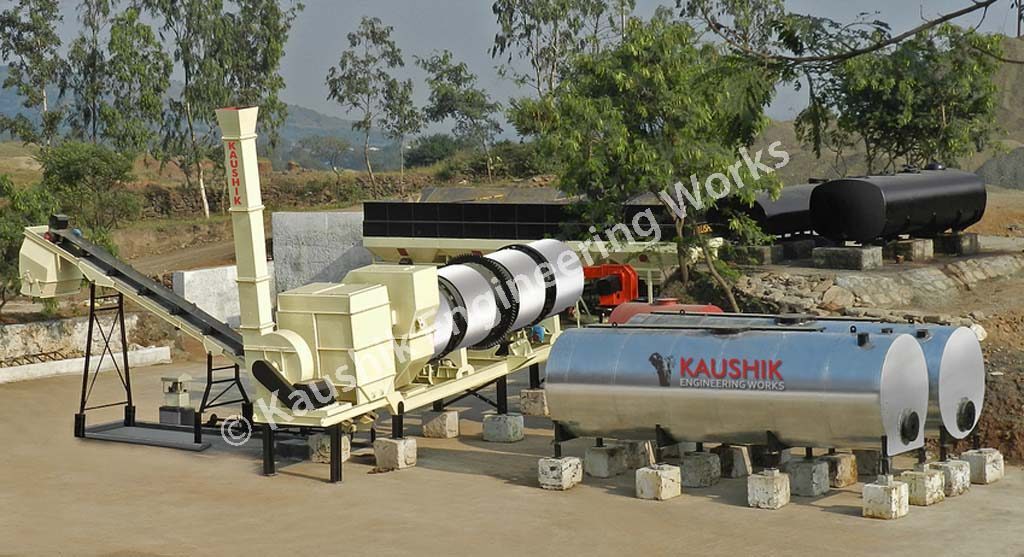
Kaushik Engineering Works (KEW) is a MORTH-compliant asphalt drum mix plant manufacturer based in Sanand, Ahmedabad, Gujarat — with over 15 years of manufacturing experience and 1,238+ plant installations across 35+ countries. As a leading asphalt mixing plant manufacturer in India, our KEW Series stationary drum mix plants are engineered for continuous hot mix asphalt production at 40 to 150 TPH, combining superior fuel efficiency, trouble-free operation, and advanced automation in a plant designed for the demanding conditions of Indian highway construction.
The KEW drum mix plant range — from the KEW-45 (40–60 TPH) to the KEW-65 (120–150 TPH) — is used by highway contractors across India for NHAI four-lane and six-lane projects, state PWD highway contracts, and airport runway construction. The same plant design powers our successful exports to Nigeria, Kenya, Saudi Arabia, UAE, Bangladesh, Nepal, and 29 additional countries — part of a strong export market for drum mix plants that KEW has built over 15 years.
Our design team customises each plant to meet your specific site demands — aggregate gradation, fuel availability, pollution control requirements, and haul road access — so every KEW plant that leaves our Sanand facility is configured for your project, not just from a standard catalogue.
Why Contractors Choose KEW Asphalt Drum Mix Plants
|
Proprietary Thermodrum Technology KEW’s exclusive triple heat transfer system — conductive, convective, and radiation — transfers heat more efficiently than standard single-mode drum designs. Result: lower fuel consumption per tonne, more uniform aggregate temperature, and better mix quality at the same production rate. |
MORTH Compliant — NHAI Ready All KEW drum mix plants are designed and built to comply with the latest MORTH specifications for hot mix asphalt production — making them eligible for NHAI-approved highway contracts, state PWD tenders, and PMGSY rural road projects across India without additional approvals. |
1,238+ Installations, 35+ Countries From NHAI highway projects in Gujarat and Maharashtra to government road programs in Nigeria, Gambia, Poland, and the UAE — KEW drum mix plants have a verified global track record that no new entrant can match. Our after-sales and spare parts network supports customers long after commissioning. |
What Is Asphalt and How Is It Used in Road Construction?
Asphalt is a bituminous mixture of aggregates (crushed stone, sand, gravel), bitumen binder, and mineral filler. It is the primary paving material for road construction in India and globally — used for national highways, state roads, urban roads, airport runways, taxiways, parking lots, and bridge decks.
In road construction, asphalt is produced at a dedicated plant — the asphalt drum mix plant — where aggregates are dried, heated, and blended with bitumen at a controlled temperature to produce hot mix asphalt (HMA). (See how an asphalt drum mix plant operates for the full working process.) The HMA is then transported to the paving site and laid by a paver finisher before being compacted by rollers. The quality of the asphalt mix — its gradation, binder content, and mixing temperature — directly determines the road’s durability and service life.
Asphalt pavement dominates Indian highway construction because it is fast to construct and open to traffic immediately after cooling — unlike concrete, which requires extended curing time. This makes asphalt the preferred choice for NHAI expressways, state PWD roads, and urban infrastructure projects where minimising traffic disruption is a project priority.
KEW Asphalt Drum Mix Plant — Standard Configuration
Our asphalt production equipment is built with precision engineering to ensure low maintenance and high uptime. Each KEW drum mix plant is assembled at our Sanand GIDC facility using quality-controlled components, tested before dispatch, and commissioned on site by our technical team. Below is the full standard configuration and component breakdown:
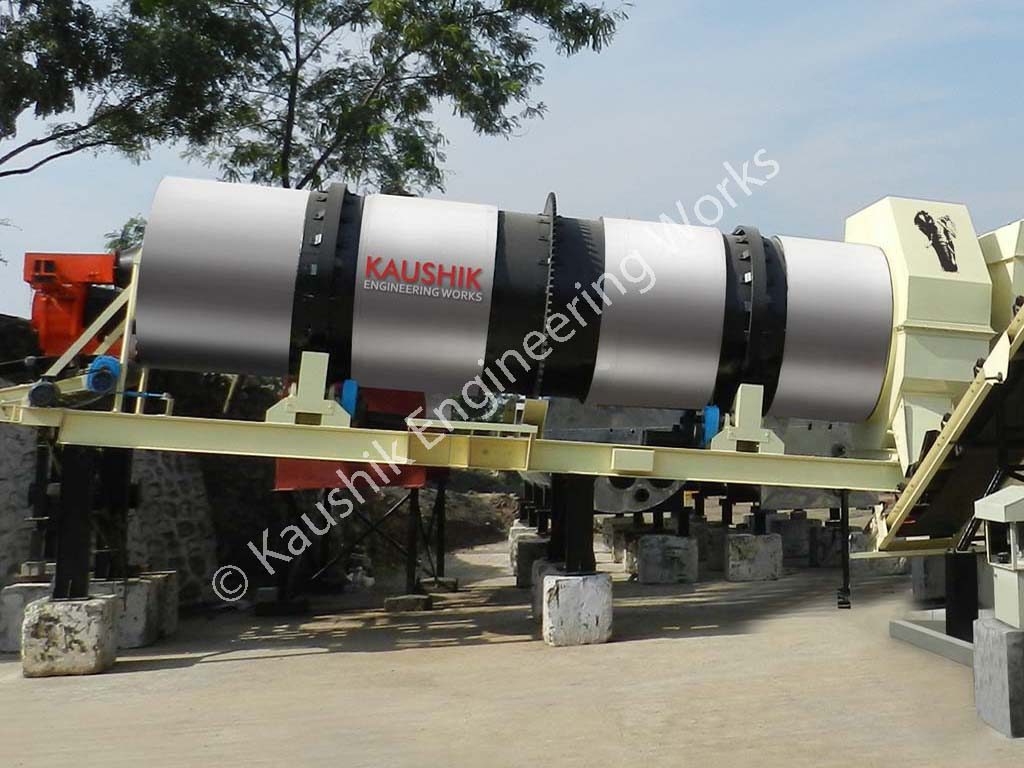
Drying & Mixing Unit — KEW Thermodrum
The drying and mixing unit is the most technically demanding component of any drum mix plant — it requires precisely engineered flight design, heat transfer technology, and drum geometry working together. KEW’s proprietary Thermodrum system uses a triple heat transfer mechanism — conductive, convective, and radiation — that transfers heat to aggregates more completely than conventional single-mode designs. The field-proven flight design ensures total heat transfer to all aggregate particles, thorough mixing and bitumen coating, lower exhaust emissions, and prevention of bitumen oxidation — the thermal degradation that weakens asphalt binder at excessive temperatures.
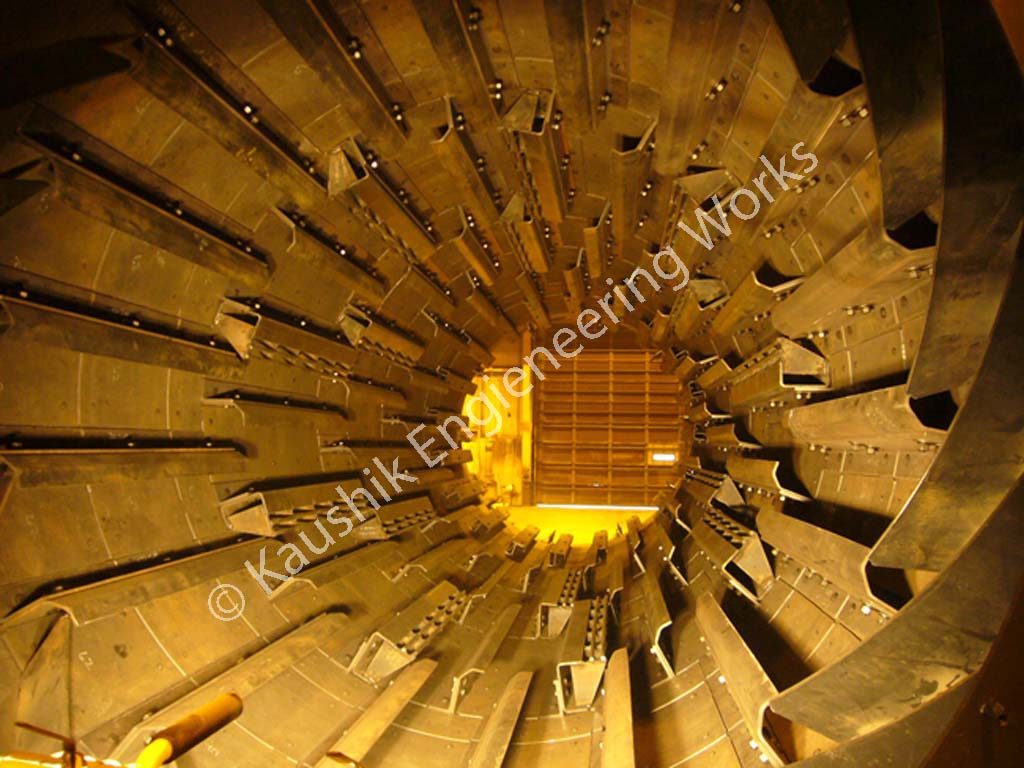
Drum Mechanics
KEW-45, KEW-50, and KEW-60 models (30–120 TPH) are supplied with a low-maintenance cradle-type drum drive with an auto-lubrication system that ensures continuous and adequate lubrication of the chain drive — extending machine life and eliminating manual greasing requirements. The KEW-65 (120 TPH and above) comes standard with a four-wheel friction drive, also available as an option on smaller models. All drum drive components — sprockets, thrust wheels, trunion rings, and trunion rollers — are specially treated and precision-engineered for flawless, long-life drum rotation under continuous production conditions.
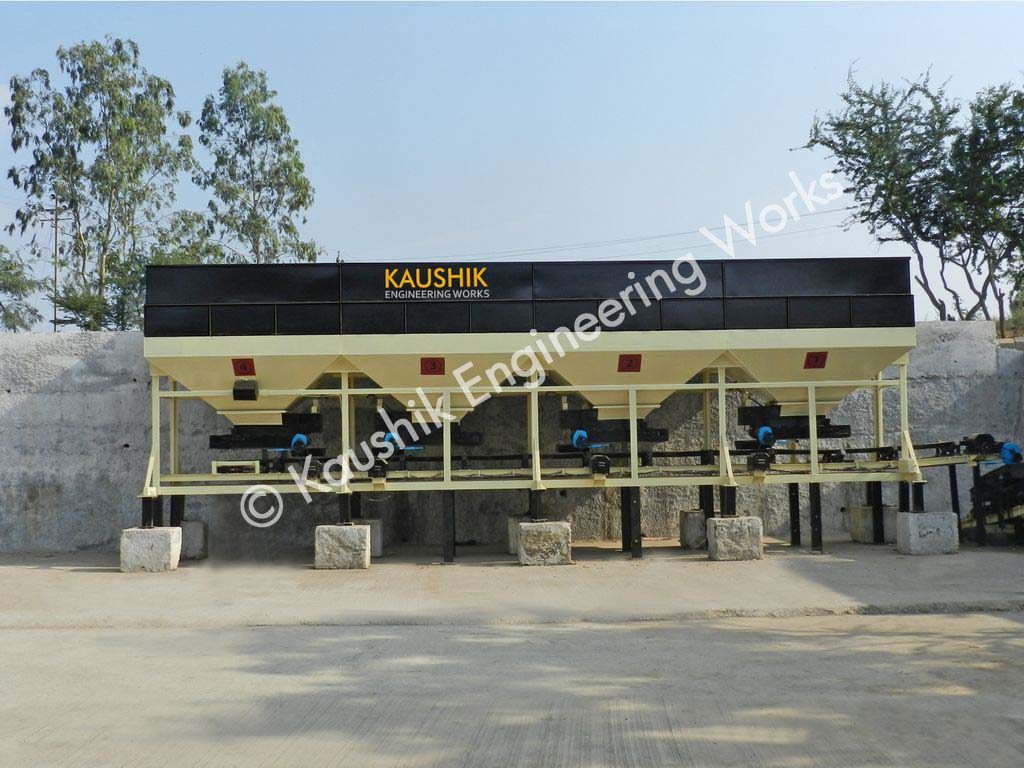
Cold Aggregate Four Bin Feeder
The aggregate feeder bins are all-welded and modular in construction — additional bins can be added to accommodate more aggregate fractions as project gradation requirements change, without structural modification to the plant. Steep bin walls and valley angles ensure free flow of aggregates from feeders, minimising material hold-up in corners and eliminating bridging with sticky or moist aggregates. Adjustable calibrated gate openings and variable speed feeder drives together provide total proportional control of each aggregate fraction — giving operators greater flexibility, accuracy, and the ability to switch between mix designs without extended downtime.
Bitumen Heating & Storage Tank
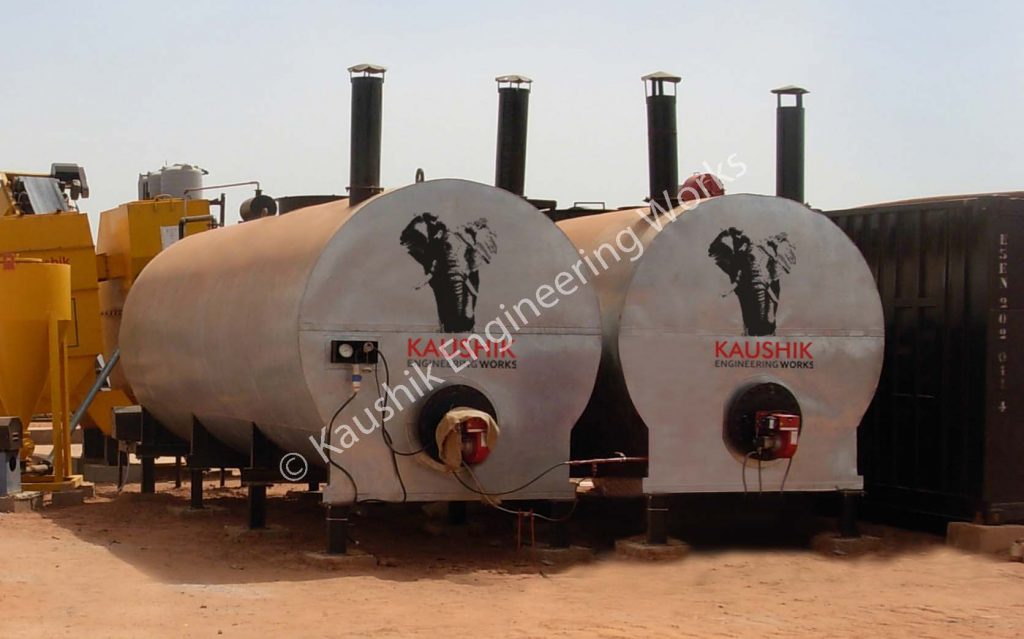
KEW offers two bitumen storage and heating configurations: direct heating tanks supplied with automatic imported pressure jet burners, and hot oil-heated tanks supplied with Japanese-design thermic oil heaters. Storage capacities range from 10 tonnes to 50 tonnes. All KEW bitumen tanks — regardless of heating type — are supplied with auto thermostatic controls, hot oil circulating systems, jacketed bitumen pumps, and full tank insulation to minimise heat loss. The variable-speed computerised bitumen metering pump is electronically synchronised with the aggregate feed rate, maintaining the target binder percentage automatically as production rate changes.
High-Efficiency Burner Unit
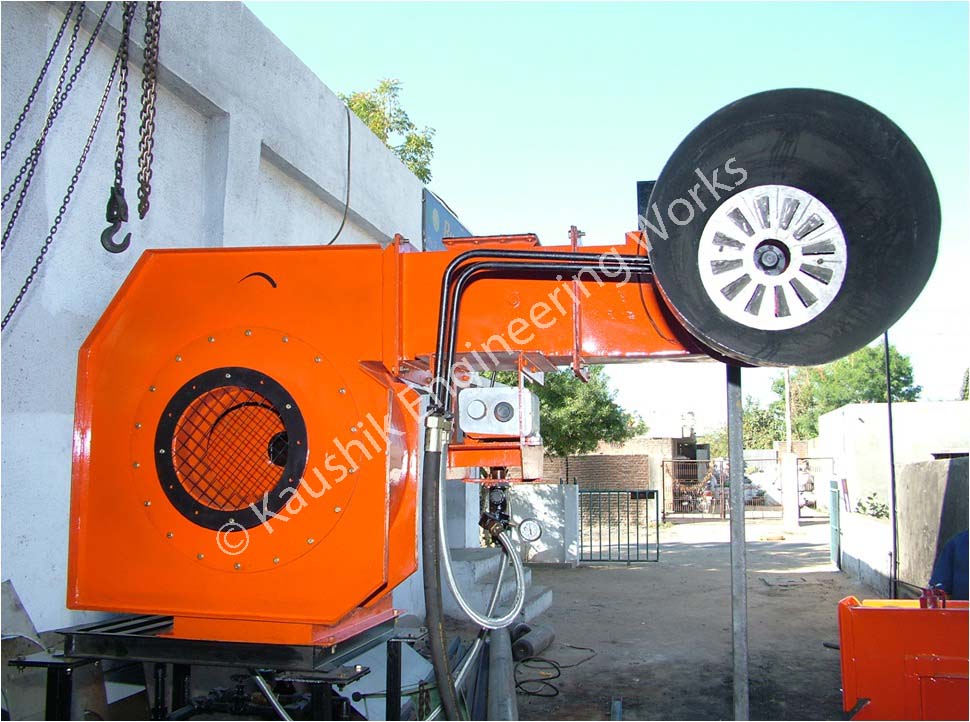
The KEW high pressure atomised, fully automatic, remotely controlled burner unit is established on Indian highway projects for its fuel efficiency, ease of operation, and high uptime. Completely automatic process controls with system interlocks meet high safety standards. The burner operates on LDO, Diesel, or Furnace Oil — compatible with fuel types available across Indian project sites — and is fitted with a remote control system for flame failure detection and electric spark ignition. KEW’s unique nozzle design allows cleaning during plant operation, eliminating nozzle-related downtime without stopping the drum.
LDO / Fuel Tank
Fuel storage tanks are available in capacities ranging from 300 litres to 10,000 litres — sized to the plant’s production rate and the fuel delivery frequency at your project site. Larger fuel tanks reduce refilling frequency on remote sites where fuel logistics are a constraint on production continuity.
Mineral Filler Storage & Feeding Unit
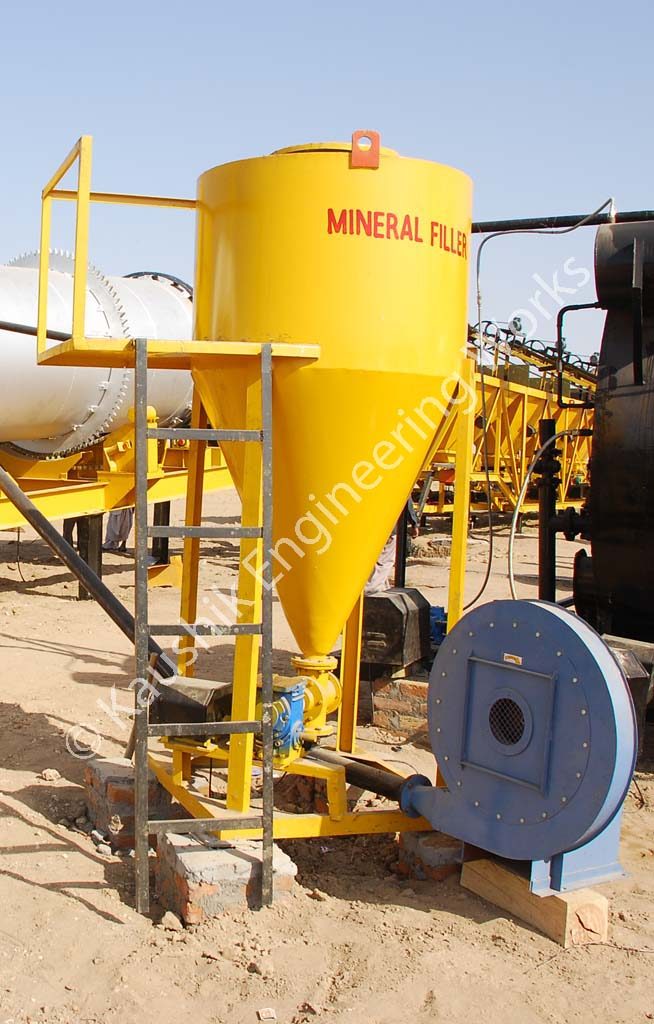
KEW offers mineral filler storage and feeding solutions from 1.5 tonnes to 50 tonnes silo capacity. A variable-speed computerised synchronised metering system delivers filler to the drum’s mixing zone in precise proportion to the aggregate feed — maintaining the target filler content automatically without manual adjustment. The filler feed rate is electronically linked to the cold aggregate feed and bitumen pump, so all three inputs adjust together when production rate changes.
Oversize Removal Vibratory Screen
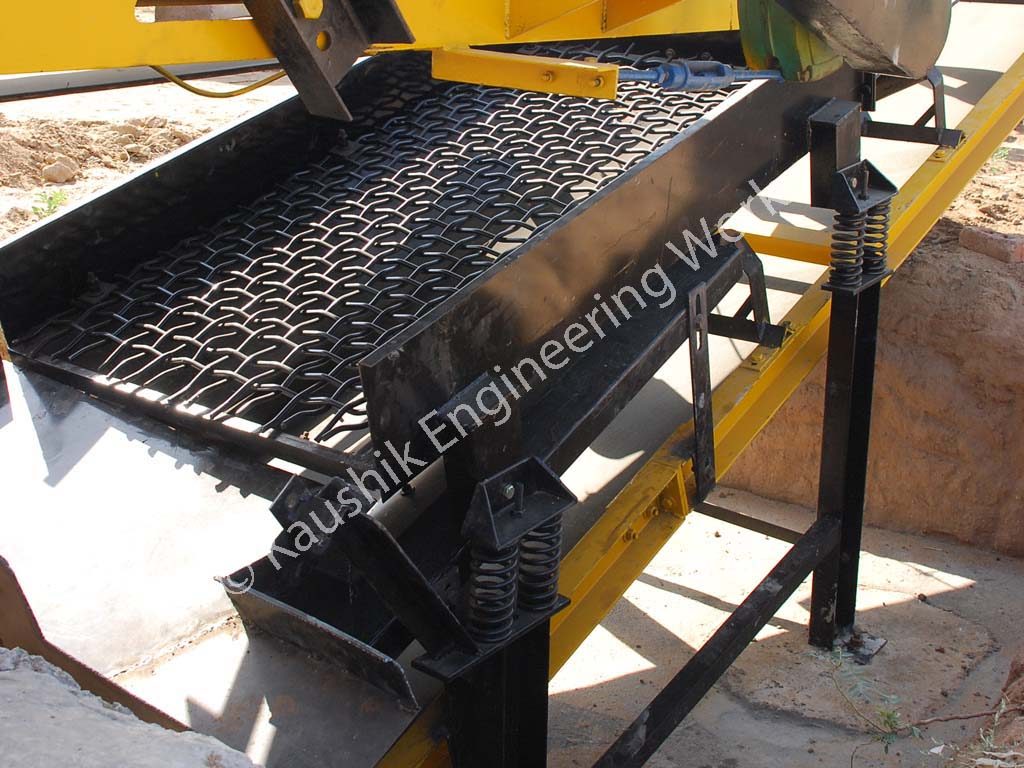
Positioned at the end of the cold aggregate feeder conveyor, the oversize removal vibratory screen intercepts any aggregate particles too large for the approved mix design before they enter the drum. Oversize material in the drum damages the Thermodrum internals, creates gradation spikes in the finished mix, and risks production stoppages. The vibratory screen is a standard — not optional — component on all KEW drum mix plants, providing a critical quality and equipment protection function that many budget manufacturers skip.
Load-Out Conveyor & Slinger Conveyor
The load-out conveyor transfers finished hot mix asphalt from the drum discharge point to the slinger conveyor, which distributes the mix evenly across the truck body below. The slinger conveyor is designed to swing across the full truck width — preventing one-sided loading that causes material segregation and creates density variation in the finished road surface. Both conveyors are designed for durability under continuous hot material handling conditions.
Gob Hopper
The gob hopper provides controlled, measured discharge of hot mix asphalt into the truck body — preventing material segregation and ensuring consistent flow from the slinger conveyor to the truck. Its design eliminates the uneven dump that occurs with direct drum discharge, which can cause coarse and fine aggregate particles to separate during loading and produce an inhomogeneous mix delivery to the paving site.
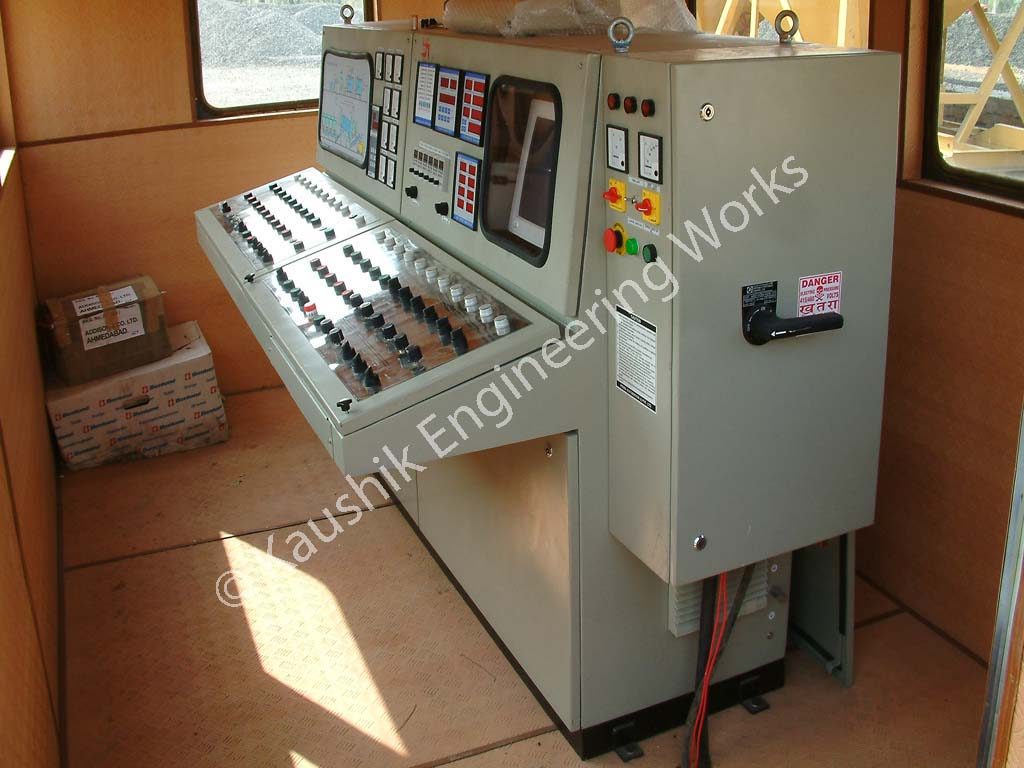
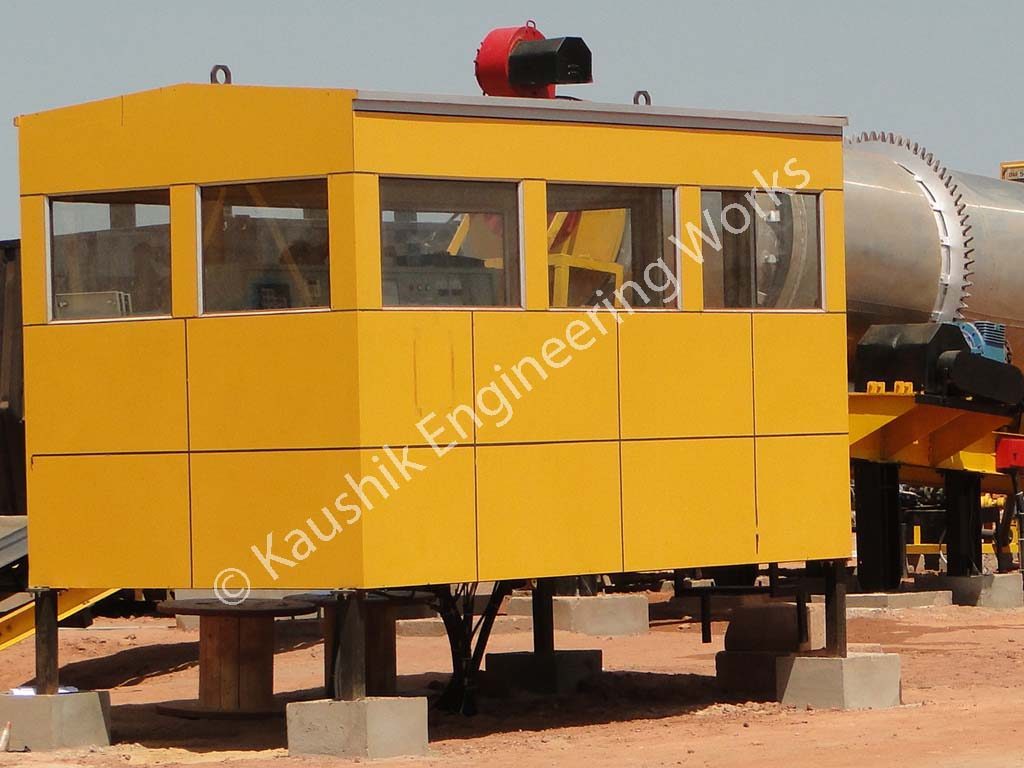
Computerised Control Panel & Fully Furnished Cabin
A fully computerised control cabin with an onboard electrical power control console, distribution switchboard, and fully automatic process and sequence controls are standard on all KEW series plants. The user-friendly software interface requires no specialised programming skills — function keys and numeric keys give operators complete control with minimal training.
- Fail-proof interlocks and automatic process controls
- Online fault detection and process alarm display
- Online printing facility for production records
- Print, store, and edit production details, mix proportions, and shift reports
- Real-time display of all process control parameters
- Automatic, semi-automatic, and manual operation modes
Optional Attachments
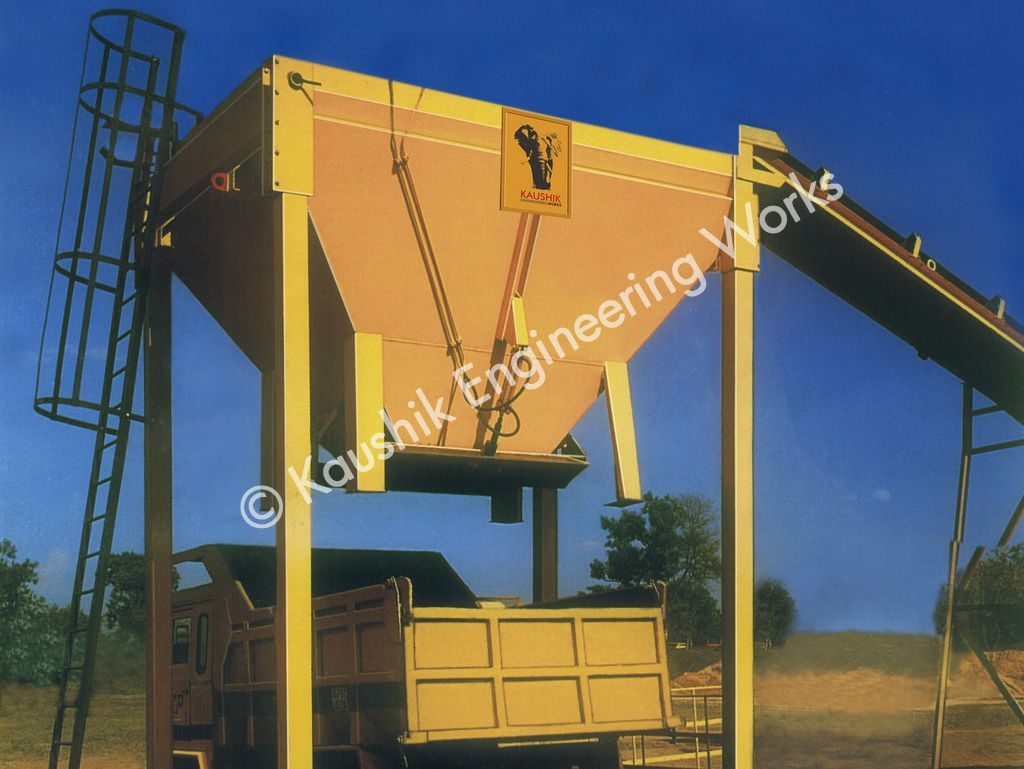
Hot Mix Storage Silo
An insulated hot mix storage silo allows the drum mix plant to continue production during brief truck shortfalls or paving delays — holding finished asphalt at temperature for 1 to 4 hours without significant quality loss. This buffer decouples plant production from truck cycle time, improving average plant utilisation and reducing the stop-start disruptions that cause mat joints at the paving site. Available in various capacities to match the plant’s output rate and site logistics requirements.
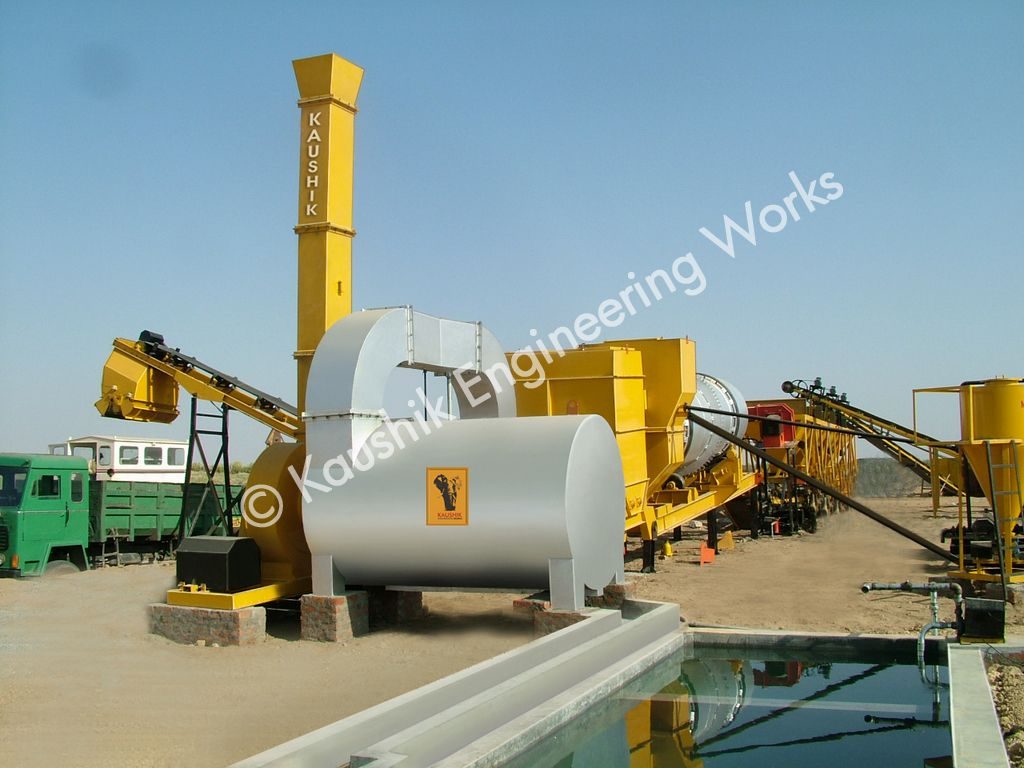
Wet Dust Collector — CV Series
The KEW CV Series high-efficiency wet dust collector uses a venturi-type design for excellent entrapment of dust-laden exhaust gas. Stainless steel spray nozzles provide clog-free, low-water-use operation meeting CPCB particulate norms. An adjustable venturi throat allows fine-tuning of cleaning efficiency for specific plant operating conditions and dust loading levels. Suitable for sites in specific environmental zones and as an additional secondary pollution control unit where required.
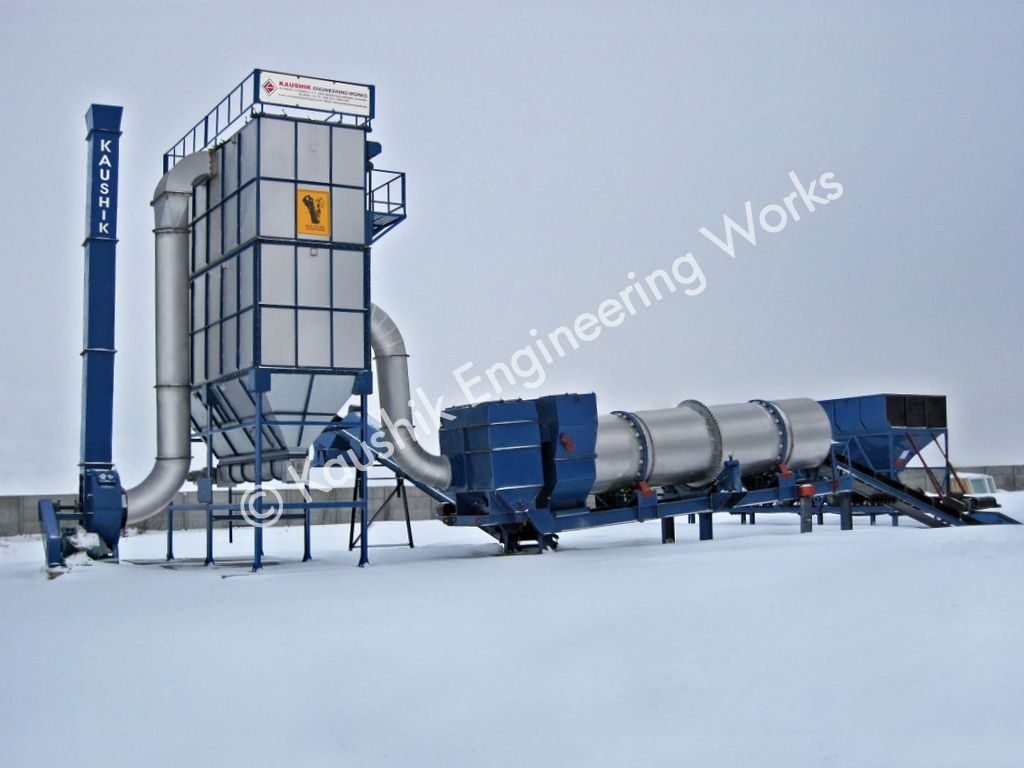
Bag House Filter Unit
KEW’s precision-engineered free-air-flow bag house filter unit is specifically engineered for asphalt applications, using specially treated meta-aramid filter elements that withstand the high-temperature, abrasive conditions of asphalt plant exhaust. This zero-maintenance design keeps particulate emissions below 50 mg/Nm³ — meeting CPCB (Central Pollution Control Board) emission standards and the environmental requirements specified on NHAI highway contracts. Learn more about emission control systems in asphalt drum mix plants and how to choose the right one for your site. Low operating cost and long service life make this the preferred secondary pollution control choice for KEW drum mix plants operating in India’s most regulated zones.
Global Installations — KEW Drum Mix Plants in Action
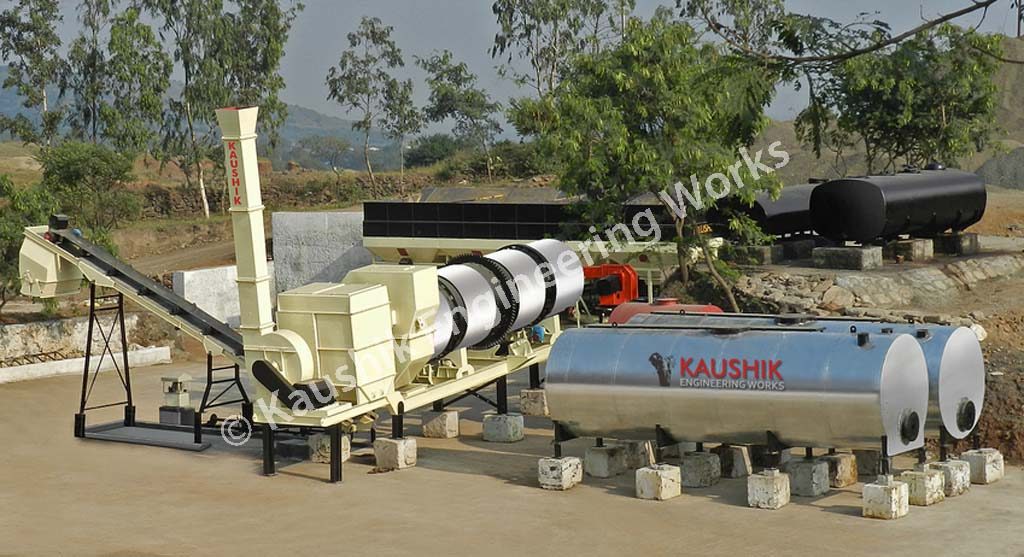 KEW-60 (90–120 TPH) Nasik, Maharashtra, India |
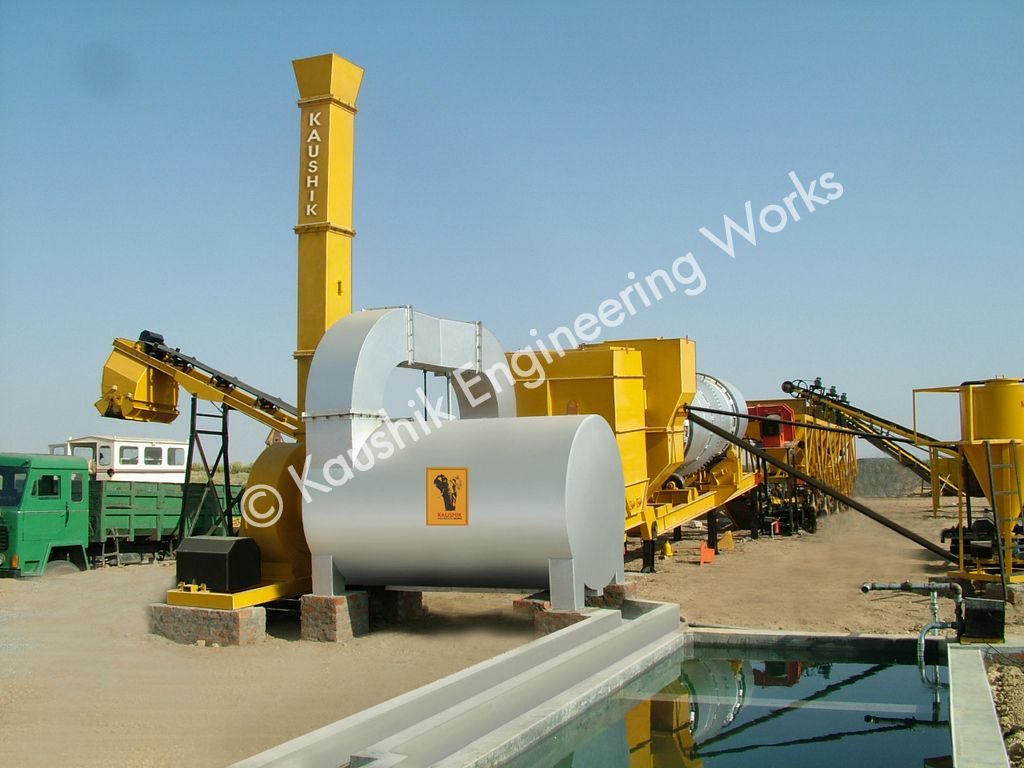 KEW-60 (90–120 TPH) Gujarat, India |
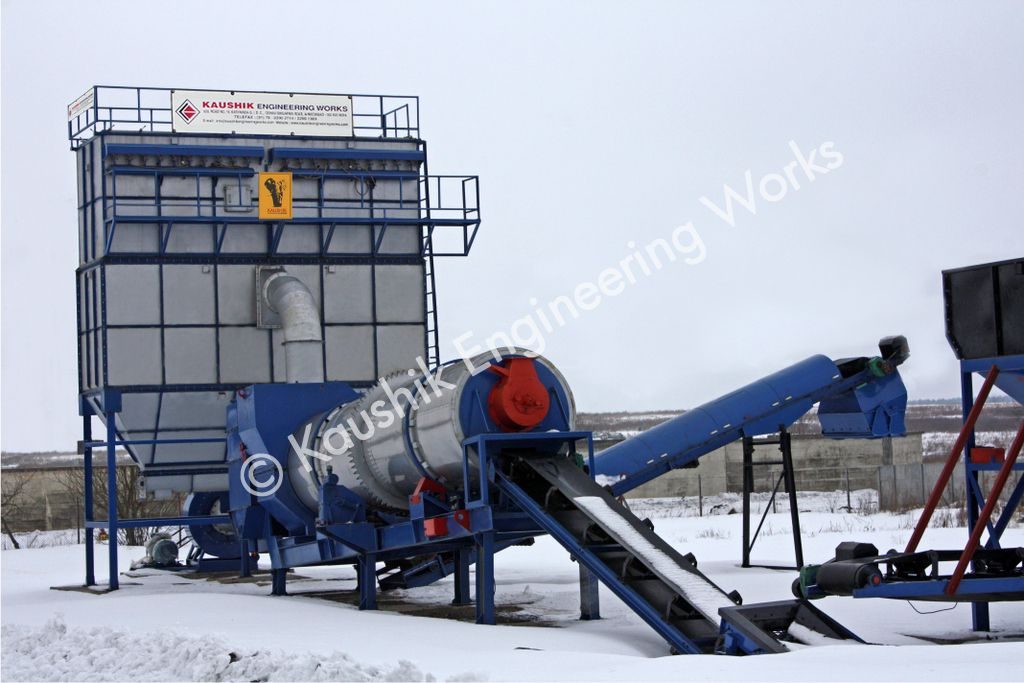 KEW-50 (60–90 TPH) + Bag House Poland, Europe |
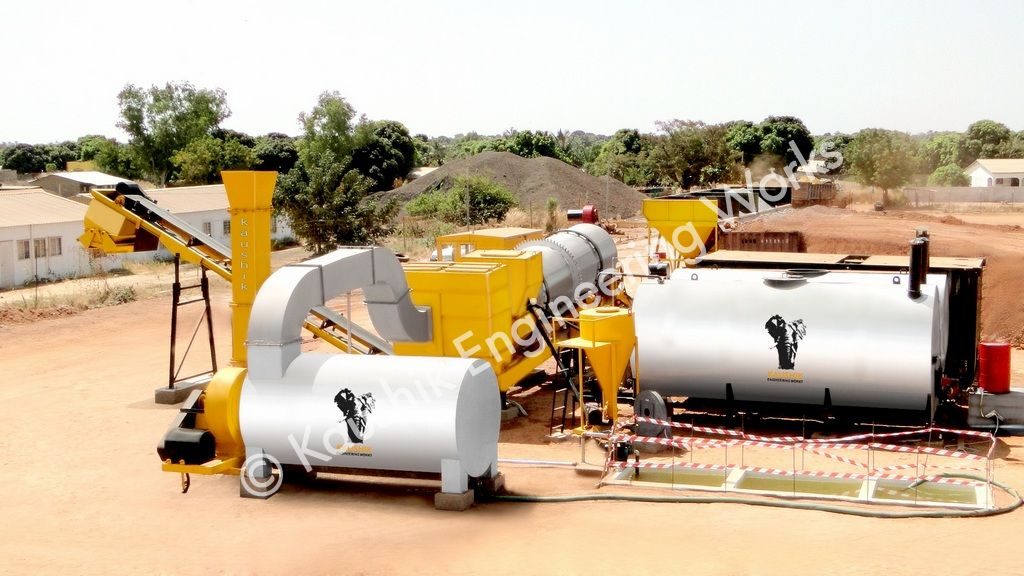 KEW-50 (60–90 TPH) Gambia, Africa |
KEW Asphalt Drum Mix Plant vs Other Manufacturers
| Factor | KEW Drum Mix Plant | Typical Competitor |
|---|---|---|
| Heat transfer technology | Proprietary Thermodrum — triple mode (conductive + convective + radiation) | Standard single or dual mode convective heating |
| Oversize aggregate screen | Standard on all models — protects drum internals and mix quality | Often optional or absent on budget models |
| MORTH compliance | Fully compliant — all models designed to MORTH specification | Varies by manufacturer and model |
| Pollution control | Dry dust collector standard; wet collector and bag house filter available — emissions <50 mg/Nm³ | Primary collector only standard on most budget models |
| Track record | 1,238+ installations — India, Europe, Africa, Middle East, South Asia | Limited or unverified international installation record |
| After-sales support | Spare parts from Sanand facility + service team across India and internationally | Variable — spare parts availability often a risk |
| Customisation | Design team customises to project site requirements — fuel, aggregate, terrain, pollution zone | Catalogue specification only on most models |
Frequently Asked Questions — Asphalt Drum Mix Plant
What capacities are KEW asphalt drum mix plants available in?
KEW stationary asphalt drum mix plants are available in four standard models: KEW-45 (40–60 TPH), KEW-50 (60–90 TPH), KEW-60 (90–120 TPH), and KEW-65 (120–150 TPH). Higher capacity plants beyond 150 TPH are available on specific enquiry — contact our team with your project’s daily tonnage requirement and we will recommend the appropriate model or custom configuration.
Are KEW asphalt drum mix plants MORTH and NHAI compliant?
Yes. All KEW asphalt drum mix plants are designed and manufactured to comply with the latest MORTH specifications for hot mix asphalt production. As a MORTH-compliant asphalt drum mix plant manufacturer in India, our plants are eligible for NHAI national highway contracts, state PWD highway projects, and PMGSY rural road contracts without additional equipment approvals.
What is the KEW Thermodrum system and how does it reduce fuel consumption?
KEW Thermodrum is a proprietary heat transfer system built into KEW drum mix plants’ drying and mixing drum. Unlike standard drum designs that rely primarily on convective heat transfer, the Thermodrum uses three simultaneous heat transfer mechanisms — conductive (direct contact between drum wall and aggregate), convective (hot gas flow through cascading aggregate), and radiation (radiant heat from drum internals). This triple-mode approach transfers more heat to aggregates from the same fuel input — reducing fuel consumption per tonne of asphalt produced while maintaining consistent aggregate temperature throughout the drum cross-section.
What fuels can a KEW drum mix plant use?
KEW drum mix plant burners are designed to operate on LDO (Light Diesel Oil), HSD (High Speed Diesel), and Furnace Oil — covering the full range of fuels available across Indian project sites. The burner system includes remote control flame failure detection and electric spark ignition. Fuel tank capacities from 300 litres to 10,000 litres are available to suit different project site fuel delivery frequencies.
Do you provide after-sales service and spare parts?
Yes. Kaushik Engineering Works maintains a spare parts inventory at our Sanand, Ahmedabad facility and provides after-sales service support across India and internationally. Our technical team provides on-site commissioning for every KEW plant supplied, plus ongoing consultation support for any operational or maintenance questions. We aim to maintain a long-term relationship with every customer — not just complete the sale. Spare parts for all KEW drum mix plant models are stocked in India, avoiding the 6 to 8 week lead times associated with imported equipment from overseas manufacturers.
Can a KEW drum mix plant be customised for specific site requirements?
Yes. Our design team reviews each customer’s specific project requirements — aggregate gradation, site terrain, available fuel type, pollution control zone requirements, haul road access, and daily production targets — and configures the plant accordingly. This includes selecting the right pollution control package (wet collector vs bag house filter), bitumen tank heating type (direct vs hot oil), fuel tank capacity, and optional attachments like storage silos. Every KEW plant is configured for your project before it leaves our Sanand facility.
Get a Quote for KEW Asphalt Drum Mix Plant
Whether you need an asphalt drum mix plant for a state highway contract, an NHAI expressway project, or an international road program, our team is ready to help you select, configure, and commission the right plant for your requirements. As an experienced asphalt plant manufacturer and drum mix plant manufacturer in Gujarat with 15+ years of manufacturing, 1,238+ global installations, and a full range from 40 to 150+ TPH, Kaushik Engineering Works has the depth and the track record to back every plant we supply.
Download our product catalogue for full technical specifications and configuration options, or contact our team directly for a project-specific quote.
| Phone: +91 98251 64764 | +91 2717 415587 |
| Email: info@kaushikengineeringworks.com |
| Address: PE-107, Sanand II Industrial Estate, Bol GIDC, Sanand, Ahmedabad – 382110, Gujarat, India |
| Hours: Mon–Sat: 8:00 AM – 7:00 PM |

