
Road construction equipment includes all the machines used to build, repair, maintain, and finish roads — from initial earthwork and base preparation to asphalt laying, compaction, and road marking. The most commonly used types are motor graders, road rollers, asphalt mixing plants, wet mix macadam plants, bitumen pressure distributors, paver finishers, road sweepers, and road marking machines.
At Kaushik Engineering Works, we have been manufacturing and supplying road construction machinery from our Sanand, Ahmedabad facility for over 15 years. In that time, we have supplied equipment for 1,238+ installations across 35+ countries — from NHAI highway projects in India to government road programs in Nigeria, Saudi Arabia, and the UAE. This guide is written from that hands-on manufacturing and field experience.
Last Updated: July 2026 | Originally published July 2018 | Updated to reflect 2026 machine technology, NHAI/MORTH compliance requirements, and current site conditions across Indian highway projects.
What Is Road Construction Equipment?
Road construction equipment is the collective term for all machinery involved in building a road from scratch or maintaining an existing one. A road project does not depend on just one machine — it needs a coordinated system of equipment working together across multiple stages: site clearing, base preparation, asphalt production, bitumen application, paving, compaction, and finishing.
The right selection of road construction machinery depends on the type of road (highway, rural, urban, airport), the daily production target, the terrain, and the project’s quality specifications. Poor equipment planning is one of the most common reasons road projects run over budget or fall behind schedule.
Complete Road Construction Equipment List
Here is a detailed breakdown of all major machines used in road construction, their function, and where they fit in the project sequence:
1. Motor Grader
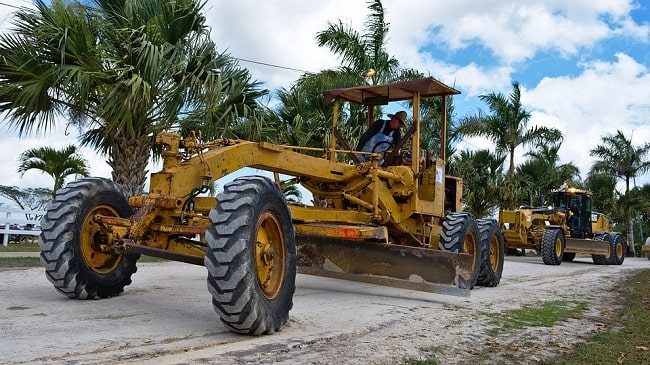
A motor grader — also called a road grader — is used in the early stages of road construction to level, flatten, and shape the ground surface. It handles both earthen and rocky terrain and is critical for achieving the correct road camber and drainage slope before any base material is laid.
Motor graders have three axles and a long, adjustable blade that can be angled and tilted for precise grading. For highway projects, they are used repeatedly — first for subgrade preparation, then again between each pavement layer to maintain level tolerances. GPS-equipped graders are increasingly common on NHAI projects for automated elevation control.
2. Road Roller Machine
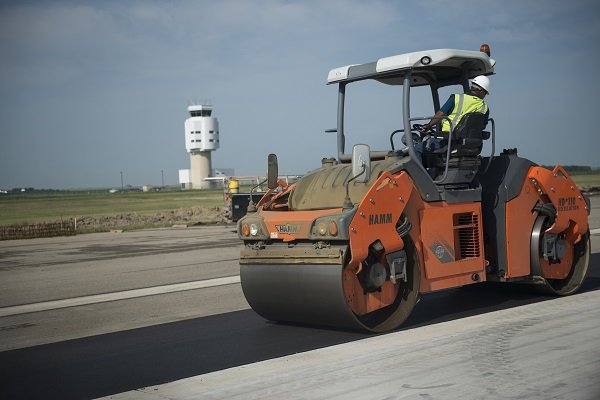
A road roller compacts whatever material has just been laid — whether subgrade soil, wet mix macadam base, or asphalt wearing course. Without proper compaction, the road surface develops ruts, cracks, and potholes under traffic load far earlier than its design life.
Common types of road rollers used in India include:
- Vibratory rollers — for compacting granular subgrade and base layers
- Tandem rollers (smooth drum) — for asphalt compaction immediately after paving
- Pneumatic tyre rollers — for intermediate compaction of asphalt, providing a kneading action that improves density
- Static rollers — for finish rolling on asphalt surface courses
The type and number of rollers needed depends on the paver speed, the asphalt layer thickness, and the required compaction density. On highway work, Intelligent Compaction (IC) systems are now specified on some projects to monitor real-time density during rolling.
3. Asphalt Mixing Plant
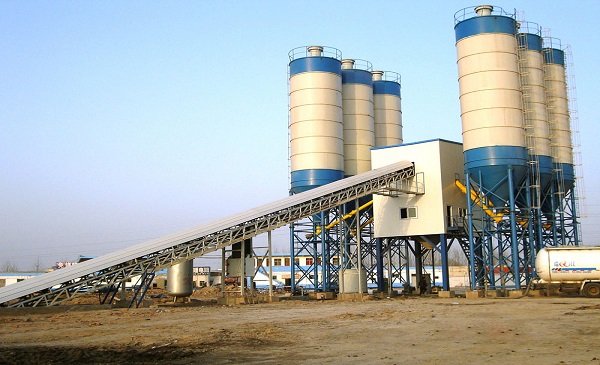
The asphalt mixing plant — also called a hot mix asphalt plant — is the core production machine for any road project that uses bituminous pavement. It heats aggregates to the required temperature, combines them with bitumen and filler in the correct proportions defined by the job mix formula, and produces a hot mix asphalt that is then transported to the paving site.
Two main types are used in Indian highway construction:
- Asphalt drum mix plant — continuous production, suitable for large-scale highway projects with consistent single mix designs. Capacities from 40 to 200 TPH.
- Asphalt batch mix plant — batch-wise production with precise control over each batch’s composition. Preferred for projects requiring multiple mix designs or higher quality consistency.
KEW manufactures both types at our Sanand facility. Our drum mix plants feature the proprietary KEW Thermodrum system — a triple heat transfer technology (conductive, convective, and radiation) that delivers better fuel efficiency and consistent mix temperature compared to standard drum designs.
For a detailed comparison of which plant suits which project type, see our guide on asphalt drum mix vs batch mix plant selection.
4. Wet Mix Macadam Plant
A wet mix macadam (WMM) plant produces the granular base layer material that sits between the subgrade and the asphalt layers on MORTH-compliant highway projects. It blends coarse aggregates, fine aggregates, and water in controlled proportions to produce a well-graded, uniform base material.
WMM is a MORTH-specified requirement on most national and state highway projects in India. A poorly produced WMM layer — from an uncalibrated or low-quality plant — leads to base failures that are expensive to repair once the asphalt surface is in place. This makes the WMM plant a critical machine in the road construction sequence, not just a supporting one.
5. Bitumen Pressure Distributor
A bitumen pressure distributor applies bitumen uniformly across the prepared road surface before the asphalt wearing course is laid. This bitumen application — called prime coat (on granular base) or tack coat (between asphalt layers) — creates the adhesive bond between pavement layers.
Uneven bitumen application from a poorly calibrated distributor causes weak bonding between layers, which results in delamination, cracking, and slippage of the asphalt surface under traffic. A reliable bitumen sprayer must maintain consistent spray pressure, clean nozzle operation, and accurate discharge rate across the full spray bar width.
6. Hydrostatic Paver Finisher
A hydrostatic paver finisher (also called an asphalt paver) receives hot mix asphalt from trucks and lays it in a continuous mat at a controlled width, depth, and cross-slope. The quality of the paved mat — its evenness, texture, and thickness consistency — is directly determined by the paver’s performance and the operator’s skill.
Paving works best when material flow is continuous. If trucks arrive late and the paver stops, joints form in the mat that are weak points for water ingress and cracking. On highway projects, paver stops should be minimised through careful tipper scheduling and plant-to-site coordination.
7. Hydraulic Road Sweeper
A hydraulic road sweeper cleans the pavement surface before bitumen application, overlay work, or road marking. Dust, loose aggregate, and debris on the surface significantly reduce the adhesion of bitumen and asphalt layers applied over it.
On highway projects, sweepers are used at multiple stages: before tack coat application, before overlay work, before road marking, and for maintaining clean work zones during construction. A clean surface is not a cosmetic requirement — it directly affects bonding quality and the durability of the finished road.
8. Road Marking Machine
A road marking machine applies thermoplastic or paint markings on the finished road surface — centre lines, edge lines, lane dividers, zebra crossings, arrows, and other road safety markings required before the road opens to traffic.
Road marking is a safety-critical activity. Poor or faded markings reduce driver visibility, especially at night and in rain. On NHAI projects, road marking specifications are defined in IRC standards and must be completed before final inspection and handover.
9. Mobile Concrete Batching Plant
A mobile concrete batching plant is used on road projects that include concrete elements — concrete pavement (CC roads), bridge deck pours, culverts, drains, and median structures. The mobile version allows concrete production at the project site, reducing transport time and concrete quality degradation during haul.
10. Mobile Drum Mix Plant
A mobile drum mix plant is a portable asphalt mixing plant mounted on a chassis for easy relocation between project sites. It is the preferred choice for contractors working on multiple smaller projects or sites in remote locations where a stationary plant cannot be economically justified. Setup time is fast — typically one to two days — and output ranges from 40 to 100 TPH depending on the model.
11. Bitumen Decanter
A bitumen decanter heats and liquefies packed bitumen (typically supplied in drums or blocks) so it can be transferred to the asphalt plant’s bitumen storage tank or directly to a bitumen pressure distributor. It is an essential support machine at any asphalt plant setup that receives bitumen in solid or semi-solid form, which is common on sites far from bitumen refineries.
12. Line Striping Machine
A line striping machine is a compact, walk-behind or ride-on road marking equipment for applying paint or cold plastic markings on roads, parking areas, warehouses, and construction zones. It is used for applications where a full thermoplastic road marking machine is not required — smaller road sections, temporary markings, or industrial paving projects.
13. Forklift Truck
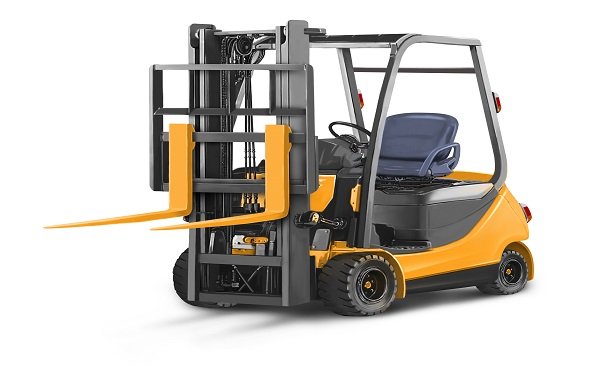
A forklift truck (also called a lift truck or fork truck) handles material movement and loading operations on construction sites. On road projects, forklifts are used to unload and position heavy material, move equipment components during plant assembly, and handle materials within the asphalt plant yard or WMM plant stockpile area. They are particularly useful for loading operations in confined plant yards where larger machines cannot manoeuvre efficiently.
14. Crawler Excavator

A crawler excavator is a heavy earthmoving machine used for digging, trenching, and earth removal during the early stages of road construction. It handles cutting through rock, clay, and compacted soil, loading excavated material onto dump trucks for disposal. On highway projects, excavators are used for subgrade cutting, drainage trench excavation, culvert installation, and slope clearing. Changing the front attachment (bucket, breaker, or grapple) allows the same machine to handle multiple tasks across the project.
15. Truck Crane
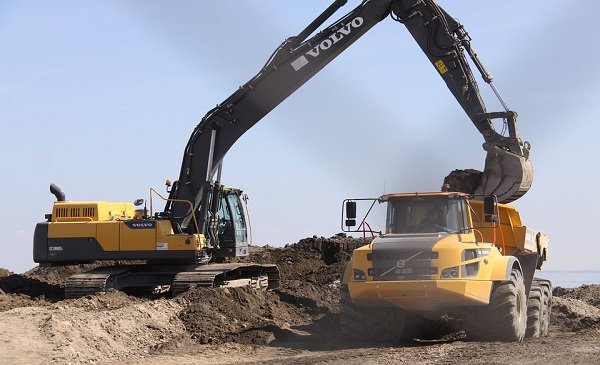
A truck crane is used for heavy lifting on road construction sites — installing bridge beams, placing precast culvert sections, erecting sign gantries, and mobilising heavy plant components. The truck-mounted design gives it mobility across the project site, while the crane boom provides the reach needed for large lifts. On highway projects involving bridges or overpasses, a truck crane is essential for placing precast elements that cannot be lifted by smaller equipment.
16. Wheel Loader
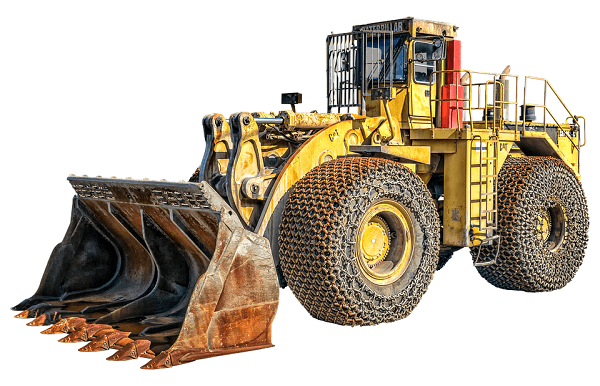
A wheel loader (also called a front loader or bucket loader) lifts and moves bulk materials — aggregate stockpiles, soil, sand, and crusher dust — within the construction site. At an asphalt plant or WMM plant, wheel loaders feed aggregate from stockpiles into the plant’s cold feed bins. On the road site, they load and spread material for sub-base layers. Wheel loaders are among the most widely used support machines on any road construction project because of their speed, payload capacity, and versatility.
Road Construction Equipment: Comparison Table
| Machine | Primary Use | Project Stage | MORTH/NHAI Applicable |
|---|---|---|---|
| Motor Grader | Levelling, shaping subgrade | Site preparation | Yes |
| Road Roller | Compacting soil, WMM, asphalt | All stages | Yes |
| Asphalt Drum Mix Plant | Continuous hot mix asphalt production | Asphalt production | Yes — MORTH spec |
| Asphalt Batch Mix Plant | Precision batch asphalt production | Asphalt production | Yes — MORTH spec |
| Wet Mix Macadam Plant | Granular base layer production | Base preparation | Yes — MORTH mandatory |
| Bitumen Pressure Distributor | Prime coat and tack coat application | Pre-paving bonding | Yes |
| Paver Finisher | Asphalt mat laying | Paving | Yes |
| Hydraulic Road Sweeper | Surface cleaning pre-paving/marking | Pre-paving, finishing | Recommended |
| Road Marking Machine | Lane marking, road safety lines | Finishing | Yes — IRC standards |
| Mobile Concrete Batching Plant | Concrete for CC roads, bridges, drains | Structural elements | Yes |
Types of Roads and Their Equipment Needs
Not every road project needs the same equipment. The right machine selection depends on road classification, traffic load, terrain, and project specifications.
National Highways and NHAI Projects
National highway construction in India requires MORTH-compliant equipment with documented calibration records, certified plant capacity, and proper dust collection systems. Asphalt batch mix plants or high-capacity drum mix plants (above 120 TPH), MORTH-spec wet mix macadam plants, automated bitumen distributors, and sensor pavers are standard requirements.
State PWD and District Roads
State and district road projects typically use medium-capacity asphalt drum mix plants (40–120 TPH), WMM plants, and standard road rollers. Budget constraints often make drum mix plants — which offer lower capital cost than batch mix plants — the preferred choice for PWD contractors.
Rural Roads (PMGSY)
Pradhan Mantri Gram Sadak Yojana (PMGSY) projects often use compact, mobile equipment that can be relocated frequently between village road projects. Mobile drum mix plants, compact WMM plants, and smaller road rollers are common. The key constraint here is terrain access — equipment must be able to reach remote village road sites.
Urban Roads and City Projects
Urban road construction involves tighter site constraints: utility corridors, pedestrian traffic, limited working hours, and narrow access. Compact pavers, smaller drum mix or batch mix plants, and mini road sweepers are preferred. Night work is common, which adds temperature management requirements for asphalt production and laying.
Airport Runways
Airport runway paving requires the highest mix precision — typically asphalt batch mix plants with tight tolerance controls, combined with precision pavers and a larger roller fleet for achieving the required density in fewer passes. The tolerances for surface smoothness (IRI) and density on runways are significantly tighter than on road projects.
How to Choose the Right Road Construction Equipment
Equipment selection should start with the project’s daily output target, not the machine specifications. Here is the practical approach we recommend based on our experience supplying equipment for 1,238+ projects:
- Start with daily tonnage. How many tonnes of asphalt or WMM does the project need to lay per day? That figure drives the required plant capacity, tipper count, paver speed, and roller numbers.
- Calculate haul distance. If the plant is far from the paving site, mix temperature drops en route. Either move the plant closer, insulate trucks, or adjust plant discharge temperature accordingly.
- Match plant to paver speed. A 200 TPH plant is wasted if the paver can only absorb 80 TPH — you either run the plant part-time, or queue hot material. Neither is efficient.
- Check compliance requirements early. NHAI and PWD projects have specific equipment approval requirements. Confirm before purchasing — some projects require plant inspection and approval before mobilisation.
- Plan for spare parts. Downtime costs more than spare parts. Confirm availability of critical consumables (wear parts, sensors, burner nozzles) before committing to any plant supplier.
For a deeper stage-wise breakdown of equipment selection for highway projects, see our guide on road construction equipment planning for highway projects.
Technological Advancements in Road Construction Equipment
GPS and Automation
GPS-equipped motor graders and pavers now allow automated grade control, lane alignment, and cross-slope adjustment — reducing rework and improving surface regularity without relying entirely on operator skill. On large NHAI highway projects, machine control systems connected to design data allow real-time feedback during grading and paving.
Intelligent Compaction
Intelligent Compaction (IC) systems on rollers use onboard accelerometers and GPS to map compaction quality in real time. The roller knows which areas have reached target density and which need additional passes — reducing over-compaction (which can fracture aggregates) and under-compaction (which causes premature failure). IC is increasingly specified on airport runways and expressway projects.
Automated Plant Control
Modern asphalt mixing plants use PLC-based control systems that automatically adjust aggregate feed, burner output, and bitumen dosing to maintain the target mix temperature and binder content. This level of automation reduces material waste, improves batch-to-batch consistency, and generates production records that satisfy quality control documentation requirements on government projects.
Frequently Asked Questions — Road Construction Equipment
What is the most important road construction equipment?
The most important piece of road construction equipment depends on the project stage. For asphalt roads, the asphalt mixing plant — either drum mix or batch mix type — is the central production machine that determines mix quality and output capacity. Without a reliable asphalt plant, the paver, rollers, and distributor have no material to work with.
What is the difference between a drum mix plant and a batch mix plant?
A drum mix plant produces asphalt continuously in a rotating drum, making it suitable for high-volume highway projects with a consistent single mix design. A batch mix plant produces asphalt in measured batches, giving precise control over each batch’s composition — preferred when multiple mix designs are required or when project specifications demand tighter quality control.
What machines are used in road construction in India?
Road construction in India typically uses motor graders, road rollers (vibratory, tandem, and pneumatic), asphalt drum or batch mix plants, wet mix macadam plants, bitumen pressure distributors, paver finishers, hydraulic road sweepers, and road marking machines. For concrete roads, mobile concrete batching plants are also used.
What is a wet mix macadam plant used for?
A wet mix macadam plant produces the granular base layer material required below asphalt pavement on MORTH-compliant highway and state road projects. It mixes coarse and fine aggregates with a controlled amount of water to produce a uniform, well-graded base material that is compacted to form a stable foundation for asphalt layers.
How do I choose an asphalt mixing plant for my road project?
Choose based on your project’s daily tonnage requirement, the number of mix designs needed, site access, and budget. Drum mix plants are more cost-effective for single-mix, continuous highway production. Batch mix plants offer greater mix design flexibility and precision for quality-sensitive projects. Confirm MORTH/NHAI compliance and spare parts availability before committing to any supplier.
What is a bitumen pressure distributor?
A bitumen pressure distributor is a road construction machine that applies heated bitumen uniformly across a road surface before asphalt is laid. It is used to apply prime coat (on granular base layers) and tack coat (between existing and new asphalt layers) to create a proper adhesive bond between pavement layers.
Which road construction equipment manufacturers are in India?
India has several road construction equipment manufacturers. Kaushik Engineering Works, based in Sanand, Ahmedabad, Gujarat, manufactures asphalt drum mix plants, batch mix plants, wet mix macadam plants, mobile concrete batching plants, bitumen pressure distributors, road sweepers, paver finishers, and road marking machines — with 1,238+ installations across India and 35+ countries.
Get Road Construction Equipment From Kaushik Engineering Works
Whether you are setting up a new asphalt plant for a highway project, equipping a state PWD contract, or looking for a reliable WMM plant supplier in Gujarat, Kaushik Engineering Works has the manufacturing depth and field experience to help you choose the right equipment.
We manufacture and supply a complete range of road construction equipment from our Sanand, Ahmedabad facility — including asphalt drum mix plants, batch mix plants, wet mix macadam plants, mobile concrete batching plants, bitumen pressure distributors, and road marking machines.
Contact our team to discuss your project requirements, request a quote, or download our product catalogue.
📞 +91 98251 64764 | 📧 info@kaushikengineeringworks.com
PE-107, Sanand II Industrial Estate, Bol GIDC, Sanand, Ahmedabad – 382110, Gujarat, India
Mon–Sat: 8:00 AM – 7:00 PM

