
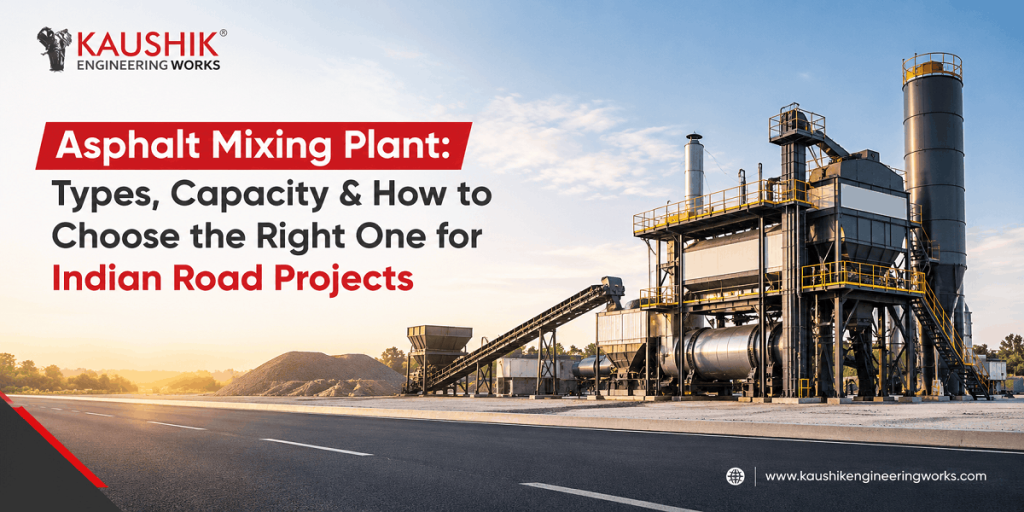
Road contractors across India face one decision that shapes every project they take on: which asphalt mixing plant to buy. Get it right and you meet timelines, pass NHAI quality inspections, and move efficiently from one contract to the next. Get it wrong and you have idle capacity you cannot recoup, or output you cannot deliver fast enough to avoid penalty clauses.
The market offers drum mix plants, batch mix plants, mobile units, and stationary setups — each built for a different operating reality. This guide covers what each type actually does, how to calculate the capacity your project needs, and which factors separate a well-matched plant from a costly mismatch, based specifically on Indian project conditions.
What Is an Asphalt Mixing Plant?
An asphalt mixing plant is a machinery system that dries and heats mineral aggregates, then blends them with bitumen binder at controlled temperatures to produce hot mix asphalt (HMA) for road construction. The plant governs aggregate grading, bitumen content, mix temperature, and output rate — all of which determine the structural quality of the finished road surface.
In India, every asphalt mixing plant used on national highway or state highway projects must produce mix that meets MoRTH (Ministry of Road Transport and Highways) specifications and IRC (Indian Roads Congress) standards for mix design, aggregate gradation, and bitumen content. Plant output temperatures typically range from 140°C to 180°C. Rated capacity in the Indian market runs from 30 TPH (tonnes per hour) for compact mobile units to 400 TPH for large stationary batch plants deployed on Bharatmala expressway corridors.
Drum Mix vs. Batch Mix: The Core Decision
Every asphalt mixing plant belongs to one of two fundamental process types. This distinction drives more of the selection decision than any other single factor.
How a Drum Mix Plant Works
A drum mix plant feeds aggregates continuously into a rotating drum where drying, heating, and bitumen mixing happen in one uninterrupted sequence. There is no pause between cycles — the plant runs continuously and delivers hot mix asphalt at a steady, high-volume rate.
Drum mix plants dominate large highway projects in India for good reason. They produce high throughput (typically 60–200 TPH for Indian-manufactured models), consume less fuel per tonne of mix because drying and mixing share the same drum, and have fewer mechanical stages to maintain. Kaushik Engineering Works manufactures asphalt drum mix plants from 60 TPH to 200 TPH, built specifically for the continuous, high-volume demands of national highway and state highway work.
The trade-off is mix design flexibility. Switching from one bitumen specification to another mid-project means clearing the drum and recalibrating feed rates — workable on long stretches with a single spec, but inefficient on projects that require frequent changes.
How a Batch Mix Plant Works
A batch mix plant processes aggregate in precisely weighed, individual batches. Cold aggregates are dried in a separate dryer drum, screened into heated holding bins by size, then weighed on a computerised weigh bridge and mixed with a measured bitumen quantity in a twin-shaft pugmill. The cycle repeats every 45 to 60 seconds.
The defining advantage is precision. Every ingredient is weighed independently before mixing, which means batch plants consistently hit tighter Marshall stability tolerances and bitumen extraction test values. This matters on NHAI expressway contracts, airport runway projects, and urban arterials where quality audits are frequent and penalties for out-of-spec mix are severe.
Contractors working on high-specification NH or state expressway contracts regularly choose asphalt batch mix plants for exactly this reason. Indian market capacity range: 80 TPH to 400 TPH.
Drum vs. Batch: Direct Comparison
| Factor | Drum Mix Plant | Batch Mix Plant |
|---|---|---|
| Output method | Continuous | Batch cycle (45–60 sec) |
| Mix precision | Good — meets standard MoRTH specs | High — preferred for NHAI/expressways |
| Mix flexibility | Limited — suits 1–2 spec types per run | High — switch specs between batches |
| Fuel efficiency | Better — single drum does both jobs | Slightly higher fuel per tonne |
| Maintenance | Simpler — fewer mechanical stages | More components: pugmill, screens, weigh bridge |
| Capital cost | Lower for equivalent output | Higher — justified by precision output |
| Best for | Rural NH work, long stretches, WBM upgrades | Expressways, urban roads, airport runways |
| RAP (recycled asphalt) | Easier to incorporate | Possible with add-on RAP feeder |
Mobile vs. Stationary: The Second Decision
Beyond drum vs. batch, every plant is either stationary or mobile. For many Indian contractors, this choice is equally consequential.
Stationary Asphalt Mixing Plants
Stationary plants are installed at a fixed site, either permanently or for the duration of a long project. They provide maximum output stability, higher capacity ceilings, and easier maintenance access. Contractors with a consistent project base in one region — or those running a central production yard supplying multiple nearby sites — get the best cost-per-tonne from a stationary setup.
Mobile Drum Mix Plants
Mobile plants are mounted on trailers or skid-frames and can relocate between project sites in one to three days. For contractors who operate across multiple districts or states — the reality for most mid-size Indian road contractors working on state PWD and PMGSY contracts — mobility removes the cost of establishing a separate plant foundation at every new location. Mobile drum mix plants in the 60–120 TPH range are the standard choice for this profile: short-to-medium project durations (12–24 months), dispersed geography, and frequent relocation.
The practical limitation: most mobile units top out at 120–160 TPH, and the structural concessions needed for trailer-mounting do affect long-term durability relative to purpose-built stationary plants.
How to Calculate the Asphalt Mixing Plant Capacity You Actually Need
Oversizing wastes capital. Undersizing creates timeline risk and contract penalty exposure. Use this four-step method before finalising any capacity decision.
Step 1 — Calculate Your Daily Mix Requirement
Work from your contract scope: total surface area to be paved and available working days. A standard 7-metre two-lane road with a 40mm wearing course and 60mm binder course requires approximately 240–260 tonnes of HMA per lane-kilometre. A 4-lane carriageway requires roughly double.
Example: A 10 km, 4-lane highway project needing 2,400 tonnes total, scheduled across 20 working days, requires 120 tonnes per day.
Step 2 — Convert to Hourly Requirement
Assuming 8 effective production hours per shift (after warm-up time, coordination delays, and breaks):
120 tonnes ÷ 8 hours = 15 TPH theoretical minimum.
Step 3 — Apply the Indian Site Efficiency Factor
No plant runs at rated capacity continuously. Under Indian site conditions — variable aggregate quality, power fluctuations, dust and heat — plan for 70–80% operational efficiency. At 75%:
15 TPH ÷ 0.75 = 20 TPH actual rated plant requirement.
Step 4 — Add a Headroom Buffer
Select a plant rated 25–30% above your calculated requirement. This covers weather-related production gaps, accelerated deadline periods, and scope increases common in Indian NH contracts.
20 TPH × 1.30 = 26 TPH → select a minimum 30 TPH plant for this contract.
For a practical reference across common Indian project types:
| Project Type | Typical Daily Output Needed | Recommended Plant Capacity |
|---|---|---|
| PMGSY / village road (single lane) | 40–80 tonnes/day | 30–60 TPH drum mix |
| State highway / PWD 2-lane | 100–250 tonnes/day | 60–120 TPH drum or batch mix |
| National Highway 4-lane | 300–600 tonnes/day | 120–200 TPH drum or batch mix |
| Expressway / Bharatmala corridor | 600–1,200+ tonnes/day | 160–400 TPH batch mix (often 2 plants) |
| Urban road / municipal project | 80–200 tonnes/day | 80–160 TPH batch mix |
What Indian Contractors Face That No Generic Guide Covers
Every global guide on asphalt plant selection is written for Western or Chinese operating conditions. Indian road contractors face a distinct set of site realities that change the selection calculus.
Aggregate Quality Variation
India’s aggregate supply is inconsistent between quarries and even between batches from the same quarry. A plant with inadequate cold feed variation tolerance will need constant recalibration as gradation shifts. For highway projects, a minimum of four cold feed bins is standard practice in India. On Bharatmala corridor projects, five or six bins are common — the extra bins allow more precise gradation control when aggregate source quality varies across a long project stretch.
Power Supply and DG Compatibility
Many Indian project sites run on diesel generator power or experience significant grid voltage fluctuation. Plants with high-sensitivity electronic controls are more vulnerable to voltage spikes. Specifying appropriate electrical surge protection and verifying DG set compatibility before purchase is not a precaution — it is a baseline requirement on most Indian sites outside major urban areas.
CPCB Dust and Emissions Compliance
CPCB (Central Pollution Control Board) norms apply to asphalt plant operations across India, with stricter enforcement near urban and semi-urban areas. Bag filter dust collection is now the standard on quality Indian plants. Wet scrubber systems may no longer satisfy current emission norms in certain states. Verify compliance documentation before purchase — non-compliant plants face operating restrictions or shutdown orders.
Bitumen Grade Compatibility
National highway and state highway contracts in India specify VG-30 and VG-40 viscosity-grade bitumen under IRC:111 and MoRTH mix design guidelines. Plants must be verified for consistent bitumen heating and metering performance across the full range of Indian ambient temperatures — from 45°C+ summer conditions in Rajasthan to sub-10°C winters in Himalayan foothill project areas.
What Components Determine Long-Term Reliability?
Two plants of identical type and rated capacity can perform very differently over a five-year operating life. These components are where that difference is built in — or left out.
Burner
The burner governs drying efficiency and fuel cost per tonne of mix. Multi-fuel burners compatible with HSD (High Speed Diesel), LDO (Light Diesel Oil), or furnace oil provide flexibility when fuel supply changes between project locations — a common situation for contractors moving between sites in different states. For high-altitude project work, verify the burner’s minimum ambient ignition temperature.
Dryer Drum Flight Design
The arrangement of lifting flights inside the drum determines how uniformly aggregate is cascaded through the hot gas zone. Well-designed flights produce consistent aggregate drying with lower fuel input. Poorly designed flights leave cold spots in the aggregate bed, leading to inconsistent mix temperatures and failed MoRTH temperature compliance checks at the paver.
Control System and Data Logging
PLC-based automation with production data logging is no longer optional on serious highway contracts. NHAI and multiple state highway departments now require batch production records — mix temperatures, bitumen percentages, aggregate weights — as part of quality documentation submitted during project audits. A plant without proper data logging creates compliance risk regardless of how well the mix actually performs.
Bag Filter Sizing
A bag filter undersized relative to the plant’s rated output is one of the most common cost-cutting measures on low-quality plants. The result: dust carryover into the mix, rapid filter choking, frequent shutdowns for cleaning, and potential CPCB compliance violations. Confirm that the bag filter’s rated filtration capacity is matched to the plant’s maximum TPH output, not a lower-cost intermediate specification.
Frequently Asked Questions
Which is better for Indian highway projects — drum mix or batch mix plant?
For large-volume national highway and Bharatmala corridor work where one mix specification runs continuously over months, drum mix plants offer better economics: lower fuel use, simpler maintenance, and lower capital investment for equivalent output. For NHAI expressway contracts, urban roads, or projects requiring frequent mix design changes with strict extraction test compliance, batch mix plants are the stronger investment. Most serious Indian highway contractors operate both types to cover their full contract portfolio.
What asphalt mixing plant capacity is right for a state highway contract?
A typical state highway 2-lane resurfacing contract needs 100–250 tonnes of hot mix per day. A 60–120 TPH drum mix plant running one shift covers this comfortably with operational headroom. If the contract has accelerated milestones or simultaneous work on multiple stretches, step up to 120–160 TPH to eliminate schedule risk.
Can a drum mix plant meet NHAI quality specifications?
Yes — a well-calibrated drum mix plant with accurate aggregate feed systems and reliable bitumen metering consistently meets MoRTH and NHAI quality specifications. The key variables are calibration accuracy and cold feed system reliability. For projects with tight Marshall stability requirements or polymer-modified bitumen (PMB) specifications, batch mix plants provide more consistent extraction test results due to their weighed-batch process.
How long does asphalt mixing plant installation take in India?
A mobile drum mix plant is operational at a new site in 1–3 days. A semi-stationary unit on a skid frame takes 5–10 days. A fully stationary plant requiring concrete foundations typically takes 3–6 weeks from equipment delivery to first production, depending on civil foundation completion. Factor this into project mobilisation planning — a delayed plant startup on a fixed-deadline NH contract has direct penalty implications.
What is the expected lifespan of an asphalt mixing plant in Indian conditions?
A well-maintained plant from a quality Indian manufacturer runs productively for 15–20 years with regular drum inspection, burner servicing, and scheduled bag filter replacement. The highest-wear components are drum liners, burner refractory, pugmill paddles and liners (on batch plants), and bag filter sleeves. Spare parts availability from the manufacturer is a critical long-term cost factor — a plant with poor spares support can become effectively unserviceable well before its structural frame reaches end of life.
Does Kaushik Engineering Works provide plant selection guidance for specific project types?
Yes. Kaushik Engineering Works provides project-specific plant recommendations for contractors across India — based on your contract type, daily output requirement, site conditions, and aggregate profile. The technical team can advise on plant type, capacity, and configuration before you commit to a purchase. Call +91 98251 64764 or email info@kaushikengineeringworks.com to discuss your requirements.
Making the Right Asphalt Mixing Plant Decision
Choosing an asphalt mixing plant is among the largest capital commitments a road contractor makes. The wrong type creates quality compliance problems. The wrong capacity creates either idle overhead or timeline failure. The wrong manufacturer creates a spares and support problem that compounds over the plant’s entire operating life.
The decision framework, applied in sequence: first, match plant type to your mix precision requirement — drum mix for standard highway work, batch mix for high-specification expressway and urban contracts. Second, calculate capacity from your actual contract scope using the four-step method above, not from a general estimate. Third, assess mobility against your project geography — stationary for long-term regional work, mobile for contractors who move frequently across project sites. Fourth, verify India-specific compliance: CPCB dust norms, VG-30/VG-40 bitumen compatibility, NHAI-compliant data logging.
Kaushik Engineering Works manufactures asphalt drum mix plants, asphalt batch mix plants, and mobile drum mix plants from Sanand, Ahmedabad, with 1,238+ installations across 35+ countries. Every plant is built for Indian site conditions — aggregate variation, DG power, dust, and heat — with full after-sales support and spare parts availability across India. To discuss your project requirements and get a matched recommendation, call +91 98251 64764 or email info@kaushikengineeringworks.com.

