
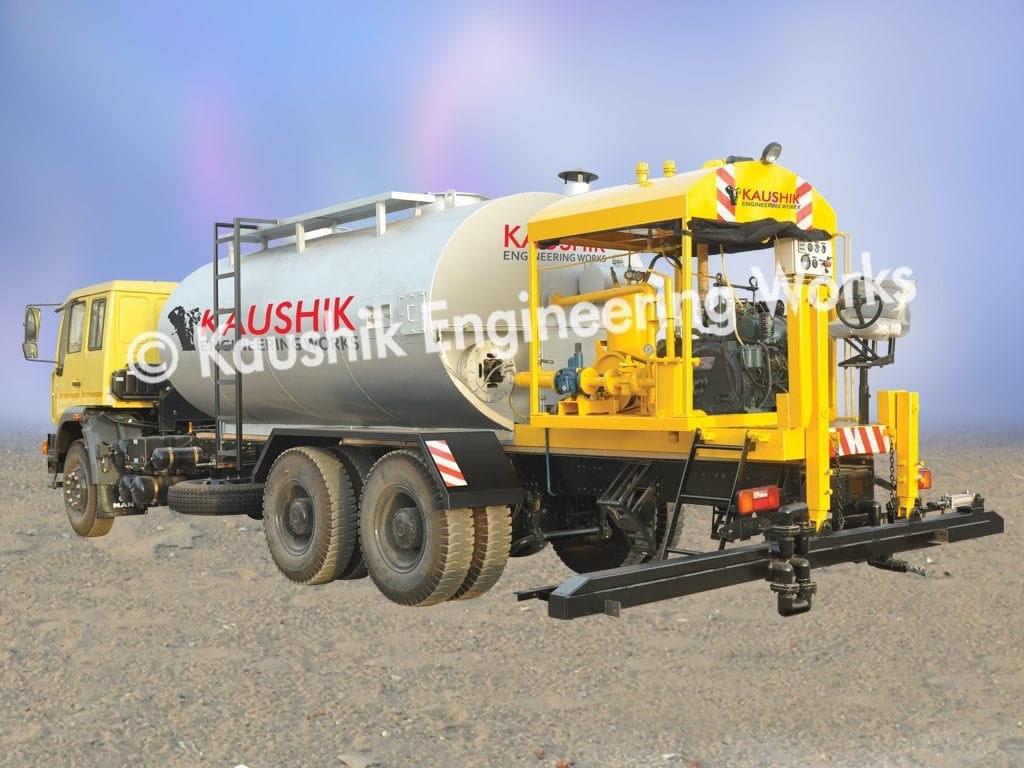
A bitumen sprayer — also called a bitumen pressure distributor or asphalt distributor — applies heated bitumen uniformly across a prepared road surface before asphalt is laid. This single step, done correctly, determines whether the asphalt layers bond properly to each other and to the base. Done poorly, it creates the conditions for delamination, surface cracking, and pothole formation within months of road opening.
At Kaushik Engineering Works, we manufacture bitumen pressure distributors from our Sanand, Ahmedabad facility and have supplied them alongside asphalt plants and road sweepers on projects across India and 35+ countries. This guide is written from that field and manufacturing experience — covering machine types, working principles, key components, application methods, and the practical questions contractors and project managers ask before purchasing.
What Is a Bitumen Sprayer and What Does It Do?
A bitumen sprayer is a road construction machine that heats bitumen to a specified temperature and sprays it at a controlled rate through a spray bar onto the road surface below. The spray bar spans the full road width — or a portion of it, since the bar is adjustable — ensuring consistent coverage without gaps or overlaps.
The machine’s primary role is applying the binding layers that hold the road pavement structure together:
Prime coat — applied on a prepared granular base (WMM or WBM) before the first asphalt layer. It penetrates the surface, fills surface voids, and creates adhesion between the base and the bituminous layer above it.
Tack coat — applied between successive asphalt layers to bond them. Without a proper tack coat, asphalt layers can delaminate under traffic load — sliding apart from each other rather than acting as a unified structure.
Surface dressing (chip sealing) — bitumen is sprayed over an existing road surface, immediately followed by a layer of stone chips that is then rolled into the bitumen. Used for road maintenance and surface rejuvenation.
The rate of bitumen application — measured in kg per square metre — is critical for each of these operations. Too little bitumen gives weak adhesion; too much causes bleeding, surface instability, and loss of skid resistance. A well-calibrated bitumen sprayer, operated correctly, hits the target rate consistently across the entire spray width.
Types of Bitumen Sprayers Used in Road Construction
Truck-Mounted Bitumen Pressure Distributor
The most common type used on Indian highway and state road projects. The bitumen tank, heating system, spray bar, and control unit are all mounted on a truck chassis, making the machine self-propelled and fully mobile. The truck moves at a controlled forward speed while the spray bar applies bitumen at the target rate.
KEW bitumen pressure distributors are truck-mounted units designed for consistent-pressure application of both hot bitumen and bitumen emulsion. They are equipped with a Pressure Cleaning System (PCS) that cleans the spray lines and nozzles after each use — preventing clogging between operations, which is one of the most common causes of uneven spray patterns on site.
Trailer-Mounted Bitumen Sprayer
The bitumen system is mounted on a trailer that is towed by a separate vehicle. These offer flexibility — the same trailer can be moved by different tow vehicles — and are suitable for smaller projects or sites where a full truck-mounted unit cannot justify the capital cost. Manoeuvrability in tight spaces is better than truck-mounted models, making them useful on urban road projects.
Skid-Mounted Bitumen Sprayer
A compact, fixed-base unit designed for transport by flatbed vehicle. Skid-mounted sprayers are used on projects that require frequent relocation between short-stretch worksites, or in locations where a full truck-mounted system is difficult to access. They are also used for spray applications within plant yards or controlled site areas.
Trolley-Mounted Bitumen Sprayer
The smallest configuration — a manually positioned unit suitable for small-area repairs, maintenance patching, and applications where precise placement is needed. KEW supplies trolley-mounted versions on demand for contractors who need a smaller-capacity unit alongside their main truck-mounted distributor.
Key Components of a Bitumen Sprayer — What to Evaluate Before Buying
Understanding what is inside a bitumen sprayer helps contractors ask the right questions and compare machines beyond just tank capacity.
Bitumen Tank
The tank stores and heats bitumen to the application temperature — typically 150°C to 175°C for standard penetration grade bitumen, lower for emulsions. A quality tank is:
- Welded internally to prevent leakage
- Insulated with glass wool to minimise heat loss between filling and spraying
- Fitted with an outer galvanised sheet for corrosion protection
- Equipped with an internal heating coil
- Fitted with both manual and electrical temperature gauges
Tank capacities on Indian highway projects typically range from 4,000 to 12,000 litres, depending on the road width, application rate, and haul distance from the bitumen supply point. A tank that is too small for the project requires frequent refilling stops — each of which creates a potential inconsistency in the spray pattern where work resumes.
Burner Unit
The burner heats the bitumen in the tank and maintains it at the target temperature during operation. On cold climate sites or after long idle periods, the burner’s ability to reheat bitumen quickly is critical — bitumen that drops below its working temperature becomes too viscous to spray uniformly. A burner that heats slowly or inconsistently is one of the more common causes of non-uniform bitumen application rates on site.
Bitumen Pump
The pump draws bitumen from the tank and delivers it to the spray bar at the required pressure. Pump capacity determines the maximum application rate and the consistency of pressure across the full spray bar width. The pump also drives the fast-filling function — the ability to fill the tank quickly from a bitumen tanker — which affects how much time is lost on refilling operations.
Spray Bar
The spray bar spans the road width and carries the nozzles that apply bitumen to the surface. Key features to evaluate:
- Variable width: The bar should fold and unfold to cover different road widths — typically from 2 metres to 6 metres in sections
- Individual nozzle control: Sections of the bar should be independently controllable to avoid over-application at road edges or around manholes
- Height adjustment: Nozzle height above the surface affects spray overlap and uniformity
- Cleaning system: Clogged nozzles produce streaky, uneven application — a Pressure Cleaning System (PCS) prevents this between operations
Control System
Modern bitumen sprayers use computer-controlled dosing systems that automatically adjust bitumen pump output based on the truck’s forward speed — maintaining a constant application rate in kg/m² regardless of how the truck speed varies. This removes the manual calculation and operator skill dependence that characterised older sprayers and directly improves spray rate consistency.
KEW bitumen pressure distributors are equipped with sensor-controlled dosing technology and display all critical operating parameters — spray pressure, application rate, air temperature, bitumen temperature, humidity — to the operator in real time.
Air Compressor and Auxiliary Engine
The air compressor provides the compressed air needed to atomise the bitumen through the spray nozzles. The auxiliary engine drives both the air compressor and the bitumen pump independently of the truck’s main engine — meaning the bitumen system continues operating at consistent power even when the truck’s engine load changes during forward movement.
Bitumen Application Methods — How Each Is Used on Site
| Application | When Applied | Typical Rate (kg/m²) | Bitumen Type |
|---|---|---|---|
| Prime coat | On granular base before first asphalt layer | 0.6 – 1.0 | MC-30, SS-1, or cutback bitumen |
| Tack coat | Between asphalt layers | 0.2 – 0.4 | RS-1, SS-1 emulsion or diluted bitumen |
| Surface dressing | Road maintenance — existing surface | 1.0 – 2.0 | Hot bitumen or rapid-set emulsion |
| Fog seal | Preventive maintenance on ageing surfaces | 0.3 – 0.6 | Bitumen emulsion (diluted) |
| Penetration macadam | Rural roads — low traffic | 1.5 – 3.0 | Hot bitumen (60/70 or 80/100 pen grade) |
The application rates above are indicative — MORTH specifications and individual project quality control plans define the exact target rates for each project, and these must be verified by the sprayer’s calibration records before work begins.
How to Calibrate a Bitumen Sprayer Before Use
Calibration is the process of verifying that the sprayer applies bitumen at the exact rate specified in the project’s quality plan. On NHAI and state highway contracts, calibration records are a mandatory quality control document — the sprayer must be calibrated at the start of each project and after any significant maintenance or temperature change.
The standard calibration method involves:
- Placing a known-area tray or sheet below the spray bar
- Running the sprayer at the target speed and pump settings for a fixed time
- Weighing the collected bitumen and calculating the actual application rate
- Adjusting pump settings or forward speed until the measured rate matches the target
- Recording the calibrated settings in the quality control log
A sprayer with a computer-controlled dosing system makes this process faster and produces more reliable results than manual adjustment — the system automatically compensates for temperature-related viscosity changes that would shift the application rate on a manually controlled machine. However, even computer-controlled systems must be physically calibrated and verified before each new project phase, not just at commissioning.
Common Bitumen Sprayer Problems and How to Avoid Them
Uneven Spray Pattern (Streaking)
Usually caused by clogged or partially blocked nozzles, incorrect nozzle height, or pressure fluctuations in the spray bar. Prevention: clean nozzles after every shift using the machine’s PCS system; verify nozzle height before each operation; check pump pressure gauge before starting.
Incorrect Application Rate
Caused by inaccurate calibration, temperature variation affecting bitumen viscosity, or operator error on manually controlled machines. Prevention: calibrate before each project phase; use computer-controlled dosing; monitor bitumen temperature continuously during spraying.
Bitumen Cooling During Operation
When ambient temperature is low or when the haul distance from the bitumen source is long, bitumen may cool below its working temperature during transport or operation. Prevention: maintain tank insulation, use the burner to maintain temperature, and coordinate supply logistics to minimise the time between heating and application.
Contaminated Surface Under Spray
Dust, moisture, or loose aggregate on the surface before spraying prevents bitumen from bonding correctly — even a perfectly calibrated sprayer cannot compensate for surface contamination. Prevention: always sweep the surface with a hydraulic road sweeper immediately before prime or tack coat application.
Frequently Asked Questions — Bitumen Sprayers
What is the difference between a bitumen sprayer and a bitumen pressure distributor?
They are the same machine — the terms are interchangeable in Indian road construction practice. “Bitumen pressure distributor” is the more technically precise term used in MORTH and IRC specifications. “Bitumen sprayer” or “asphalt distributor” are the commonly used field terms for the same equipment category.
Can a bitumen sprayer apply bitumen emulsion?
Yes. KEW bitumen pressure distributors are designed to work with both hot bitumen and bitumen emulsion. Emulsion is applied at lower temperatures than hot bitumen and requires compatible pump and spray components. Confirm emulsion compatibility with the manufacturer before specifying the machine for emulsion applications.
What tank capacity do I need for my project?
The right tank capacity depends on your project’s road width, target application rate, and the haul distance from your bitumen supply. As a practical starting point: a 6-metre wide road at a tack coat rate of 0.3 kg/m² requires approximately 1.8 kg of bitumen per linear metre. A 4,000-litre tank covers roughly 2,200 linear metres per fill — so if your site operations require more than one or two fills per shift, a larger tank may be worth the capital difference. Discuss your specific project parameters with our team before selecting capacity.
How often should a bitumen sprayer be calibrated?
On NHAI and government highway projects, calibration is required at the start of each project and after major maintenance events. On private projects, calibration should be repeated whenever any of the following occur: nozzle replacement, pump servicing, bitumen grade change, or when lab test results indicate actual application rates are diverging from target rates.
What is the Pressure Cleaning System (PCS) on KEW bitumen sprayers?
The PCS is a built-in cleaning circuit that flushes the spray bar, nozzles, and associated pipes with compressed air after each use. This prevents residual bitumen from hardening inside the nozzles between operations — one of the most common causes of blocked nozzles and uneven spray patterns. Cleaning after every use extends nozzle life and significantly reduces the time lost to maintenance on active sites.
Are KEW bitumen pressure distributors MORTH compliant?
Yes. All bitumen pressure distributors manufactured by Kaushik Engineering Works meet MORTH specifications and are designed to meet the site and technology requirements of national highway, state highway, and PMGSY road construction contracts across India.
Get a Quote for KEW Bitumen Pressure Distributor
Kaushik Engineering Works supplies bitumen pressure distributors for highway projects, state PWD contracts, and export markets across 35+ countries. Our truck-mounted units are supplied with full commissioning support, operator training, and after-sales service — including spare parts availability and technical guidance through our Sanand, Ahmedabad facility.
Whether you are equipping a new road project or replacing an ageing sprayer on an active contract, our team can help you select the right tank capacity, spray bar configuration, and dosing system for your specific requirements.
Contact Kaushik Engineering Works to discuss your project requirements or request a detailed quote. You can also download our product catalogue for complete technical specifications.
📞 +91 98251 64764 | +91 2717 415587
📧 info@kaushikengineeringworks.com
📍 PE-107, Sanand II Industrial Estate, Bol GIDC, Sanand, Ahmedabad – 382110, Gujarat, India
🕐 Mon–Sat: 8:00 AM – 7:00 PM

