
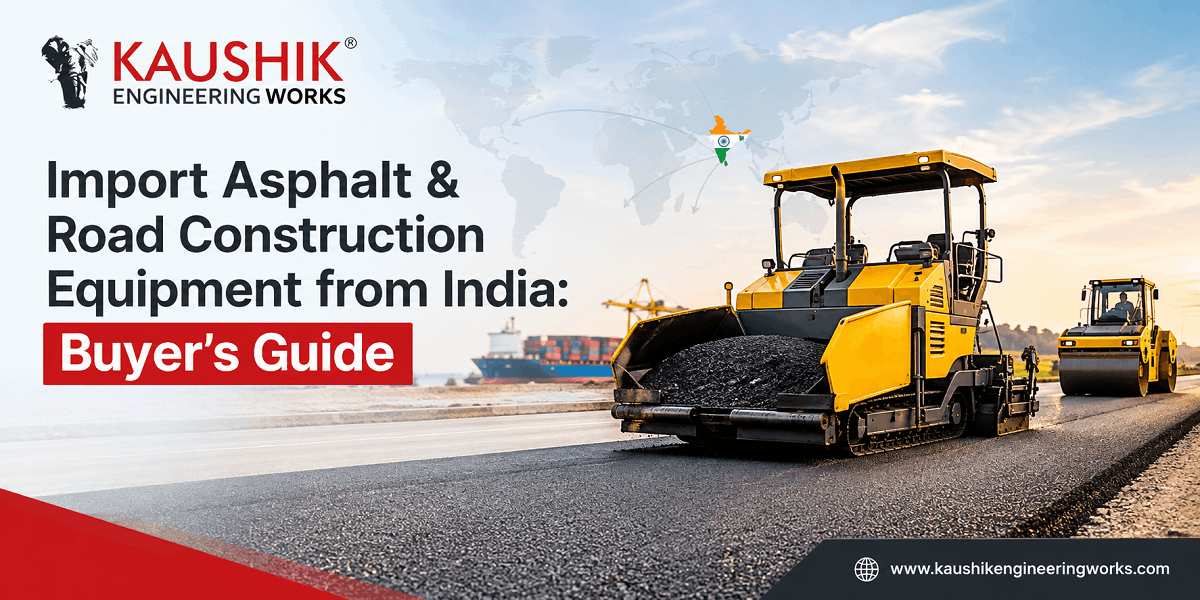
A growing share of the asphalt plants, wet mix macadam plants, and road sweepers running on highway projects across Africa, the Middle East, and Southeast Asia today were built in Gujarat, not shipped in from Europe or China. The reasons are straightforward — competitive pricing, equipment engineered for tough site conditions, and a manufacturing base that’s scaled up considerably over the past decade. What’s less straightforward is the actual process of buying from an Indian manufacturer when you’re not standing on the factory floor to inspect the plant yourself.
Most of the risk in an international equipment purchase isn’t the machine — it’s everything around it: which shipping term you agree to, whether the plant is actually built for your country’s voltage and climate, what documentation clears customs without delay, and who shows up when something needs adjusting after it arrives. Get those details wrong and even a well-built plant turns into a slow, expensive headache.
This guide walks through what an overseas buyer should actually check before placing an order with an Indian road construction equipment exporter — standards and certification, plant configuration for your site conditions, how shipping terms differ, and what commissioning and spare parts support should look like once the equipment lands.
Why Contractors Source Road Equipment from India
India’s road construction equipment sector has grown well beyond serving domestic highway projects. Government-backed manufacturing incentives and a large domestic market for asphalt and concrete plants have pushed manufacturers toward the kind of production scale that makes export pricing genuinely competitive against Western and Chinese suppliers, without cutting corners on the underlying build.
That said, sourcing from India isn’t automatically the right call for every buyer. It tends to make the most sense when a project needs mid-to-large capacity equipment (asphalt drum mix, wet mix macadam, or mobile batching plants in particular), when the buyer values direct manufacturer relationships over regional distributors, and when there’s enough lead time to plan shipping and commissioning properly rather than needing equipment on-site within days. For urgent, small-capacity needs, a local or regional supplier may still be the faster option.
Which Equipment Categories Move Most in Export
Not every product category exports equally. Based on what shows up most often in overseas project specifications, a few categories dominate:
- Asphalt drum mix plants — the highest-volume export category, since continuous drum mix output suits large highway contracts common in developing-market infrastructure programs.
- Wet mix macadam plants — frequently paired with drum mix plants on the same project, for base-layer construction.
- Mobile concrete batching plants — valued for relocatable, containerized designs that suit multi-site infrastructure programs.
- Hydraulic road sweepers and bitumen pressure distributors — smaller-ticket items, but frequently ordered alongside a plant purchase to complete a full paving fleet.
Standards and Certifications to Verify Before Ordering
Equipment compliant with Indian domestic standards isn’t automatically compliant with your destination country’s requirements, and confirming this upfront avoids a customs or project-approval problem later.
Indian Domestic Standards
Look for equipment built to Ministry of Road Transport and Highways (MORTH) specifications and relevant Bureau of Indian Standards (BIS) codes. This is the baseline most reputable Indian manufacturers build to, and it signals the plant meets recognized engineering benchmarks even before destination-specific checks.
Manufacturing Quality Certification
ISO 9001 certification indicates the manufacturer runs a documented, audited quality management system across production — worth asking for directly if it isn’t already stated on their product pages.
Destination-Country Requirements
Some markets require type-approval, CE marking equivalents, or specific electrical and safety certifications before equipment can be commissioned or insured on-site. Confirm this with your own country’s import authority or a local engineering consultant rather than relying solely on the exporter’s assurance — the exporter may not have current visibility into every destination market’s evolving requirements.
Reference Installations
Ask for reference projects in your region or a similar climate/terrain. A manufacturer with genuine export experience across 35+ countries should be able to point to comparable installations without hesitation.
Configuring the Plant for Your Country’s Conditions
A plant designed for Indian site conditions doesn’t automatically transfer perfectly to every destination without adjustment. A few configuration points worth raising directly with the manufacturer:
- Electrical supply — confirm the plant’s control panel and motors are configured for your country’s voltage and frequency (50Hz vs 60Hz), not just shipped as-built for the Indian 50Hz/415V standard.
- Fuel type — burner systems built for diesel or furnace oil may need adjustment if your project runs on a different fuel source locally available.
- Ambient temperature and altitude — extreme heat, cold, or high-altitude sites can affect combustion efficiency and component ratings; flag your site’s typical conditions during specification.
- Local aggregate characteristics — aggregate gradation and moisture content vary by region, and a plant’s feeder and drying capacity should be specified against your actual material, not a generic assumption.
Raising these points at the quotation stage, rather than after the plant ships, is the difference between a straightforward commissioning and a costly on-site retrofit.
Shipping Terms Compared: EXW vs FOB vs CIF vs DAP
Incoterms define exactly where responsibility, cost, and risk shift from seller to buyer during shipping — and choosing the wrong one for your situation can mean paying for logistics expertise or insurance you didn’t realize you were responsible for.
| Incoterm | Seller’s Responsibility | Buyer’s Responsibility | Best Fit For |
|---|---|---|---|
| EXW (Ex Works) | Makes goods available at the factory | All transport, export clearance, shipping, insurance, import clearance | Buyers with their own freight forwarder and import experience |
| FOB (Free on Board) | Delivers goods to the port and loads onto vessel, handles export clearance | Sea freight, insurance, and import clearance from the port of loading onward | Buyers who want export handled but manage their own ocean freight |
| CIF (Cost, Insurance & Freight) | Covers freight and insurance to destination port | Import clearance and inland transport from the destination port | Buyers who want less logistics coordination without full door delivery |
| DAP (Delivered at Place) | Delivers to an agreed location in the buyer’s country, before import duties | Import duties, taxes, and final unloading | Buyers who want minimal logistics involvement |
For first-time buyers without an established freight forwarder relationship, CIF or DAP terms generally reduce the number of moving parts to manage. Buyers with existing logistics partners often prefer FOB or EXW for more control over cost and carrier choice.
Installation, Commissioning, and Spare Parts Support
What happens after the plant arrives matters as much as the purchase itself. Before ordering, get clear answers on:
- Commissioning support — does the manufacturer send an engineer for on-site commissioning, or is it handled remotely via video support and documentation? For a first-time installation in a new country, on-site commissioning is worth the added cost.
- Spare parts kit — a reputable exporter typically ships an initial spare parts kit (wear items like burner nozzles, belts, and filters) alongside the plant, rather than leaving the buyer to source these locally on day one.
- Ongoing spare parts logistics — ask specifically how future spare parts orders are shipped, what the typical lead time is to your country, and whether the manufacturer maintains any regional stocking arrangement.
- Documentation package — confirm the shipment includes a complete technical manual, wiring diagrams, and a packing list matching what customs will expect to see against the commercial invoice.
Questions to Ask Before You Place the Order
A short checklist worth running through with any exporter before signing:
- What Incoterm are you quoting, and what exactly does that include on your side versus mine?
- Is the plant’s electrical configuration built for my country’s voltage and frequency, or does that need to be specified separately?
- What certifications does the plant carry, and are they recognized in my destination country?
- Do you provide on-site commissioning support, and what does that cost separately from the equipment price?
- What’s included in the initial spare parts kit, and what’s the typical lead time for reorders?
- Can you share contact details for an existing customer running similar equipment in a comparable market?
A manufacturer confident in their export process will answer these directly and specifically, not with a generic reassurance about quality and reliability.
Conclusion
Buying road construction equipment internationally comes down to managing what happens around the machine, not just evaluating the machine itself. Standards verification, plant configuration for local conditions, a clearly understood shipping term, and a real commissioning and spare parts plan are what separate a smooth import from a stalled project waiting on a part that should have shipped with the plant in the first place.
Kaushik Engineering Works has supplied asphalt drum mix plants, wet mix macadam plants, and road construction equipment to markets across Saudi Arabia, Nigeria, Kenya, Brazil, South Africa, and Bangladesh, among 35+ countries, with equipment built to MORTH specifications. For buyers weighing local versus international sourcing more broadly, our guide to local vs global construction equipment manufacturers covers that decision in more depth.
To discuss export documentation, shipping terms, and configuration for your project, email info@kaushikengineeringworks.com or call +91-98251 64764.
Frequently Asked Questions
India se road construction equipment import karne me kitna time lagta hai?
This depends on the equipment’s manufacturing lead time plus shipping duration to your country, and varies by plant capacity and destination. Confirm both production lead time and estimated transit time directly with the manufacturer at the quotation stage, since these are quoted per order rather than fixed industry-wide.
Konsa Incoterm choose karna chahiye — EXW, FOB, ya CIF?
It depends on how much logistics coordination you want to handle yourself. EXW gives you full control but full responsibility; CIF or DAP shift more of the freight and insurance coordination to the seller, which suits buyers without an established freight forwarder relationship.
Kya plant commissioning ke liye engineer site pe aata hai?
This varies by manufacturer and by agreement — some offer on-site commissioning by a dedicated engineer, others provide remote video-supported commissioning. Confirm this specifically before ordering, since remote-only support can extend installation time for a first-time buyer.
Overseas site ke liye spare parts kaise milte hain?
Reputable exporters typically ship an initial spare parts kit with the plant covering common wear items, then handle reorders through standard international shipping. Ask specifically about reorder lead time to your country before finalizing the purchase.
Kya Indian equipment destination country ke standards follow karta hai?
Indian equipment built to MORTH and BIS standards meets India’s domestic benchmarks, but destination-country certification requirements (type approval, electrical safety standards, etc.) should be confirmed separately with your local import authority, since these vary by country and aren’t automatically covered by Indian compliance alone.
Payment ke liye kaunse tareeke generally use hote hain international orders me?
International equipment purchases commonly use letters of credit (LC) or telegraphic transfer (TT) in agreed installments tied to production milestones and shipment. Exact terms vary by manufacturer and order size, so confirm the specific payment schedule and currency in your purchase agreement.

