
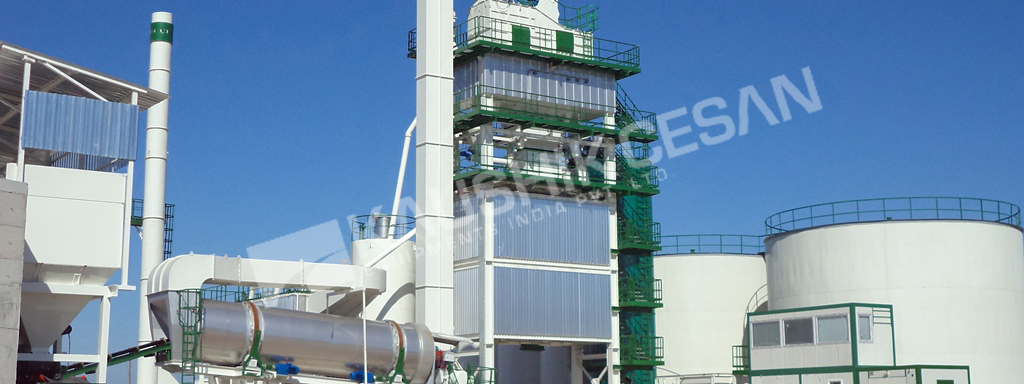
An asphalt plant works by heating and drying aggregates to a specified temperature, then blending them with bitumen and filler in precise proportions to produce hot mix asphalt ready for road paving. The process starts with cold aggregates fed from storage bins and ends with finished hot mix discharged into waiting trucks — with heating, measuring, mixing, and pollution control happening in between.
Understanding how an asphalt plant works helps contractors make better equipment decisions, operate plants more efficiently, troubleshoot quality problems at the source, and meet documentation requirements on NHAI and government highway contracts. At Kaushik Engineering Works, we have been manufacturing asphalt plants from our Sanand, Ahmedabad facility for over 15 years — supplying asphalt drum mix plants and asphalt batch mix plants across 35+ countries. This guide explains the complete working process of both plant types, stage by stage.
The Two Main Types of Asphalt Plants and How They Differ
Before explaining the working process, it is important to understand that two fundamentally different plant designs are used in India — and their working sequences differ in one critical way.
In a drum mix plant, aggregates are dried, heated, and mixed with bitumen inside a single rotating drum in one continuous process. Material flows in at one end and finished asphalt exits at the other without stopping. There are no batches.
In a batch mix plant, aggregates are dried in a separate rotary dryer, then elevated to a screening tower, sorted into hot bins by size, weighed individually, and combined with weighed bitumen and filler in a pugmill mixer — one batch at a time. Each batch is precisely measured before mixing begins.
Everything else — the cold feed system, the heating system, the pollution control system, and the control panel — works similarly between the two types. The difference is in what happens after the aggregates are dried.
Stage 1 — Cold Aggregate Storage and Feeding
Every asphalt plant starts with the cold aggregate feeder unit — a row of bins, typically four to six, each holding a different aggregate size fraction. These bins store crushed stone, gravel, and sand separately to prevent mixing between sizes before the proportioning stage.
Under each bin, a variable-speed belt feeder controls how much of each aggregate fraction is released onto a common collection conveyor below. The speed of each feeder is set by the plant’s control system according to the target mix design — so if the mix requires 40% coarse aggregate, 30% medium aggregate, and 30% fine aggregate, each feeder runs at a speed that delivers those proportions in the correct ratio.
Getting the cold feed proportioning right is the foundation of mix quality. A calibration error at this stage compounds through the entire production run — because the drum mix plant never individually weighs each aggregate fraction. It simply dries and mixes what the cold feed delivers. KEW asphalt plants are fitted with oversize aggregate removal vibratory screens at the end of the cold feed conveyor — these screens remove any particles too large for the mix design before they enter the drum, protecting equipment and preventing gradation spikes in the finished mix.
Stage 2 — Drying and Heating
Cold, moist aggregates from the cold feed conveyor enter the drying drum (in a drum mix plant) or the rotary dryer (in a batch mix plant). The purpose is the same in both: remove surface moisture from the aggregate and raise its temperature to the target application range — typically 150°C to 175°C for standard penetration grade bitumen mixes.
The drying drum or dryer is a large rotating cylinder fitted with internal flights — angled steel plates welded to the drum wall. As the cylinder rotates, the flights lift the aggregates and cascade them through the hot gas stream from a burner positioned at the drum inlet. This repeated lifting and showering through heat is what dries the moisture and raises aggregate temperature uniformly across the material cross-section.
The burner uses diesel, LDO, or furnace oil. Fuel efficiency at this stage directly affects operating cost — and KEW’s proprietary Thermodrum system improves efficiency by using three simultaneous heat transfer mechanisms (conductive, convective, and radiation) rather than the single convective mode used in standard drum designs. This extracts more heat from the same fuel input, reducing fuel consumption per tonne of asphalt produced.
Stage 3 — The Critical Difference: Drum Mix vs Batch Mix
After drying and heating, the two plant types diverge:
In a Drum Mix Plant — Mixing Inside the Drum
In the second half of the drum, dried and heated aggregates continue rotating while bitumen is injected through a spray bar and filler is added from a screw conveyor. The combined rotation of the drum, the heat, and the flight action coats every aggregate particle with bitumen — producing finished hot mix asphalt that exits at the drum’s discharge end and flows onto a load-out conveyor.
The key feature is synchronisation — the bitumen pump speed and filler feeder speed are electronically linked to the cold aggregate feed rate. As aggregate flow increases or decreases, bitumen and filler injection automatically adjusts to maintain the target percentages. This synchronisation is managed by the plant’s computerised control system.
In a Batch Mix Plant — Separate Drying, Screening, Weighing, and Mixing
After drying in the rotary dryer, hot aggregates are elevated by a bucket elevator to a screening deck at the top of the plant’s tower. The vibrating screens separate the hot aggregates back into size fractions and route each fraction into a separate hot storage bin below the screens.
From the hot bins, aggregates are discharged into a weigh hopper where each fraction is individually weighed to the exact quantity specified in the mix design. This is the batch mix plant’s defining advantage — every material is precisely weighed before it enters the mixer, producing verifiable batch-by-batch accuracy that can be recorded and audited.
The weighed aggregates, along with weighed bitumen and filler, are discharged into a pugmill mixer where counter-rotating shafts with paddle arms mix the materials for 30 to 45 seconds. The finished batch is then discharged into a waiting truck and the next batch cycle begins.
Stage 4 — Bitumen Storage and Delivery
Bitumen is stored in insulated storage tanks adjacent to the plant. These tanks maintain bitumen at 140°C to 160°C — the temperature range where it flows freely through the pump and spray system. Below this temperature, bitumen becomes too viscous to pump and spray uniformly. Above 175°C, bitumen begins to oxidise and lose its binding properties.
Tank heating is provided by hot oil heating systems (indirect) or direct fire burners (direct). All KEW bitumen storage tanks are supplied with auto thermostatic controls that maintain the target temperature automatically, plus hot oil circulating systems for consistent temperature throughout the tank volume.
A variable-speed computerised bitumen metering pump delivers bitumen from the tank to the drum injection point or the batch mix plant’s weigh bucket, in quantities precisely calibrated to the aggregate feed rate or batch weight.
Stage 5 — Filler Storage and Addition
Mineral filler — stone dust, hydrated lime, or fly ash — is stored in a dedicated filler silo and fed into the mixing zone by a screw conveyor. The filler’s role in the asphalt mix is to fill the voids between aggregate particles, improve mix stability, and contribute to the overall gradation of the finished asphalt.
KEW asphalt plants offer filler storage and feeding solutions ranging from 1.5 tonnes to 50 tonnes silo capacity. The filler feed rate is synchronised with the aggregate feed and bitumen injection — all three controlled together by the plant’s computerised system to maintain consistent mix proportions throughout production.
Stage 6 — Pollution Control
As hot gases and dust from the drying process pass through the drum or dryer, they carry fine aggregate particles and combustion products that must be captured before exhaust is released. CPCB norms require all asphalt plants operating in India to be equipped with effective dust collection systems.
KEW plants use a two-stage pollution control system:
Primary dust collector (dry type): Cyclone separators use centrifugal force to separate heavier dust particles from the exhaust gas stream. Collected dust falls into a hopper at the bottom and is typically returned to the mix as filler — reducing material waste and improving the economics of dust collection.
Secondary collector: A wet dust collector or baghouse filter captures finer particles that pass through the primary cyclone. Baghouse filters are more efficient and produce dry recoverable dust; wet collectors generate sludge. CPCB compliance on most Indian highway project sites requires effective secondary dust collection.
Stage 7 — Control System and Automation
Modern asphalt plants are controlled by a PLC-based computerised control system that manages every variable in the production process simultaneously — cold feed rates, burner output, bitumen pump speed, filler feed, mixing time, and discharge cycle.
The control cabin is the nerve centre of the plant operation. From a single operator interface, the plant manager can select and switch between stored mix design recipes, monitor aggregate feed rates and bitumen temperature in real time, adjust production rate without stopping the plant, generate production reports showing total tonnage and batch records, and identify process alarms before they become production problems.
KEW plants are supplied with fully computerised control cabins offering automatic, semi-automatic, and manual operation modes. On government highway contracts where QA documentation is mandatory, the automatic mode’s batch record generation is a practical compliance tool — every tonne of asphalt produced is traceable to the material inputs and plant settings that produced it.
Stage 8 — Hot Mix Discharge and Truck Loading
Finished hot mix asphalt exits the drum or pugmill and travels on a load-out conveyor (also called a slinger conveyor) to the truck loading point. The slinger conveyor can swing to distribute mix evenly across the truck body, preventing segregation from one-sided loading.
Trucks are loaded to their target weight and dispatched to the paving site. From discharge, the mix temperature must be monitored — most standard mixes should reach the paving site and be compacted before temperature drops below 120°C. The haul distance from plant to paving site, the ambient temperature, and the number of trucks in rotation all directly affect whether the mix arrives at the right temperature.
Plants with hot mix storage silos can hold finished asphalt for 1 to 4 hours without significant temperature loss — buffering against truck shortfalls or paving delays without stopping the plant.
Asphalt Plant Working Process — Summary Comparison
| Stage | Drum Mix Plant | Batch Mix Plant |
|---|---|---|
| Cold aggregate feeding | Variable speed belt feeders — proportioned by speed | Variable speed belt feeders — proportioned by speed |
| Drying and heating | Inside rotating drying drum — continuous | In separate rotary dryer — continuous |
| Screening (post-drying) | Not required — cold feed proportioning only | Hot screening tower — re-sorts into size fractions |
| Weighing | No individual weighing — flow rate synchronisation | Individual weigh hopper for each material |
| Mixing with bitumen | Inside drum — continuous | In pugmill mixer — batch by batch |
| Production style | Continuous — no stops between cycles | Intermittent — one batch at a time |
| Mix quality verification | By calibration and flow rate monitoring | By individual batch weight records |
Frequently Asked Questions — Asphalt Plant Working Process
What is the basic working principle of an asphalt plant?
An asphalt plant works by combining four operations in sequence: drying and heating cold aggregates to remove moisture and raise temperature; proportioning aggregates, bitumen, and filler to the exact quantities defined by the mix design; mixing all materials together until every aggregate particle is coated with bitumen; and discharging the finished hot mix asphalt into trucks for transport to the paving site.
What temperature does an asphalt plant produce hot mix at?
Standard hot mix asphalt for Indian highway projects is produced at a discharge temperature of 150°C to 170°C for penetration grade bitumen (VG-30 or equivalent). Modified bitumen mixes using PMB (polymer modified bitumen) are typically produced at slightly higher temperatures — 160°C to 180°C. The exact target temperature is specified in the project’s approved mix design and must be maintained within a tolerance of ±10°C at discharge.
What is the difference between a drum mix plant and a batch mix plant?
A drum mix plant produces asphalt continuously — aggregates are dried and mixed with bitumen in the same rotating drum in an unbroken stream. A batch mix plant produces asphalt in separate, individually weighed batches — aggregates are dried, screened into hot bins, weighed precisely, and mixed in a pugmill one batch at a time. Drum plants offer continuous high output; batch plants offer precise batch-by-batch quality control and mix design flexibility.
What fuels can an asphalt plant use?
KEW asphalt plants are designed to operate on LDO (Light Diesel Oil), HSD (High Speed Diesel), or furnace oil. The burner system is fitted with a remote control flame failure detection system and electric spark ignition. Fuel tank capacities range from 300 litres to 10,000 litres depending on plant size and site requirements. Some KEW plants can be configured for alternate fuel sources — consult our team for project-specific fuel requirements.
How is pollution controlled at an asphalt plant?
Asphalt plants control pollution through a two-stage dust collection system. The primary stage uses dry cyclone separators to capture heavy dust particles from the exhaust gas stream — collected dust is returned to the mix as filler. The secondary stage uses a wet dust collector or baghouse filter to capture finer particles. This two-stage system is designed to meet CPCB emission standards for particulate matter. All KEW plants are supplied with CPCB-compliant dust collection as standard.
Can an asphalt plant use reclaimed asphalt pavement (RAP)?
Yes. Both drum mix and batch mix plants can be configured to incorporate RAP — reclaimed asphalt pavement milled from existing roads. RAP is introduced into the process at a point beyond the main burner flame to prevent overheating the residual bitumen in the reclaimed material. The percentage of RAP that can be incorporated depends on the plant configuration and the project’s approved mix design — typically up to 30% in drum mix plants and up to 50% in batch mix plants with a parallel RAP dryer.
Get a Quote for KEW Asphalt Plants
Kaushik Engineering Works manufactures both drum mix and batch mix asphalt plants at our Sanand, Ahmedabad facility — from compact 40 TPH mobile drum mix plants to 200 TPH+ stationary plants. All models feature computerised control with automatic, semi-automatic and manual operation modes, CPCB-compliant pollution control, and full commissioning support.
Contact our team to discuss your project’s capacity, fuel, and site requirements — or visit our mobile drum mix plant page for compact, fast-mobilising options.
📞 +91 98251 64764 | +91 2717 415587
📧 info@kaushikengineeringworks.com
📍 PE-107, Sanand II Industrial Estate, Bol GIDC, Sanand, Ahmedabad – 382110, Gujarat, India
🕐 Mon–Sat: 8:00 AM – 7:00 PM

